Many travellers come to Uzbekistan for the legendary Silk Road cities, yet the Tashkent Metro reveals one of the country’s greatest surprises. An extraordinary collection of beautifully designed stations transforms an ordinary train journey in the capital into an unforgettable experience. This guide explains everything you need before stepping onto the tube. You’ll learn which seven Tashkent metro stations are the most beautiful and where to find the best platforms for photos. We also cover how much metro tickets cost and how to move around the network easily using the map. We also include our own experience after exploring the system ourselves, so you know exactly what to expect before travelling underground. By the end, you’ll have everything needed to enjoy one of the world’s most beautiful metro systems without wasting time or missing the finest stations.
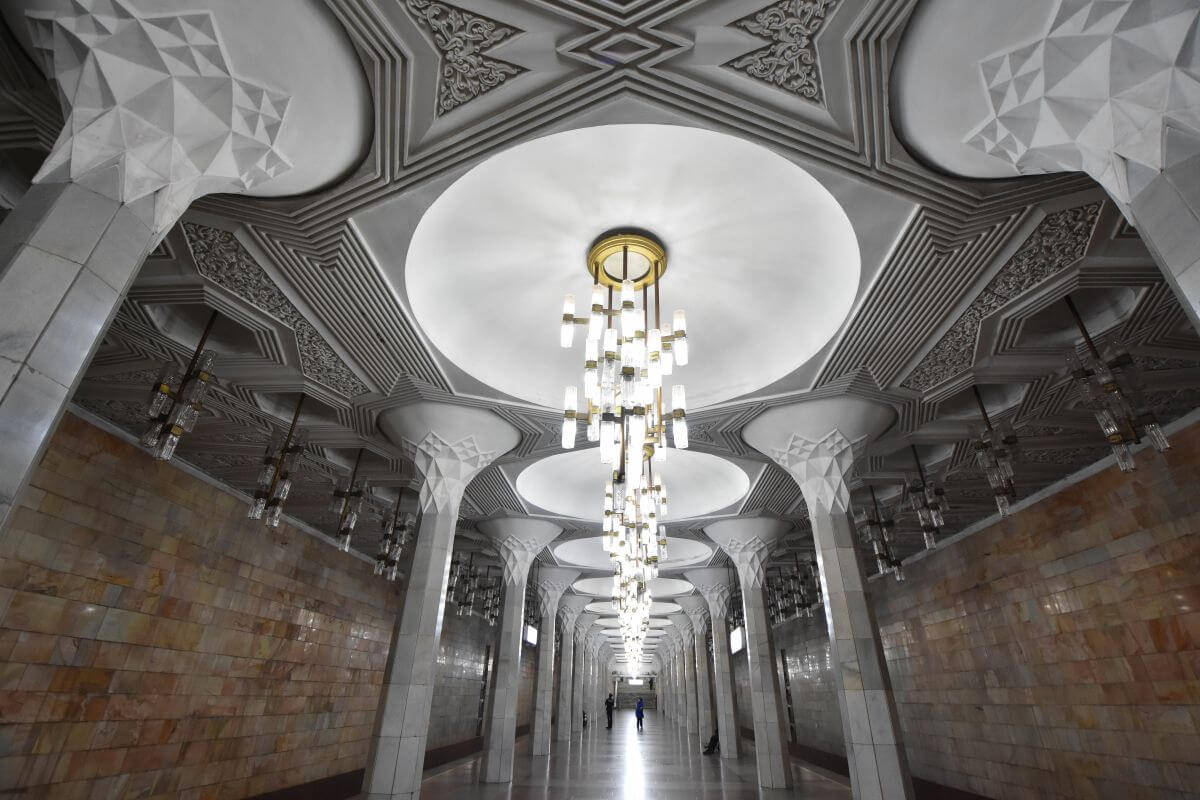
Beneath the city’s hot streets lies a secret underground world of beautiful architecture and design. During our visit, riding the Tashkent metro became one of the most unforgettable parts of our time in the city. Instead of plain underground platforms, we found station after station filled with striking artwork and creative design. It felt more like visiting a museum than catching a train.
Why is Tashkent Metro famous and one of the city’s biggest attractions?
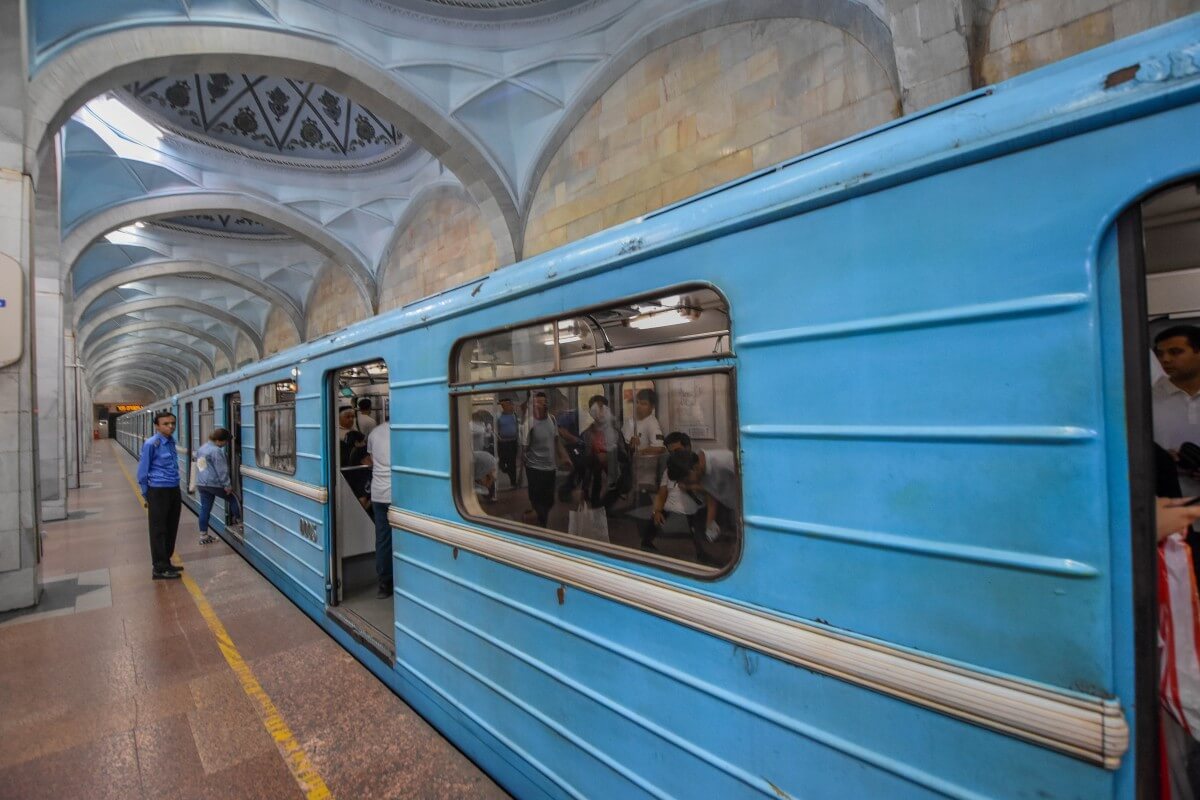
Although thousands of Uzbeks use the underground every day to travel across the city, tourists come for completely different reasons. Only a few transport systems turn an ordinary journey into an unforgettable sightseeing experience, yet Tashkent Metro has achieved exactly that.
The Tashkent Metro has earned an international reputation as one of the finest underground systems anywhere in the world. It has become one of the capital’s must-see attractions because every journey doubles as a cultural experience. For many, it is the second only to Moscow, and the reason is simple.
Instead of building identical concrete stations which you can see everywhere else in the world, here, designers created a collection of spectacular spaces. Every stop feels like stepping inside a grand museum with elegant architecture, impressive lighting, and remarkable artistic details. What makes them special is that they blend spectacular Soviet-era architecture with traditional Uzbek craftsmanship in a way few transport systems can match.
The Underground Art Gallery
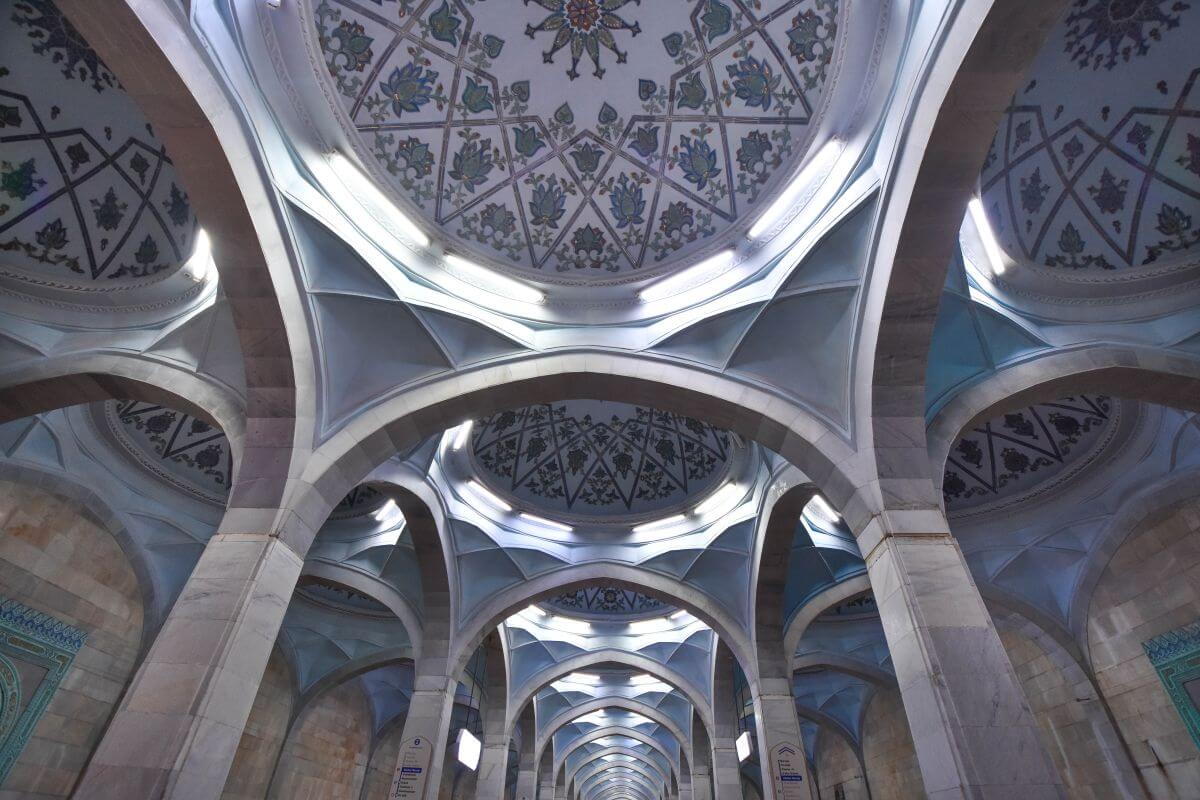
Stations resemble elegant ballrooms and mosque-like structures rather than standard railway platforms. During our visit, we found ourselves getting off the train only to admire the next station before continuing our journey. Nowhere else in Central Asia combines public transport and art on such a spectacular scale.
No Two Alike
The greatest surprise is that no station looks the same. Every Tashkent Metro stop has been designed around a completely different idea. Some celebrate famous historical figures, while others honour important industries, national achievements or cultural traditions. Together, they form a remarkable underground gallery. Decorative panels, dramatic ceilings, striking chandeliers, and a carefully planned layout give every platform its own identity. That constant sense of discovery kept us excited throughout our visit and made exploring the stations just as rewarding as visiting the city’s famous landmarks above ground.
A Short History of Tashkent Metro
The remarkable story behind the Tashkent Metro starts with one of the darkest moments in the city’s history. In 1966, a devastating 7.5-magnitude earthquake struck the city. It destroyed thousands of buildings and forced large parts of the capital to be rebuilt. Rather than simply replacing damaged buildings, Soviet planners saw an opportunity to modernise the city. According to historical records, just two years later, in 1968, state planners began designing an underground railway. It would not only move people quickly but also survive future disasters.
Construction started in 1972 on the first red route. After five years of work, the first line opened with nine stations. The Tashkent Metro immediately made history as the first metro system ever built in Central Asia. It also became the seventh metro system built anywhere in the former Soviet Union.
Why Was It Built Here First?
Receiving an underground railway during the Soviet era was a privilege rather than automatic. According to historical data, these metro systems were enormously expensive to construct because they were designed not just for transport. Stations were built deep below ground, reinforced with thick concrete and often decorated with marble, sculptures, mosaics, and grand architecture. Before approving such a costly project, the Soviet government normally required a city to reach a population of at least one million people. Rapid population growth during the 1960s meant the capital finally met this requirement. This made it eligible to receive its own underground railway.
Designed for the Worst-Case Scenario
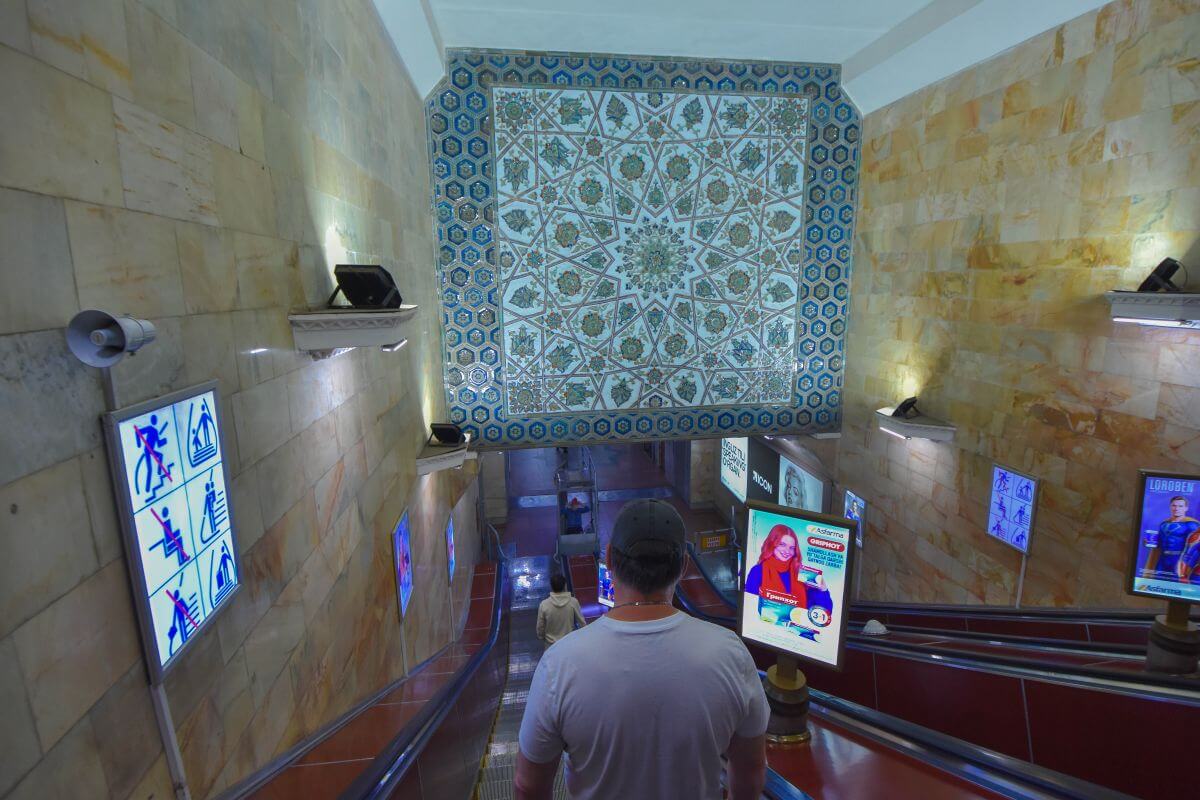
The Tashkent Metro was built with two major threats in mind. The first was earthquakes. Engineers carefully designed the tunnels to withstand earthquakes measuring up to magnitude 9.0 on the Richter scale. This impressive level of protection was inspired directly by the 1966 destruction. Today, the tunnels run between roughly 8 and 25 m beneath the streets, according to Wikipedia.
The second threat came from the Cold War. Architects carefully designed every station to function as a bomb shelter in case of a possible nuclear attack. Thick blast-resistant construction, deep platforms and protected underground spaces meant the system could shelter thousands of people during an emergency.
GROWING WITH THE CAPITAL
The network continued expanding as the city grew. Historical records explain that the original red line was extended in 1980, while another blue line followed in the 1980s. A third green line entered service in 2001, and the elevated yellow Circle Line began operating in 2020. As of August 2026, the network stretches for more than 70 km, serving 50 stations. The city has no plans to stop there. An approved expansion project aims to increase the system to 79 stations and 103 km of tracks during the 2030s.
THE SECRET THAT LASTED FOUR DECADES
Did you know that for more than 40 years, taking a single photograph or recording a video inside the Tashkent Metro was completely forbidden by law? Because the underground also served as military infrastructure and a potential nuclear shelter, it was officially treated as a secret facility. Security guards closely monitored anyone carrying a camera and confiscated it if they ignored the ban.
Everything changed on 1 June 2018 when the ban was finally lifted. Today, you can freely admire and photograph the remarkable architecture that remained hidden from most of the world for decades.
Tashkent Metro – One of the World’s Cheapest Underground Museums
One thing that surprised us almost as much as the stations themselves: the price. A single ticket costs only a tiny amount yet allows unlimited travel through the network until you leave the system. That means you can spend hours hopping between stations, taking your time to admire the architecture without spending much at all.
7 Most Beautiful Tashkent Metro Stations You Must Visit
1. Kosmonavtlar
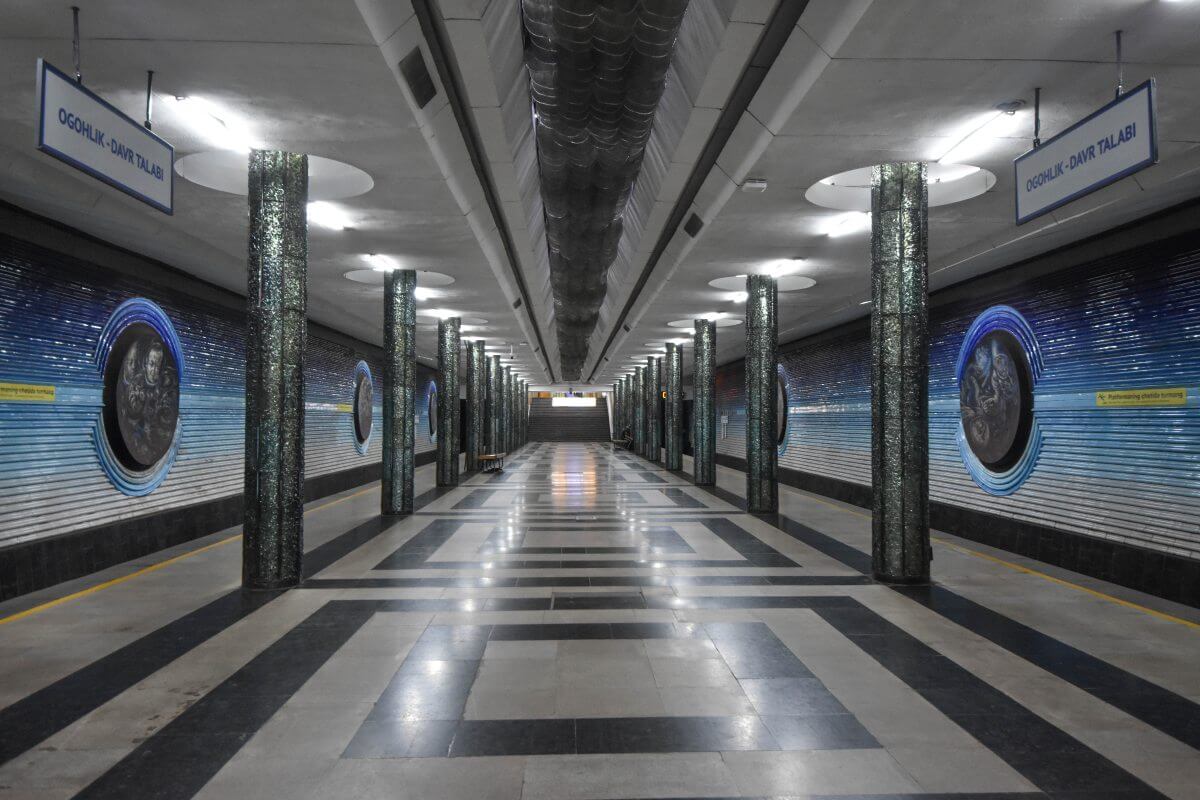
Did you know that as of July 2026, Kosmonavtlar is the only metro station in the city included on a UNESCO World Heritage list? No other underground station has received a prestigious recognition as part of the Modernist Architecture of Tashkent inscription. UNESCO recognised this unique station not just as transit infrastructure, but as a historic architectural masterpiece. Kosmonavtlar perfectly symbolises standardised Soviet structural engineering with a unique, cosmic-themed artistic tradition.
That fact alone makes it special, but the moment we stepped onto the platform, we understood why it received such a prestigious honour. Before travelling to Uzbekistan, this was the station we had heard about more than any other. In many ways, it was the main reason we decided to spend a morning exploring the underground network. After finally seeing it with our own eyes, we understood immediately why it has become so famous. Out of all the Tashkent metro stations we visited, this was our favourite.
Opened on 8 December 1984 on the Blue line, Kosmonavtlar celebrates the achievements of the Soviet space programme. The station honours famous cosmonauts. Their large circular ceramic portraits appear to float in zero gravity along the platform walls.
A JOURNEY FROM EARTH INTO DEEP SPACE
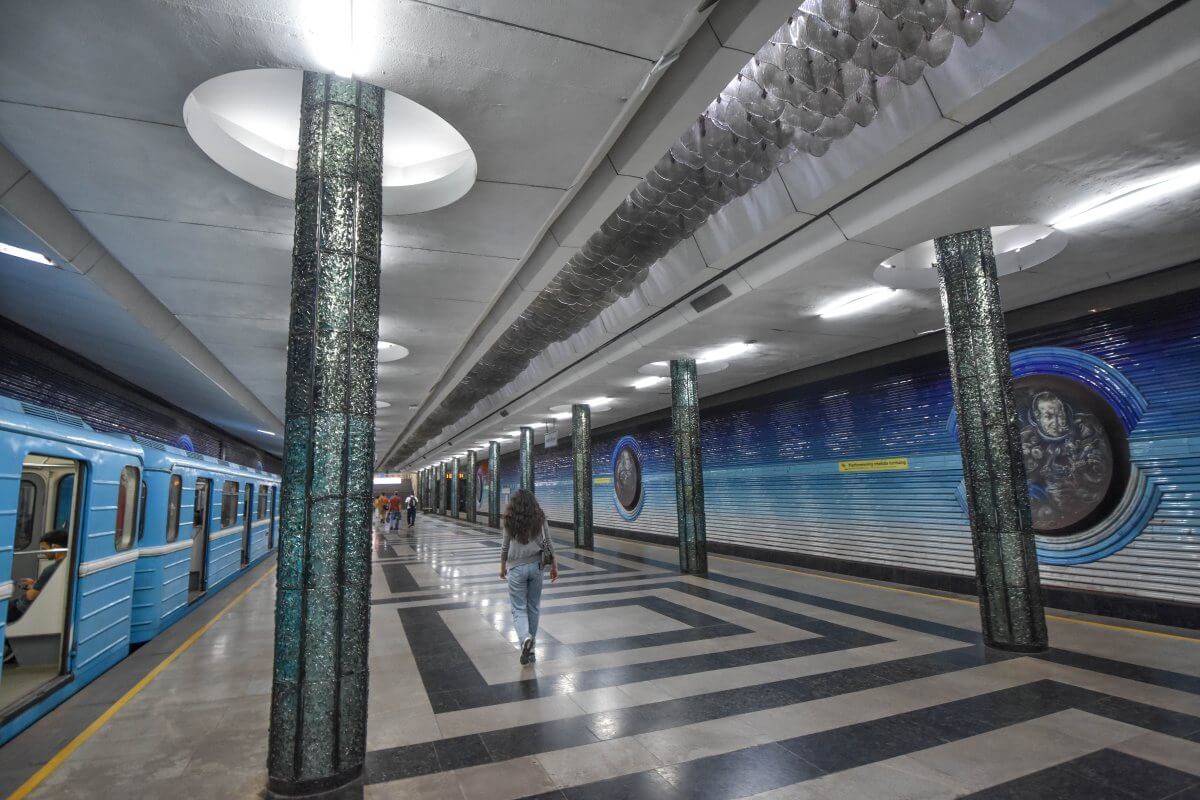
Everything here was designed to create the illusion of travelling into the cosmos. The first thing we noticed was the remarkable colour transition along the walls. Bright ceramic tiles near the platform gradually darken as they rise toward the ceiling. They change from white and pale blue to deep black. This effect resembles a spacecraft leaving Earth’s atmosphere and disappearing into space.
Running through the centre of the ceiling is one of the station’s most famous features. Hundreds of hanging glass elements create the impression of the Milky Way stretching across the platform. As trains arrive and depart, reflections shimmer across the ceiling, making the entire station feel alive.
Adding to the futuristic atmosphere are the striking teal-green columns. Covered in reflective materials and metallic finishes, they resemble giant launch structures preparing a rocket for take-off.
HEROES FLOATING AMONG THE STARS
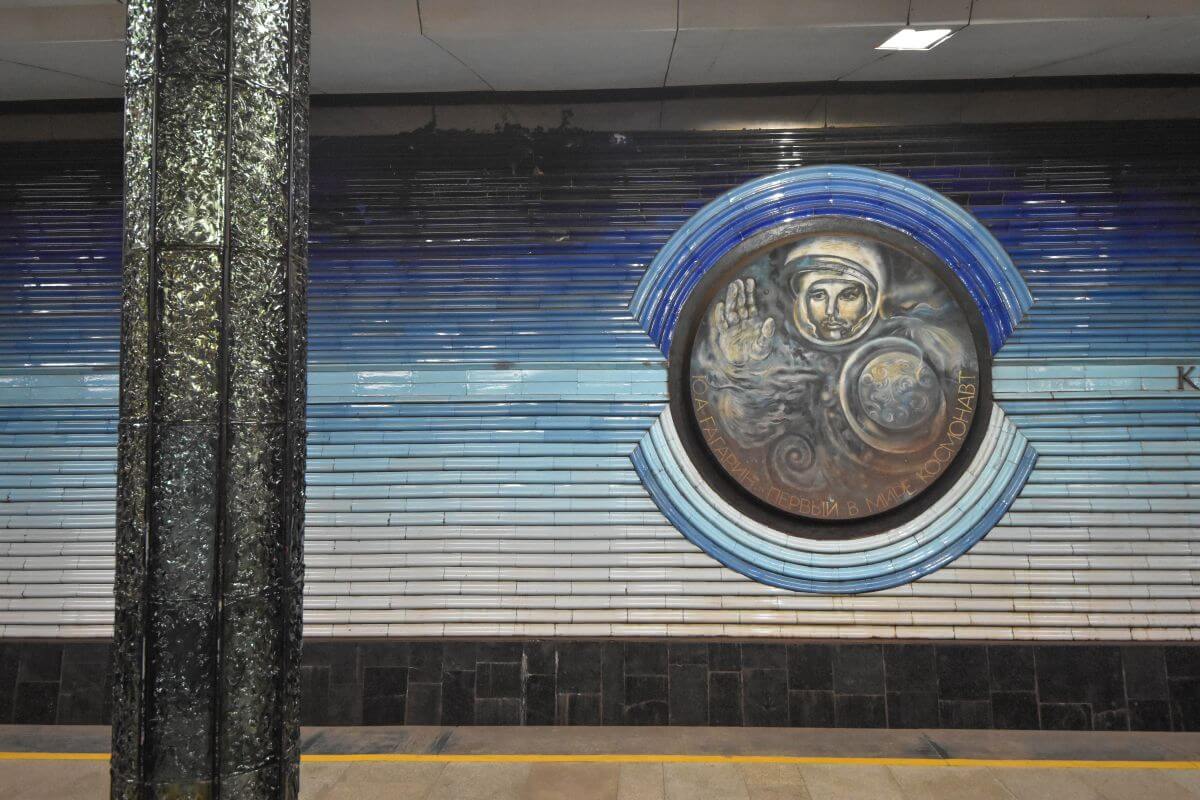
Kosmonavtlar also serves as an underground hall of fame for some of history’s greatest explorers who helped humanity reach beyond Earth. Large circular ceramic portraits appear to float against the dark walls without visible borders. Among them are Yuri Gagarin (the first human in space) and Valentina Tereshkova (the first woman in space). Their achievements changed history and remain symbols of one of the most ambitious periods of scientific progress.
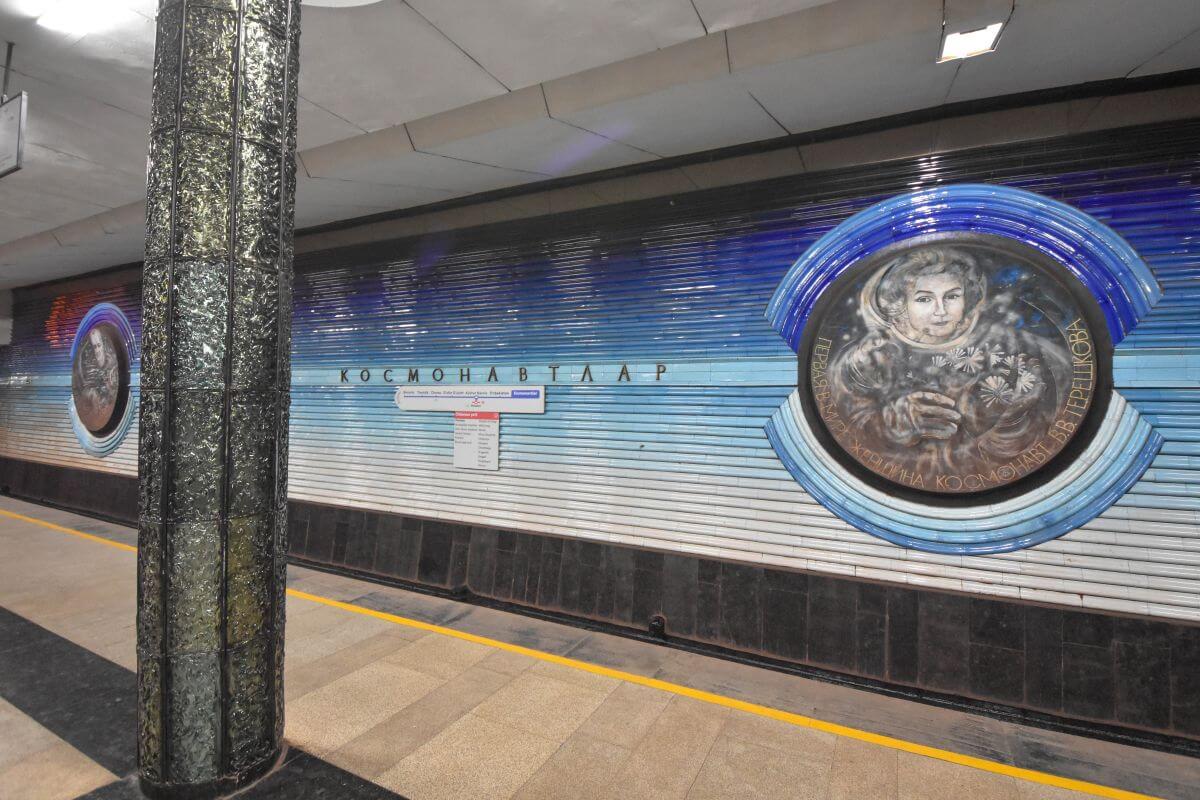
A ceramic medallion of the first woman in space.
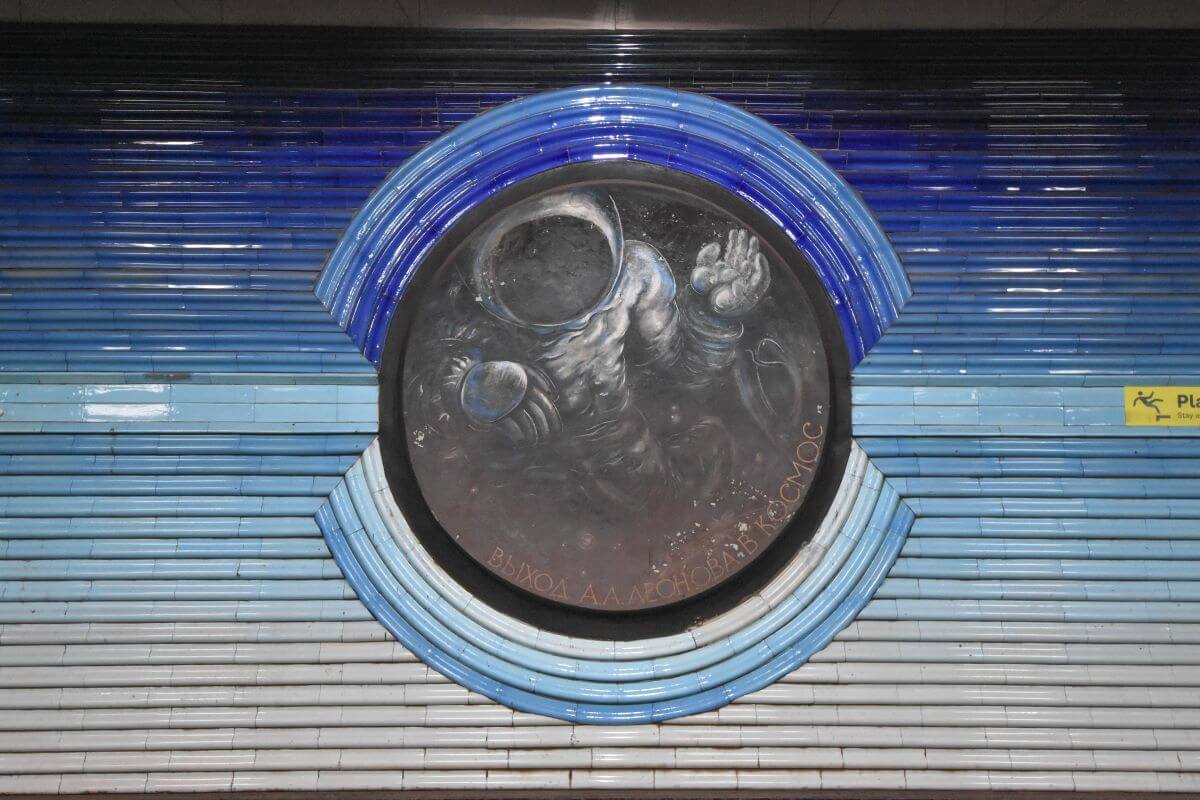
This circular medallion is a tribute to Alexei Leonov, the Soviet cosmonaut who became the first person to conduct a spacewalk in 1965. The Russian inscription around the bottom reads ‘A. Leonov’s exit into space’.
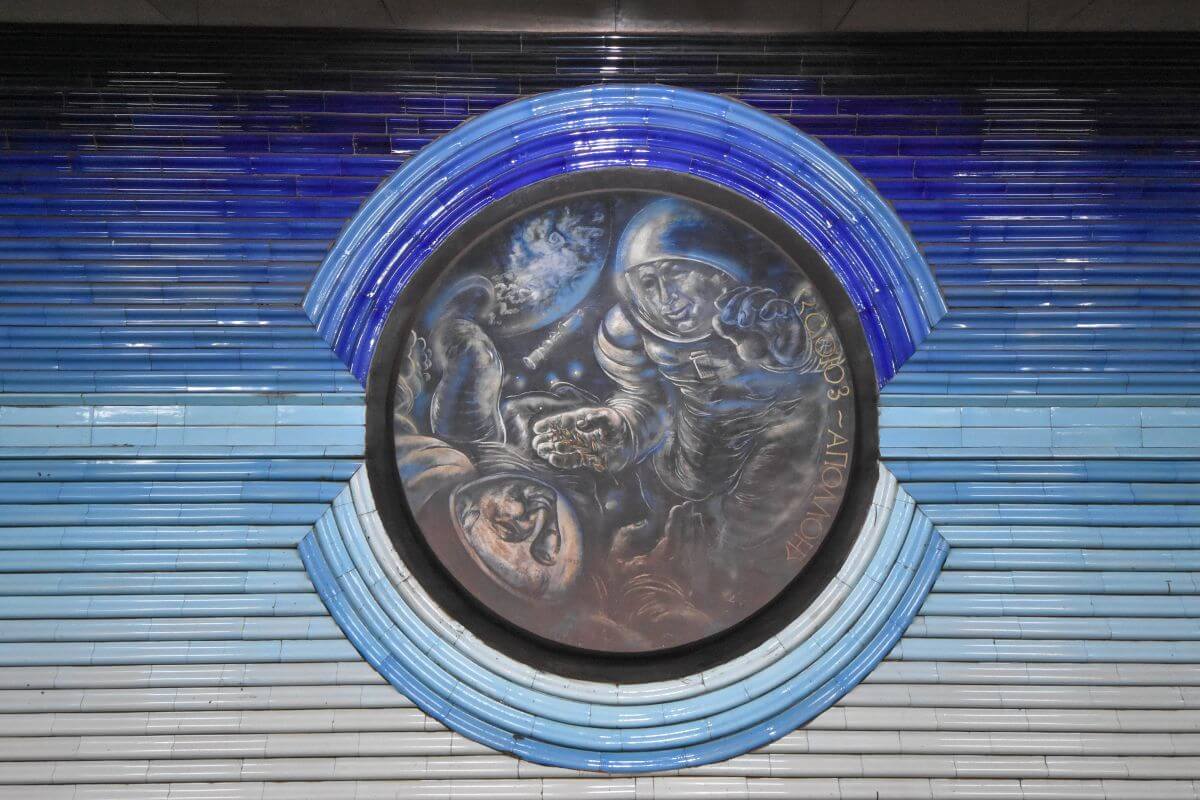
One of our favourite artworks commemorates the historic 1975 Apollo-Soyuz Test Project, which marked the official end of the Space Race and the beginning of international cosmic cooperation.
What surprised us most was the wider story the station tells. Alongside Soviet cosmonauts, you’ll also find Mirza Ulugh Beg, the famous 15th-century astronomer-king from Samarkand. You can also spot references to Icarus from Greek mythology. Together, they connect ancient dreams of flight with modern space exploration.
The result is unlike anything else we saw during our travels. Even today, few underground stations anywhere in the world manage to combine science, history, mythology, and architecture so successfully. For us, Kosmonavtlar perfectly captures what makes the Tashkent Metro so memorable. It transforms a simple train journey into an experience that feels educational, artistic, and completely unique.
TIP:
One detail many visitors miss is outside the station’s entrance. It depicts a monument to cosmonaut Vladimir Dzhanibekov, who was born in the Tashkent region.
2. Paxtakor
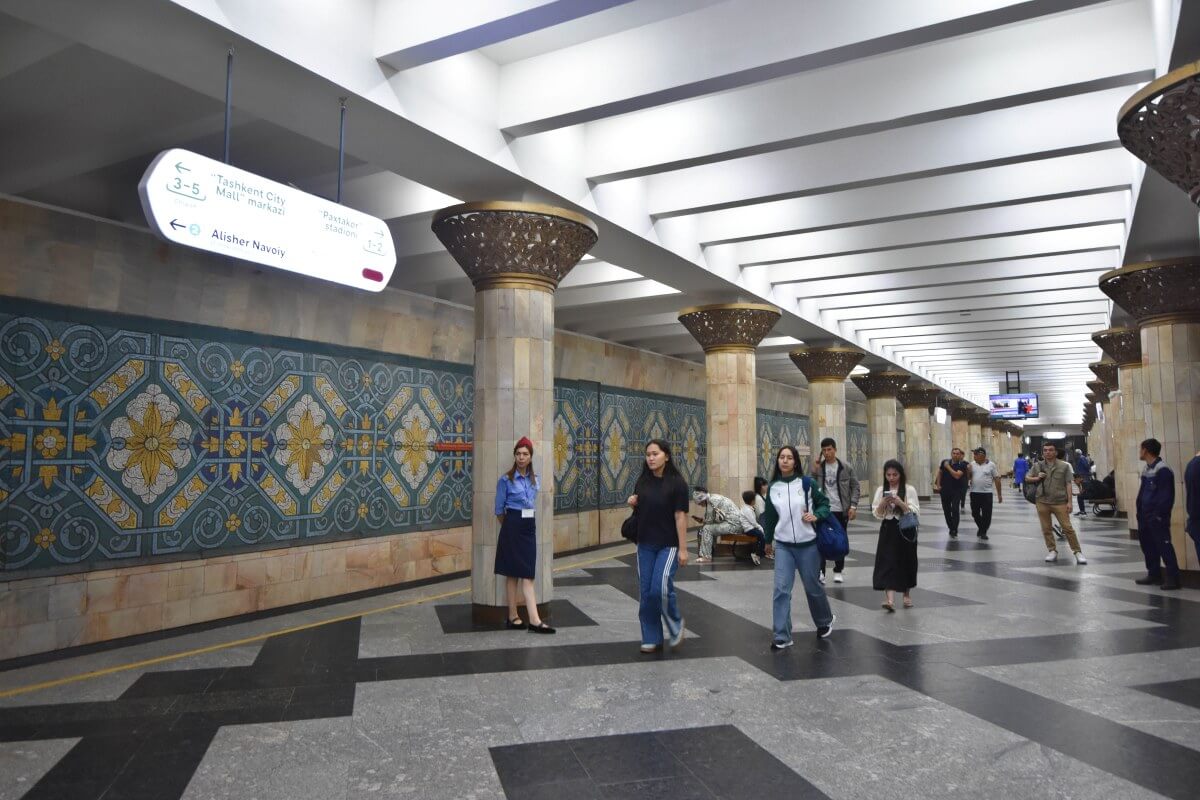
If Kosmonavtlar celebrates the future, Paxtakor tells the story of the industry that shaped modern Uzbekistan.
Opened on 6 November 1977 on the Red Line, Paxtakor was one of the original stations when the metro first opened. Its name translates as ‘cotton worker’ or ‘cotton picker’, reflecting the crop that dominated the country’s economy for decades. Cotton became so valuable that it earned the nickname ‘white gold’.
A PLATFORM COVERED IN COTTON FLOWERS
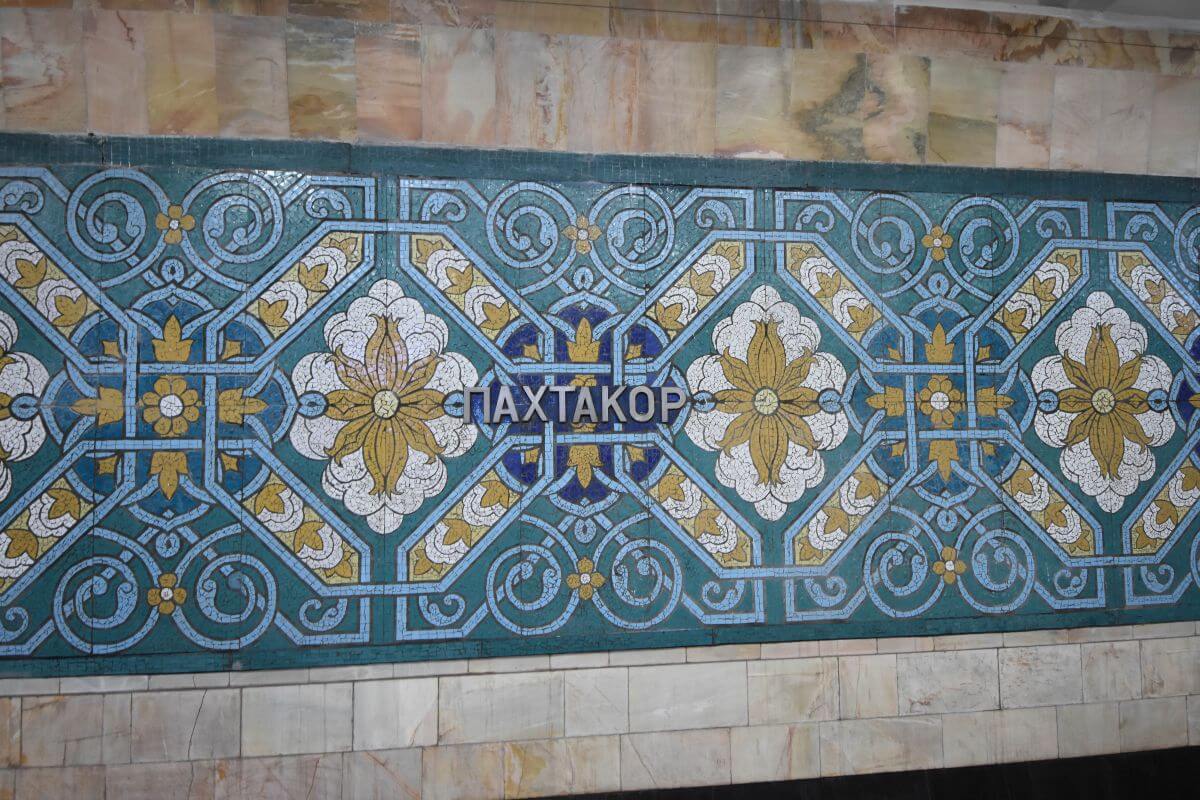
The station’s walls are impossible to miss. Massive ceramic mosaics stretch across the platform. They combine white cotton bolls with elegant green stems and traditional blue Uzbek patterns. The artwork is among the most detailed ceramic decorations we saw underground and celebrates the importance of cotton farming.
Rows of polished marble columns run through the centre of the station. Their soft creamy shapes blend into the ceiling, creating an airy appearance which resembles endless cotton fields in bloom. Bronze lamps mounted along the pillars provide a warm glow that highlights the detailed tilework.
THE HIDDEN STORY BEHIND THE BEAUTY
Paxtakor is undeniably beautiful, but it also tells a more complicated story. Cotton helped drive economic growth across the region and played a major role in Uzbekistan’s history. However, large-scale irrigation projects contributed to the environmental disaster of the Aral Sea. Standing among the elegant mosaics reminded us that great architecture can preserve both pride and difficult stories at the same time. Between the extraordinary mosaics, fascinating history, and architectural detail, Paxtakor deserves a place on every Tashkent metro itinerary.
GOOD TO KNOW:
- Above the stairs, you can also see a large copper relief showing an athlete carrying a blazing torch. The artwork references the nearby Paxtakor Stadium, home to one of Uzbekistan’s most famous football clubs. Due to its proximity to the stadium, this station becomes especially busy on football match days.
- A modern entrance connects the Paxtakor station directly with Tashkent City Mall. This creates an unusual contrast between the historic Soviet-era architecture platform below and the contemporary shopping complex above.
3. G’afur G’ulom
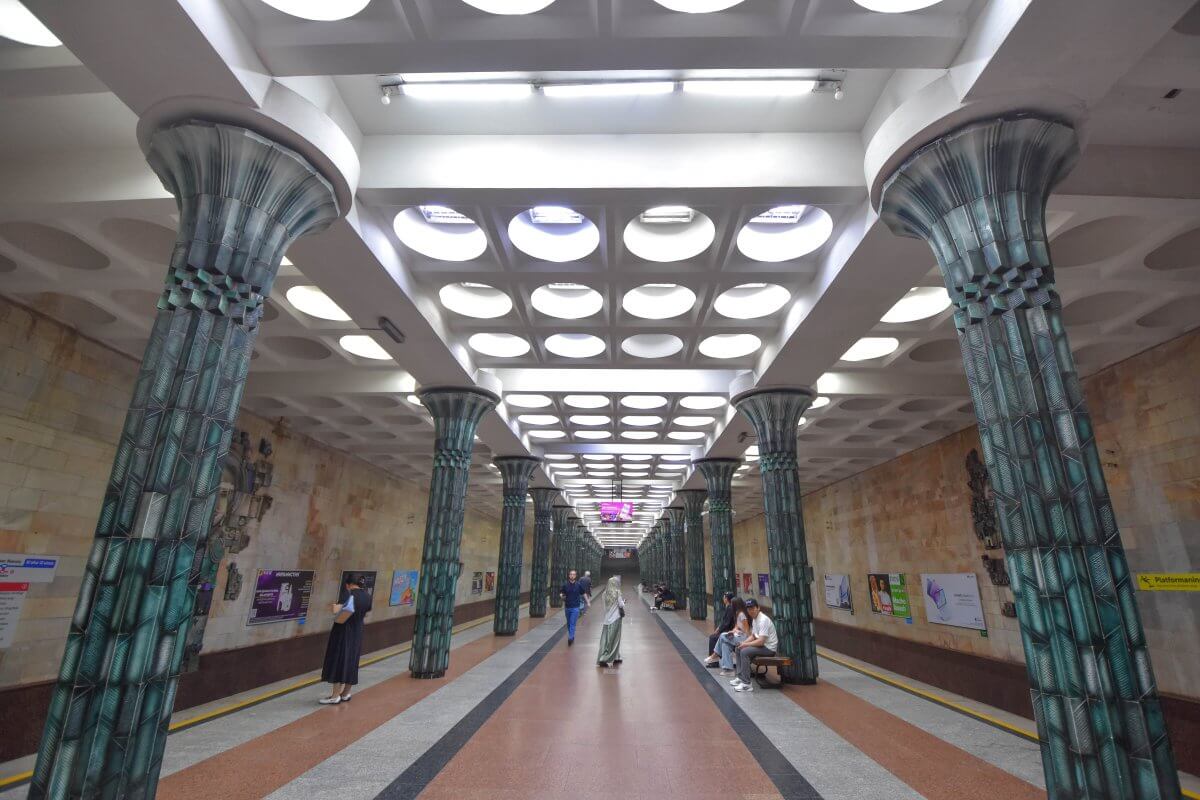
Unlike some of the more famous stops, this one receives far less attention. Yet we think it deserves a place on every visitor’s itinerary.
Opened on 6 November 1989, the station honours G’afur G’ulom, one of Uzbekistan’s greatest poets, writers, and translators. He became one of the country’s most respected literary figures during the 20th century. During the Second World War, he wrote poems that inspired hope and strengthened morale. His translations introduced Uzbek readers to famous authors, including William Shakespeare and Alexander Pushkin.
THE CERAMIC ART GALLERY AND GREEN COLUMNS
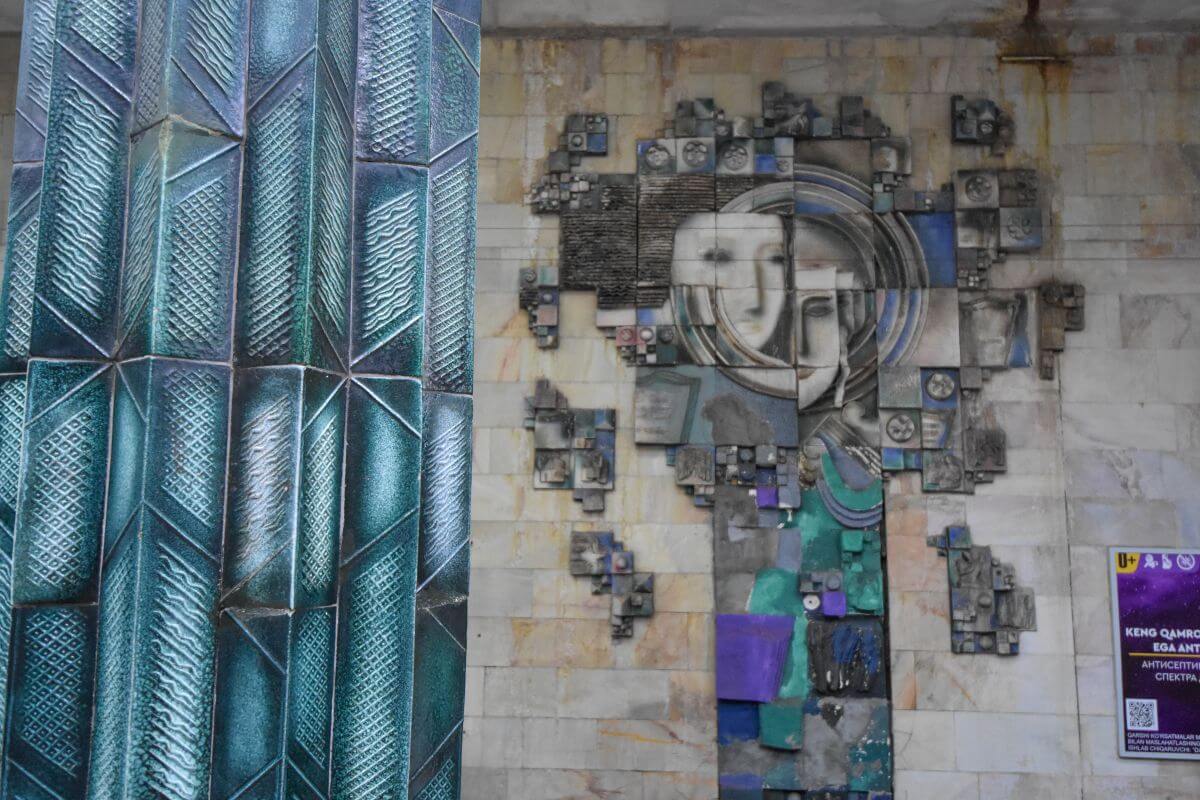
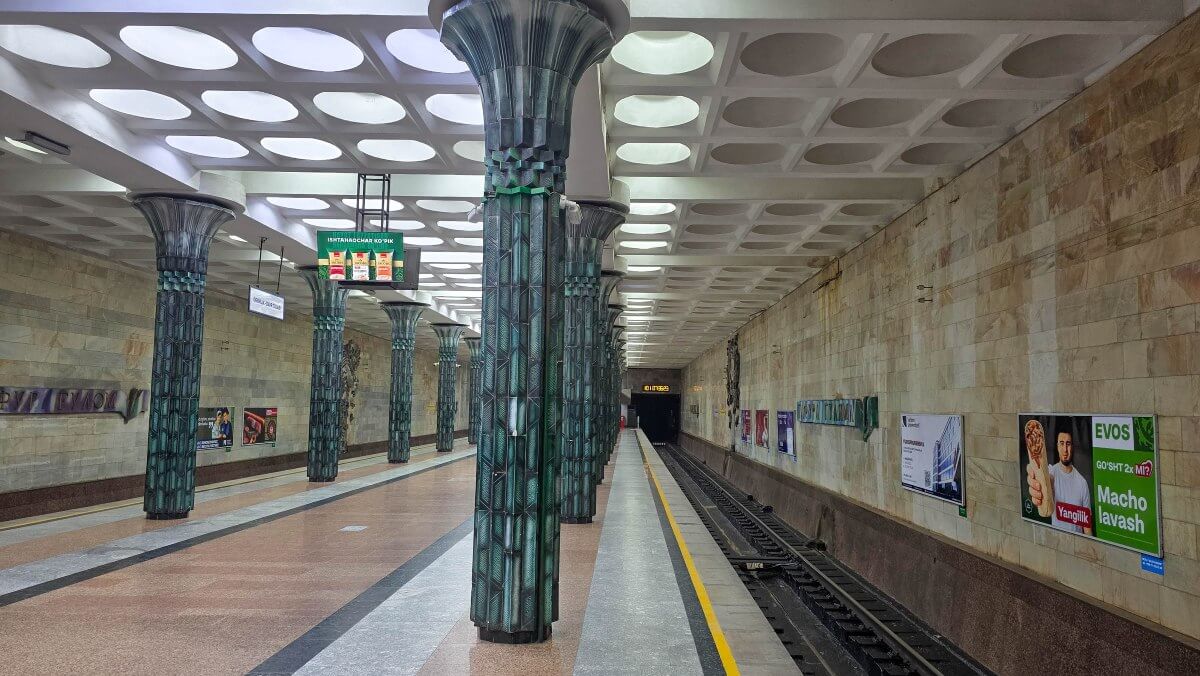
It may not be the grandest station in the network, but its distinctive colours and artistic details make it one of the most underrated Tashkent Metro stations. G’afur G’ulom immediately catches your eye because of its unusual dark green and turquoise granite columns. Their unusual multi-sided design is unlike anywhere we saw elsewhere underground. Each column widens towards the ceiling, creating elegant Art-deco style shapes that make the whole platform feel larger. Equally impressive are the colourful ceramic murals decorating the walls.
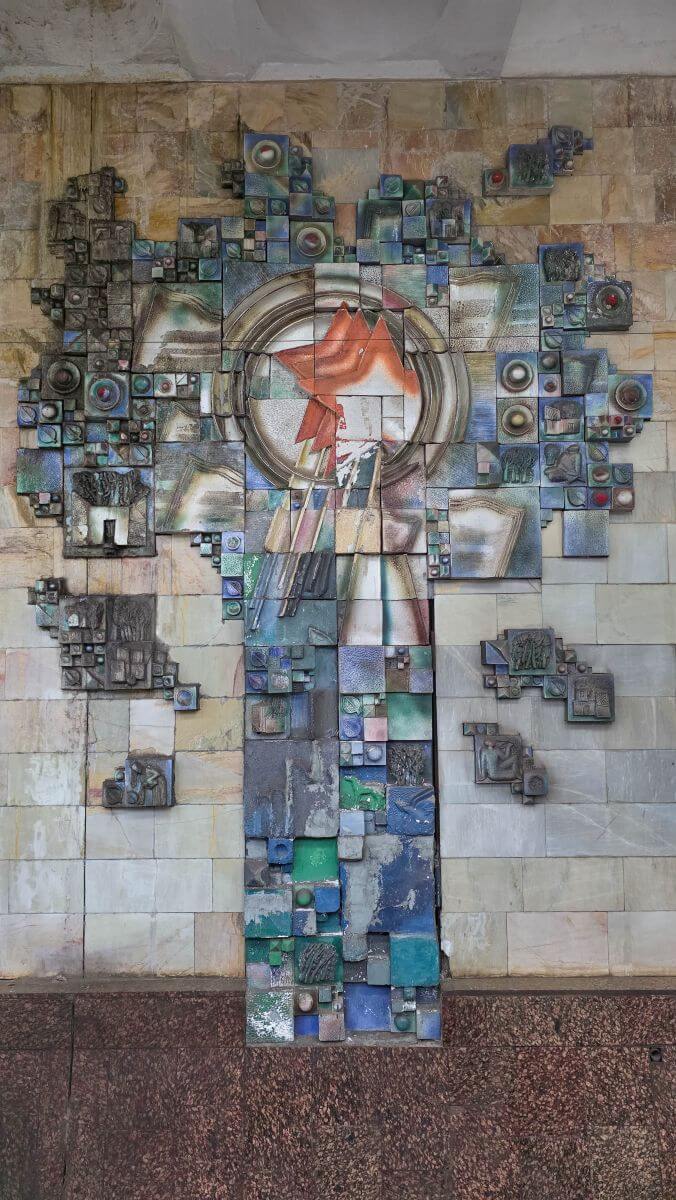
Although there isn’t any information explaining every panel, they appear to celebrate the writer’s life and literary legacy. One mural still includes the distinctive Soviet red star. It’s a rare reminder of the period when the station was built, as many Soviet symbols have disappeared from other stations over the years.
4. Alisher Navoiy
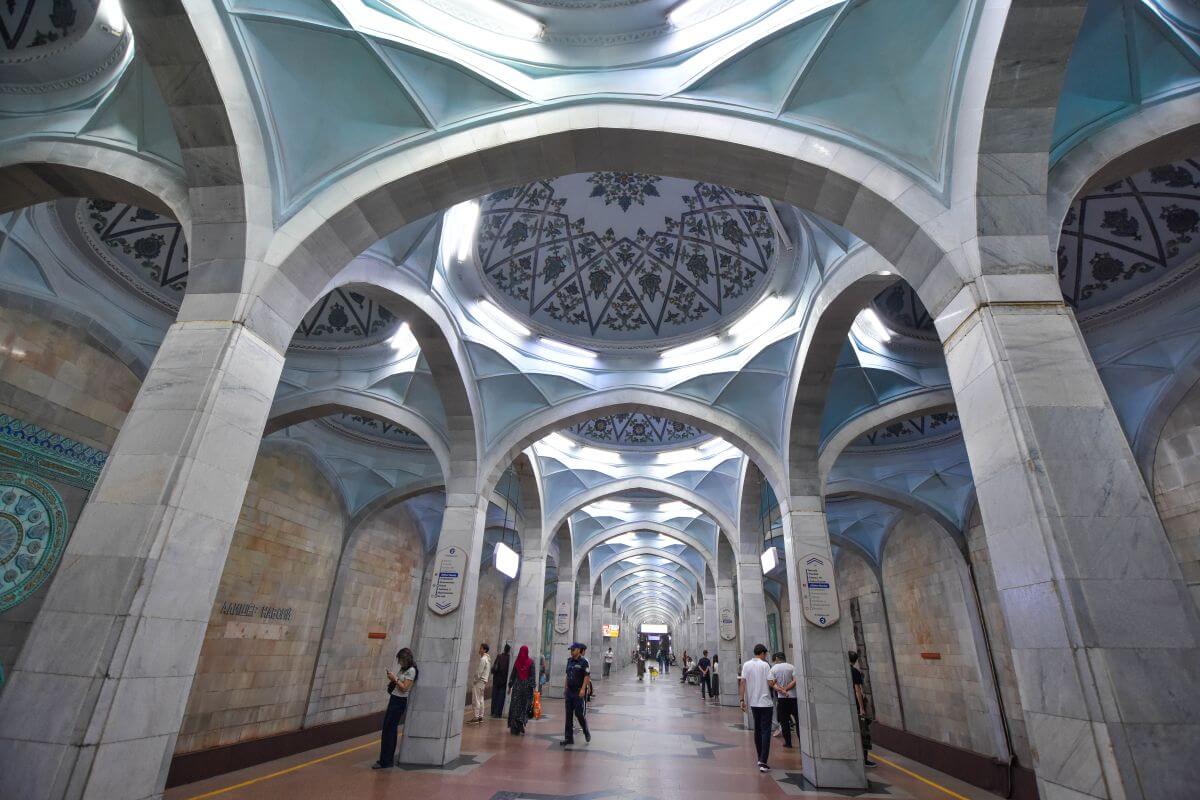
If we had to choose one station that completely exceeded our expectations, it would be Alisher Navoiy on the blue line. Before arriving, we already knew about Kosmonavtlar, the most famous Tashkent metro station. What we did not expect was to find somewhere that felt every bit as spectacular. We would never have imagined finding such extraordinary architecture beneath a busy city street.
Named after the celebrated 15th-century Muslim poet Alisher Navoiy, the station celebrates the man regarded as the father of Chagatai Turkish literature. His influence on Uzbek culture remains enormous, as he is considered the founder of early Uzbek literature. The station celebrates the poet’s achievement through remarkable works of art. The master craftsmen spent four years completing the station’s intricate ceramic work and decoration. The extraordinary attention to detail is visible everywhere you look.
THE SILK ROAD MOSQUE ARCHITECTURE
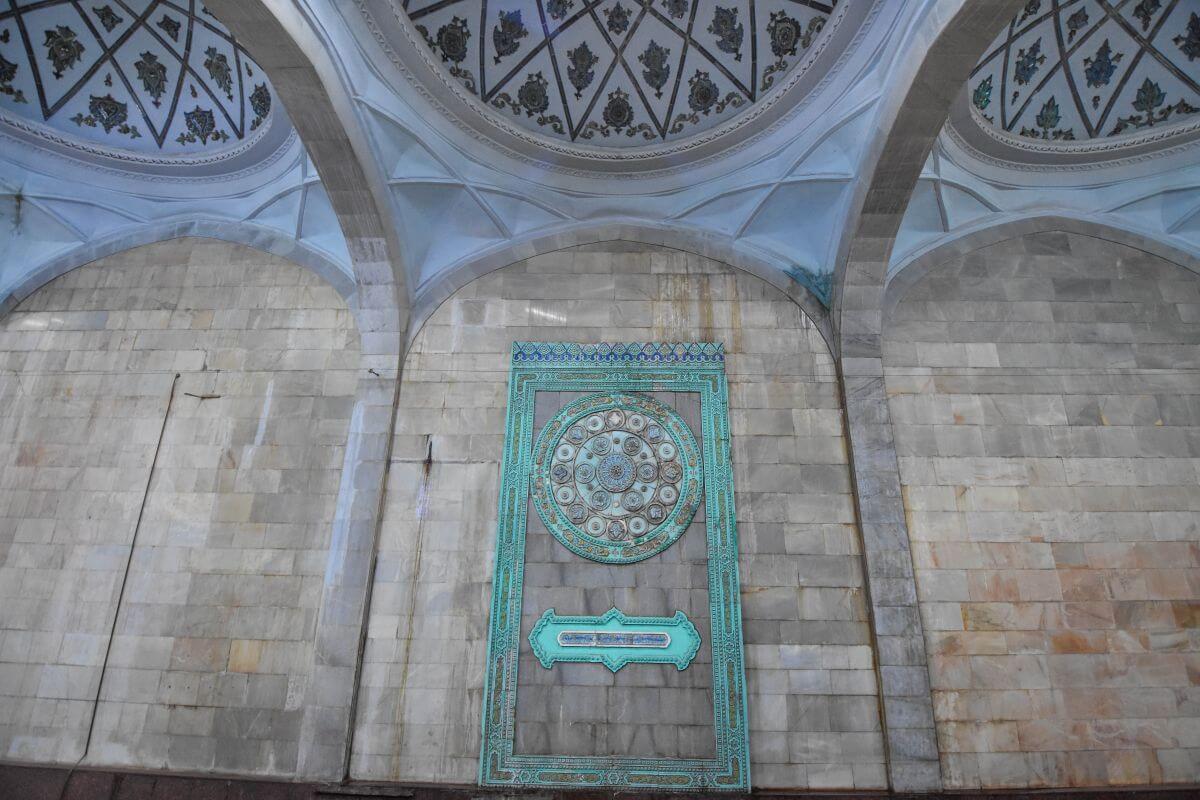
Since opening in 1984, Alisher Navoiy has become one of the finest architectural achievements in the underground network. The first thing you’ll notice is its breathtaking design. Everything about the design reflects Uzbekistan’s rich Silk Road heritage. Delicate shades of blue and white combine beneath soaring vaulted ceilings, elegant domes, and pointed arches. The entire Alisher Navoiy station resembles the magnificent Silk Road palace, mosque, or ancient madrasa rather than an underground railway station. The station felt light, peaceful, almost magical, like stepping inside a fairy tale.
Look closely at the walls, and you’ll notice beautiful ceramic artwork by the sculptor Ahmet Shaymuradov. Inside the bright turquoise frames are circular pictures. These carvings show famous scenes and characters from the Khamsa, Navoiy’s famous historic collection of epic poems. The frames use stunning Central Asian and Islamic designs. You can see perfect geometric shapes and lovely floral patterns. A vibrant turquoise colour resembles the ancient domes in Samarkand and Bukhara. For us, Alisher Navoiy perfectly combines rich history with literature, craftsmanship and practical design in one unforgettable place.
GOOD TO KNOW:
Alisher Navoiy serves as an important interchange station. A short underground passage connects it with Paxtakor on the red line. This allows easy transfers in around 3 minutes without leaving the paid area.
5. Toshkent
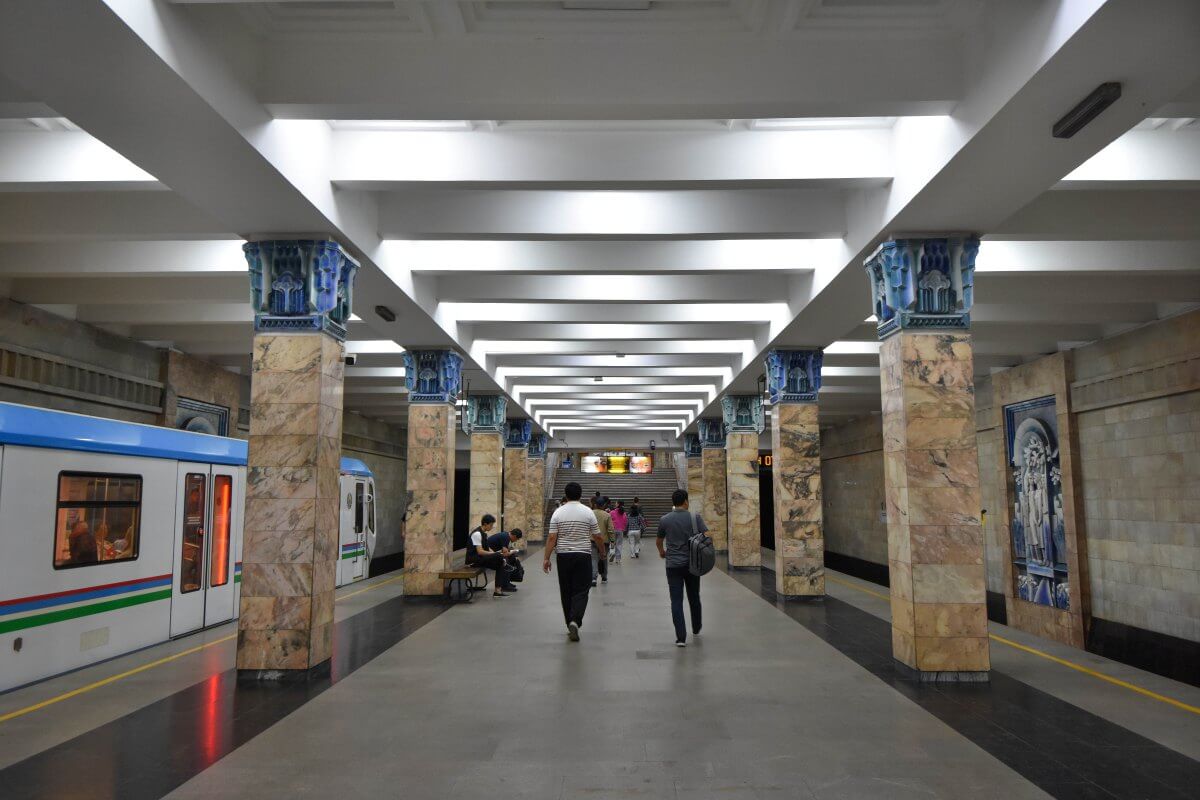
Few visitors include Toshkent on their list of the most beautiful stations, yet we think skipping it would be a mistake. While it lacks the attractive chandeliers and dramatic ceilings found elsewhere, it tells the city’s story better than almost anywhere underground. Named after the Uzbek spelling of the capital, this station celebrates more than 2,200 years of history. It reminds everyone that the modern city stands on one of Central Asia’s oldest Silk Road settlements.
Opened on 8 December 1984 on the Blue Line, Toshkent was designed as a tribute to the city’s remarkable past rather than its Soviet future. During our visit, we found ourselves slowing down to study the artwork instead of rushing to the next train. Every wall seemed to reveal another small piece of Uzbekistan’s history.
2,200 YEARS OF HISTORY
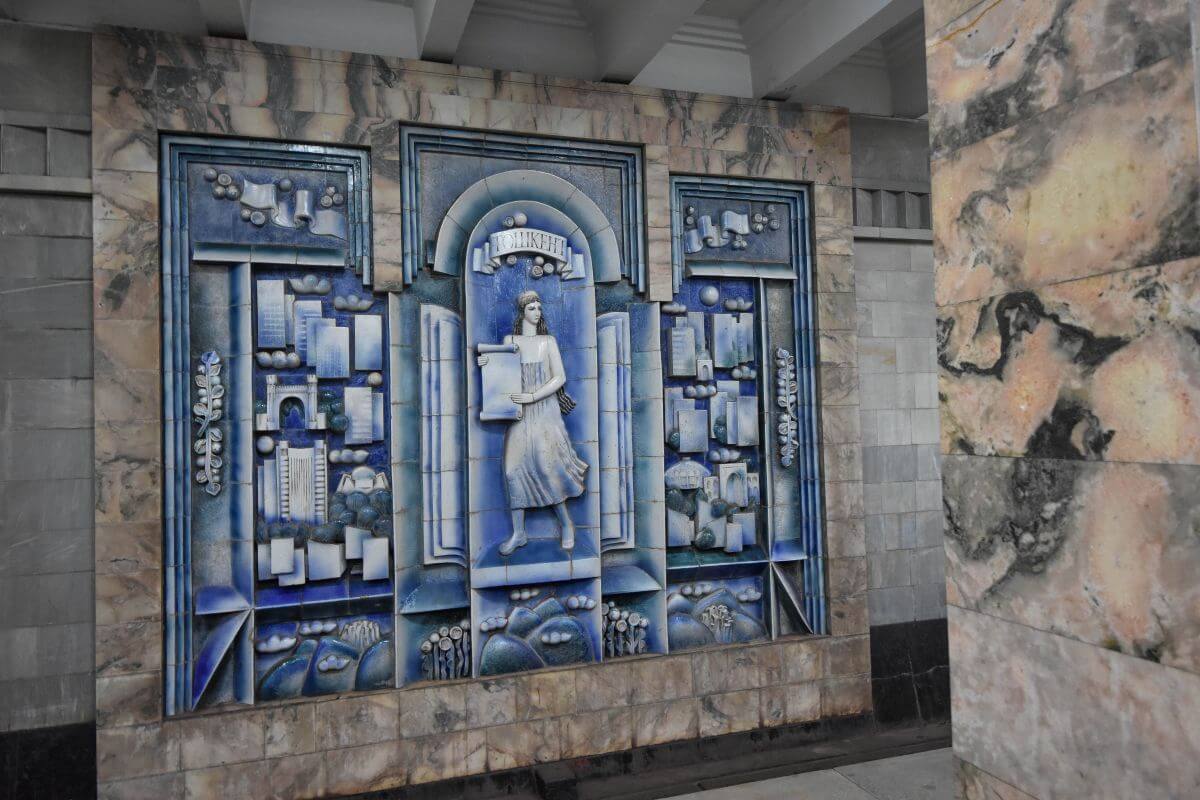
Unlike stations that focus on one historic figure or event, Toshkent celebrates the capital city. Blue-and-white glazed ceramic panels stretch along the platform, showing scenes from traditional Uzbek life. Farmers, craftsmen, families, musicians, and historic figures appear within the artworks. This creates a visual story of how the city developed over thousands of years.
Toshkent station proudly celebrates the country’s cultural heritage and everyday life. One detail we liked was how the station quietly reflects the meaning of the city’s name. Tashkent translates as ‘City of Stone’, and the carefully crafted ceramic bas-reliefs symbolise the strength, history and identity that have shaped the capital for centuries.
LITTLE DETAILS
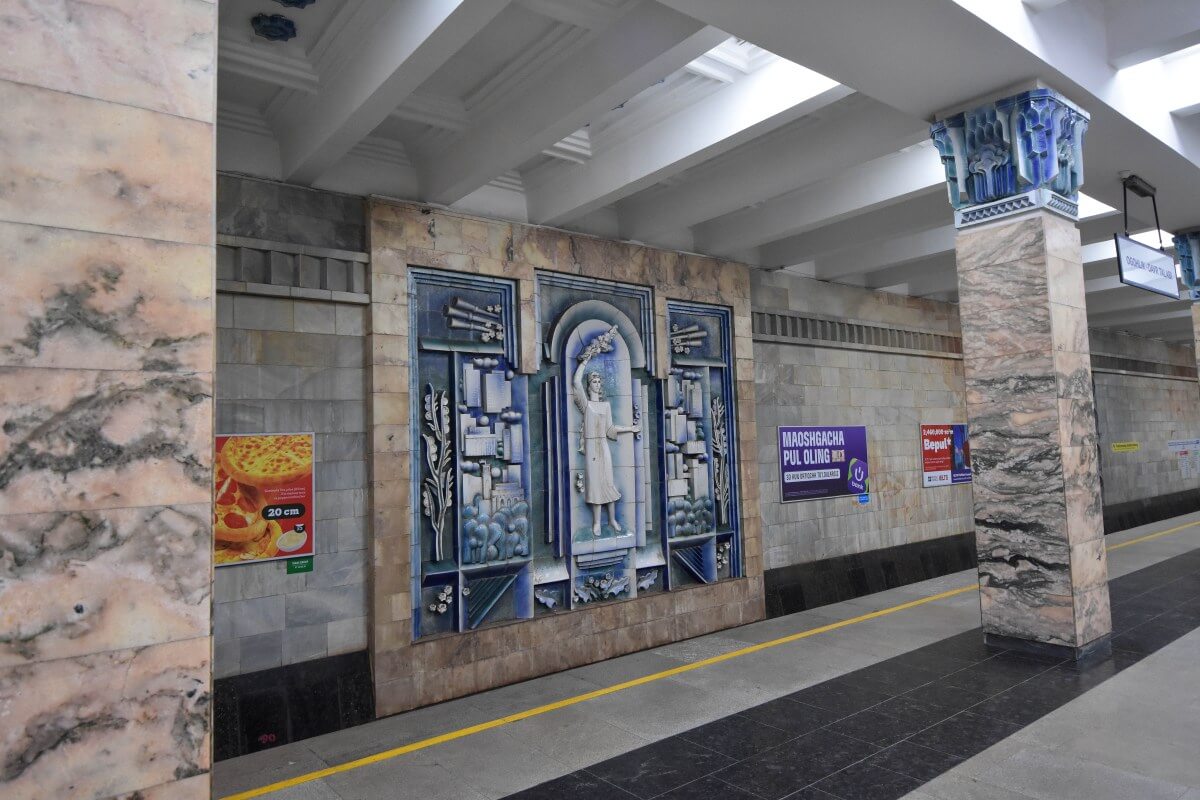
Although the platform feels less extravagant than some of the metro’s grand platforms, there are still plenty of details worth noticing. Rows of large rectangular marble columns dominate the station. Each one has bright turquoise and blue ceramic capitals that add colour to the elegant interior. The powerful lighting gives the entire platform a bright atmosphere instead of the darker mood found at many older underground stations.
Even before reaching the platforms, the entrances deserve attention. One entrance displays a large sun sculpture celebrating the city’s long history. Another features a striking blue peacock (symbol of peace and friendship), which has become one of the station’s most recognisable landmarks.
6. Mustaqillik Maydoni
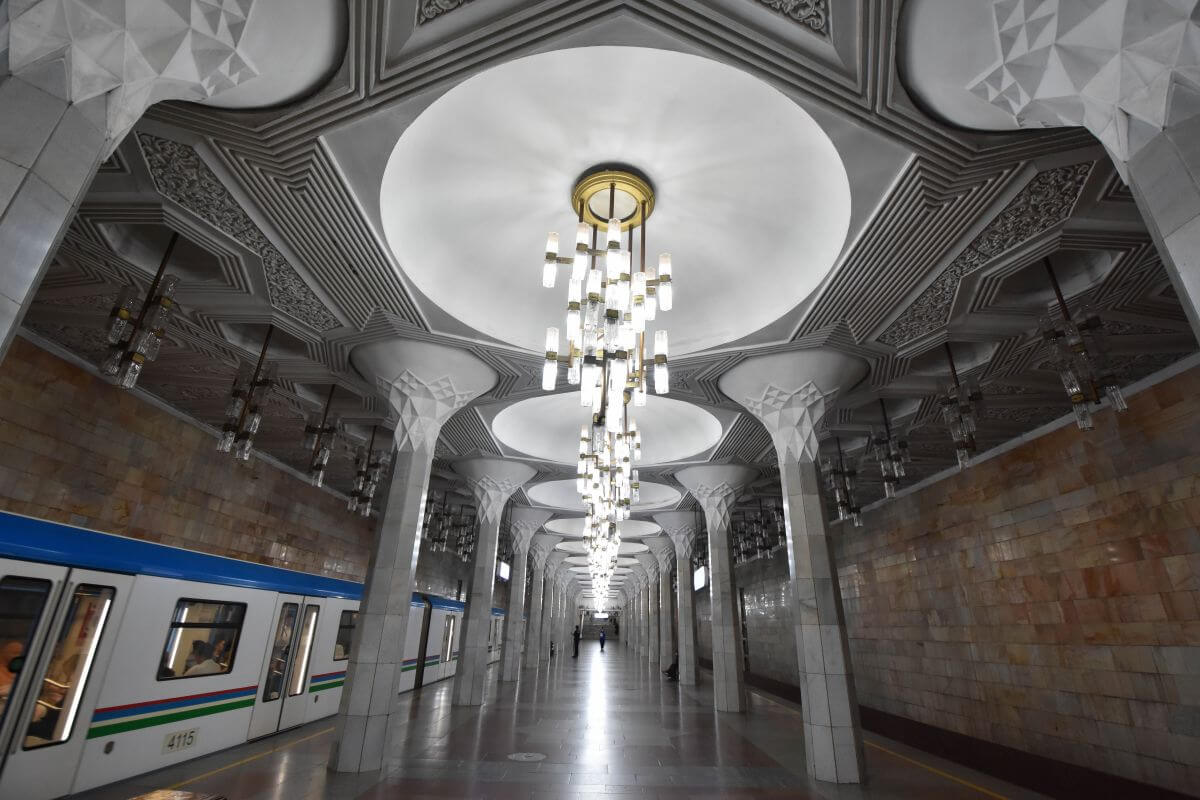
Did you know that Mustaqillik Maydoni was the very first grand station ever built for the city’s underground? As soon as we stepped onto the platform, we understood why it remains one of the network’s greatest masterpieces. We had seen photographs before arriving, but nothing prepared us for standing beneath the enormous crystal chandeliers surrounded by endless marble. It genuinely felt as if we had walked into a magnificent ballroom instead of a station.
Opened on 6 November 1977 on the Red Line, Mustaqillik Maydoni became the first completed station on the original metro line. Today its name means ‘Independence Square’, reflecting the famous square directly above the station. Before Uzbekistan gained independence, both the station and the square honoured Vladimir Lenin. Following the collapse of the Soviet Union, they were renamed to celebrate the country’s new future.
Standing here, we found it hard to believe that thousands of commuters simply walk through this station daily. Beautiful white marble brought from the Kyzylkum Desert in western Uzbekistan covers almost every surface. Massive columns stretch into the distance beneath an elegant ceiling decorated with detailed geometric patterns. Hanging between them are massive crystal chandeliers that give the platform warm light.
TIP:
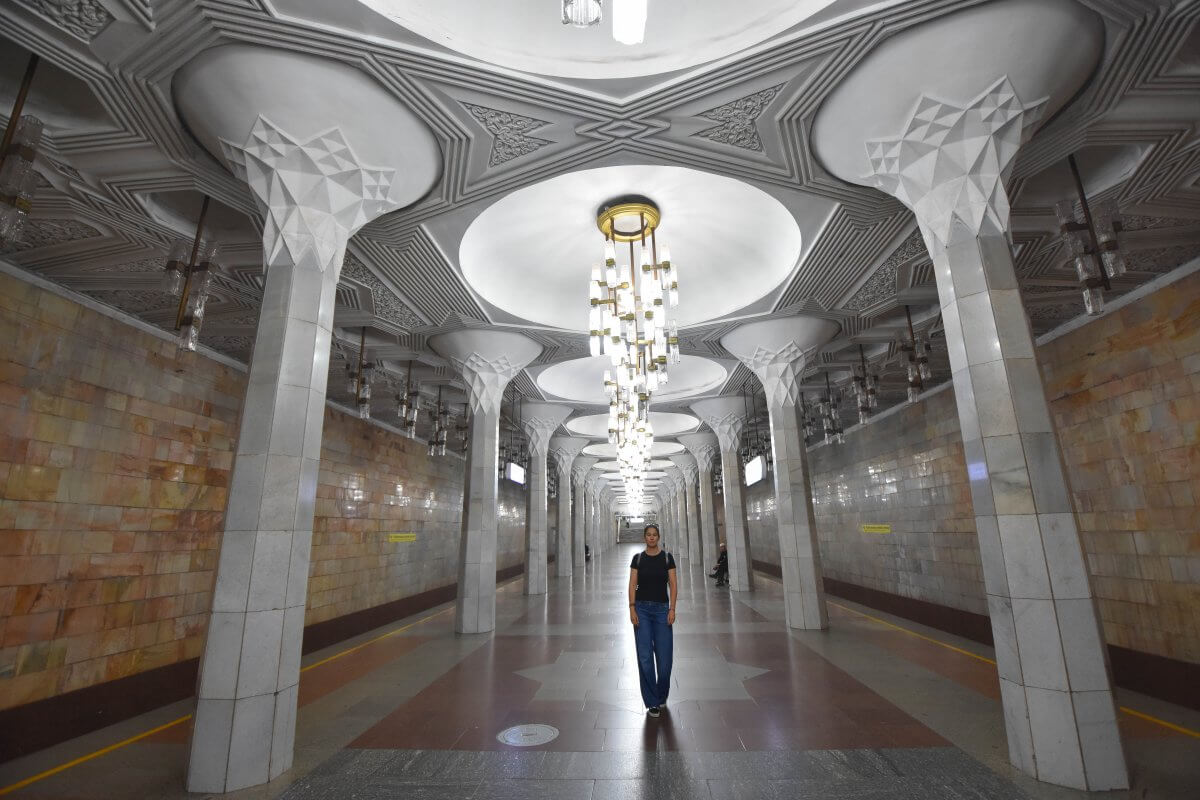
While everyone immediately admires the beautiful chandeliers, most visitors forget to look at the floor. The polished granite features a large geometric star design. It was created to celebrate the achievements of Soviet space exploration and the country’s cosmonauts. However, modern guides explain the floor stars as a tribute to the 15th-century astronomer Ulugh Beg.
GOOD TO KNOW:
Another reason we recommend visiting Mustaqillik Maydoni is its location. The exits lead directly into Independence Square, the political heart of Uzbekistan. Within a few minutes’ walk you’ll find beautiful fountains, government buildings and some of the city’s most famous monuments.
7. Yunus Rajabiy
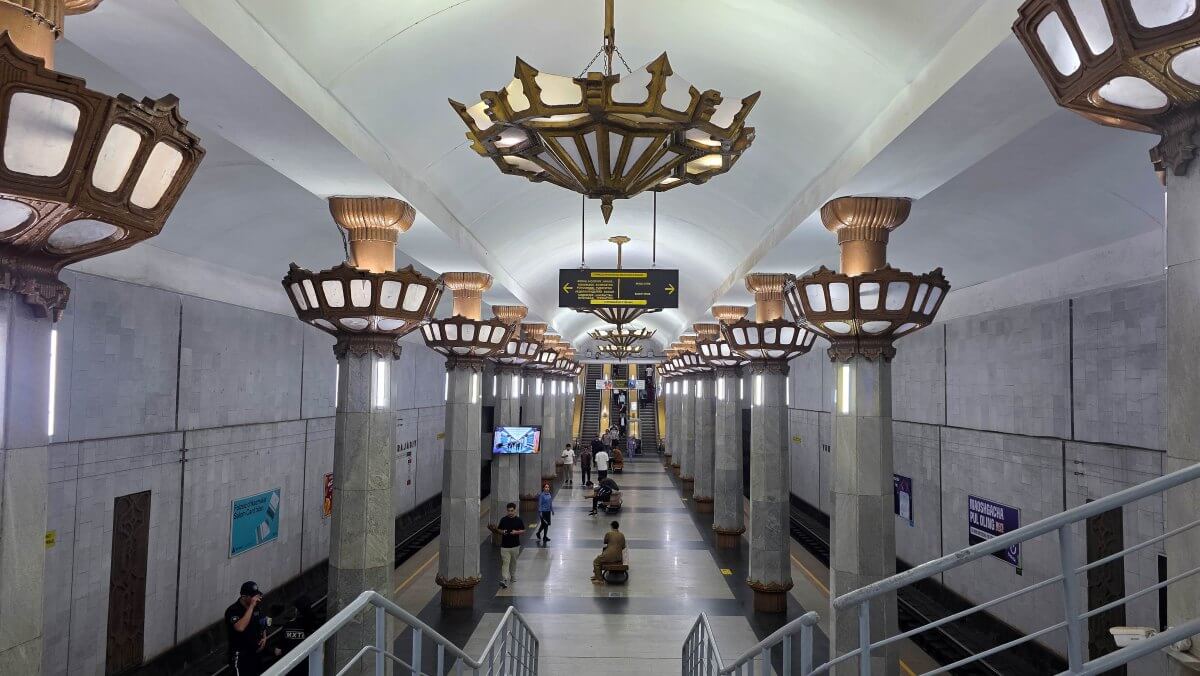
Yunus Rajabiy may look less colourful than some of the city’s older stations, but within seconds it completely changed our minds. The moment we reached the platform, one feature stole all the attention. A magnificent staircase rises proudly through the centre of the station, creating an elegant entrance unlike anything we had seen elsewhere underground. It felt more like walking into the foyer of a grand theatre than catching the next train. It quickly became one of our favourite places to photograph during our visit. Elegant Yunus Rajabiy proved that modern architecture can be just as memorable as the older Soviet masterpieces.
Opened on 24 October 2001 on the Green Line, Yunus Rajabiy is part of a newer generation of stations built after Uzbekistan gained independence. It honours Yunus Rajabiy, one of the country’s most respected composers and singers. This talented musician devoted his career to protecting the country’s traditional folk music.
A STAIRCASE THAT STEALS THE SHOW
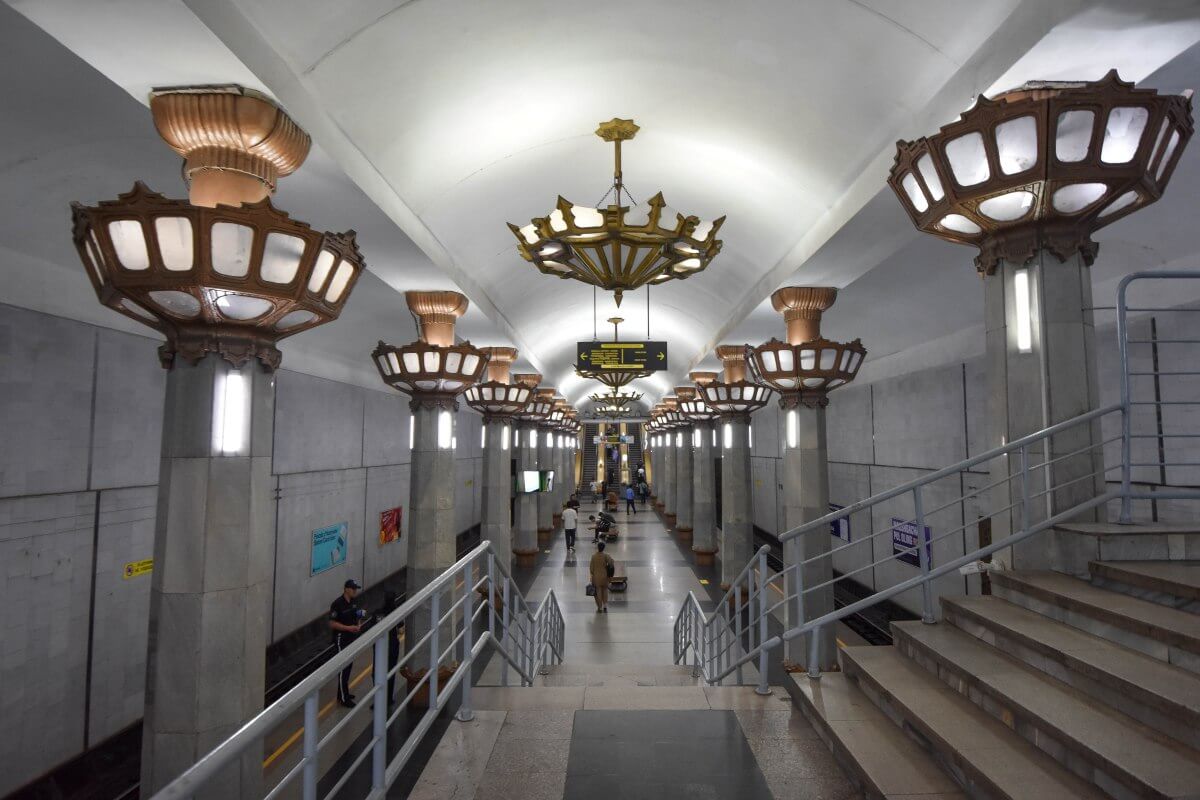
A huge staircase divides the platform into two elegant halves, creating perfect symmetry from almost every angle. We immediately thought it looked like the kind of staircase normally found inside the palace or luxury hotel. It is even easy to imagine it being used for a photoshoot rather than for passengers changing trains.
Instead of colourful murals covering every wall, the beauty here comes from elegant proportions and carefully chosen materials. Thick grey marble columns stretch across the platform, creating a striking appearance. Above each one sits a decorative lantern, filling the station with a warm golden light. Massive wrought-iron chandeliers hanging from the vaulted ceiling make the whole station feel bright, spacious, and welcoming. Looking across the platform, we almost forgot we were standing inside a metro station.
GOOD TO KNOW:
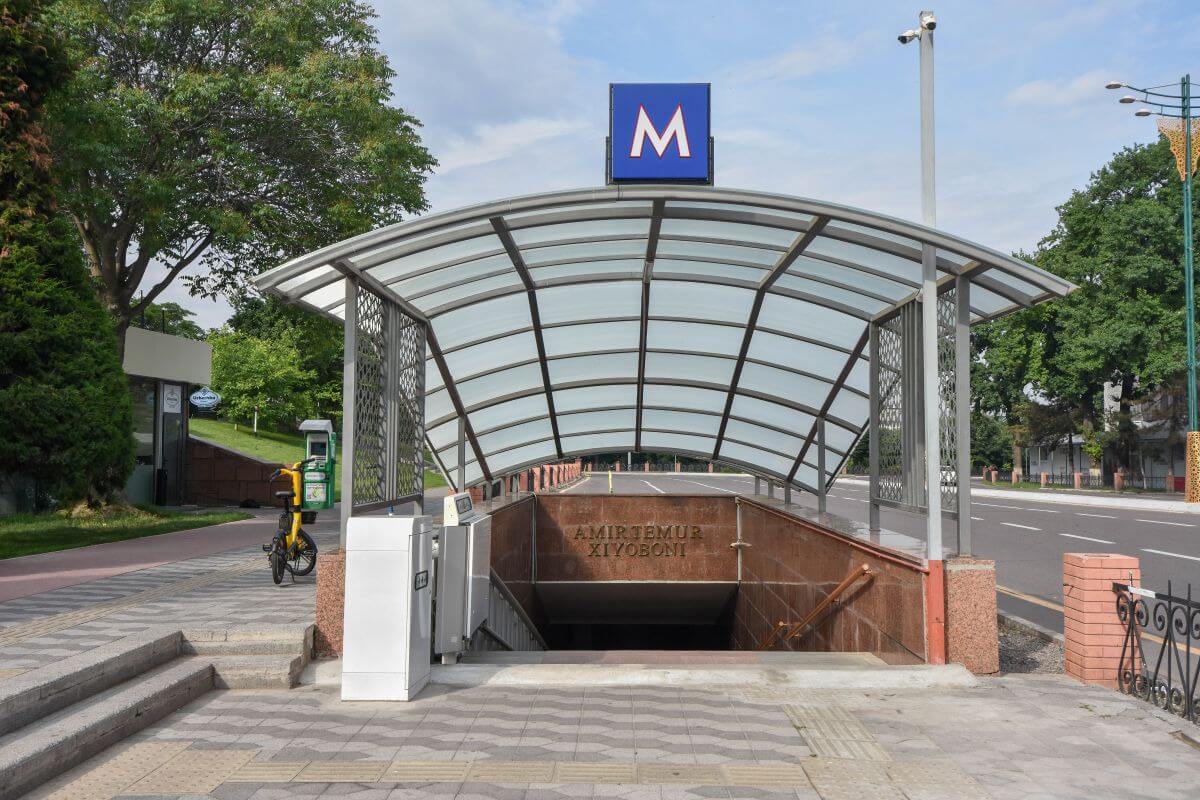
Located beneath Amir Temur Square, it connects with Amir Temur Xiyoboni on the Red Line. A convenient underground passage allows passengers to transfer between the two routes in around three minutes without leaving the station. Above ground, its entrance leads directly into the park surrounding the square. Nearby, you can find landmarks such as the famous Hotel Uzbekistan and the Amir Temur Museum.
Opening Hours and Train Times – When is the Best Time to Ride the Tashkent Metro?
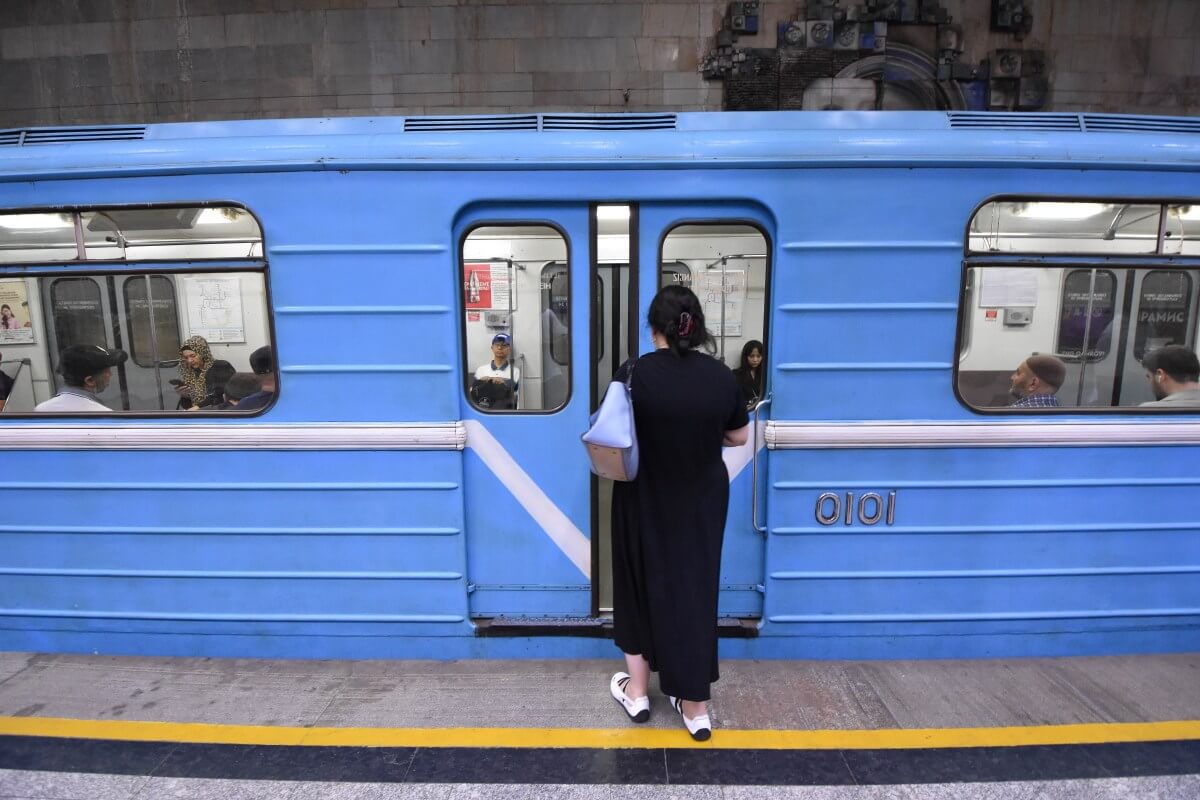
Planning your journey is surprisingly easy because the Tashkent Metro runs daily from 5 AM until midnight. This gives you almost 19 hours to explore the city underground. Unlike many rail networks, there is no fixed timetable displayed for individual trains. Instead, it works as a turn-up-and-go system, so you simply head to the platform and wait for the next service.
As the locals told us, during the busiest parts of the day, trains arrive very frequently. Between 7:30 AM and 9:30 AM, and again from 5 PM until 7:30 PM, services usually appear every 2 to 4 minutes. These are the main commuter hours when locals travel to and from work. Stations become much busier than at other times.
Between 1 PM and 4 PM, trains normally arrive every 4 to 6 minutes, yet platforms are noticeably quieter. It’s also a perfect escape during summer when temperatures outside often become uncomfortably hot. Late evenings and weekends are naturally quieter, with trains usually running every 7 to 10 minutes. During our visit on a Sunday, we rarely waited longer than about 8 minutes, which still felt quick enough for sightseeing.
GOOD TO KNOW:
Although the main underground routes follow the same operating hours every day, some sections on the elevated line or a few stations further from the centre may occasionally open around 6 AM.
THE BEST TIME FOR PHOTOGRAPHY
If your goal is to admire the Tashkent Metro’s architecture, take photographs, and move between stations without rushing, we found Sunday morning the perfect time to visit. We explored the network during these hours and found it much easier to enjoy each station without large crowds.
Understanding the Metro Map
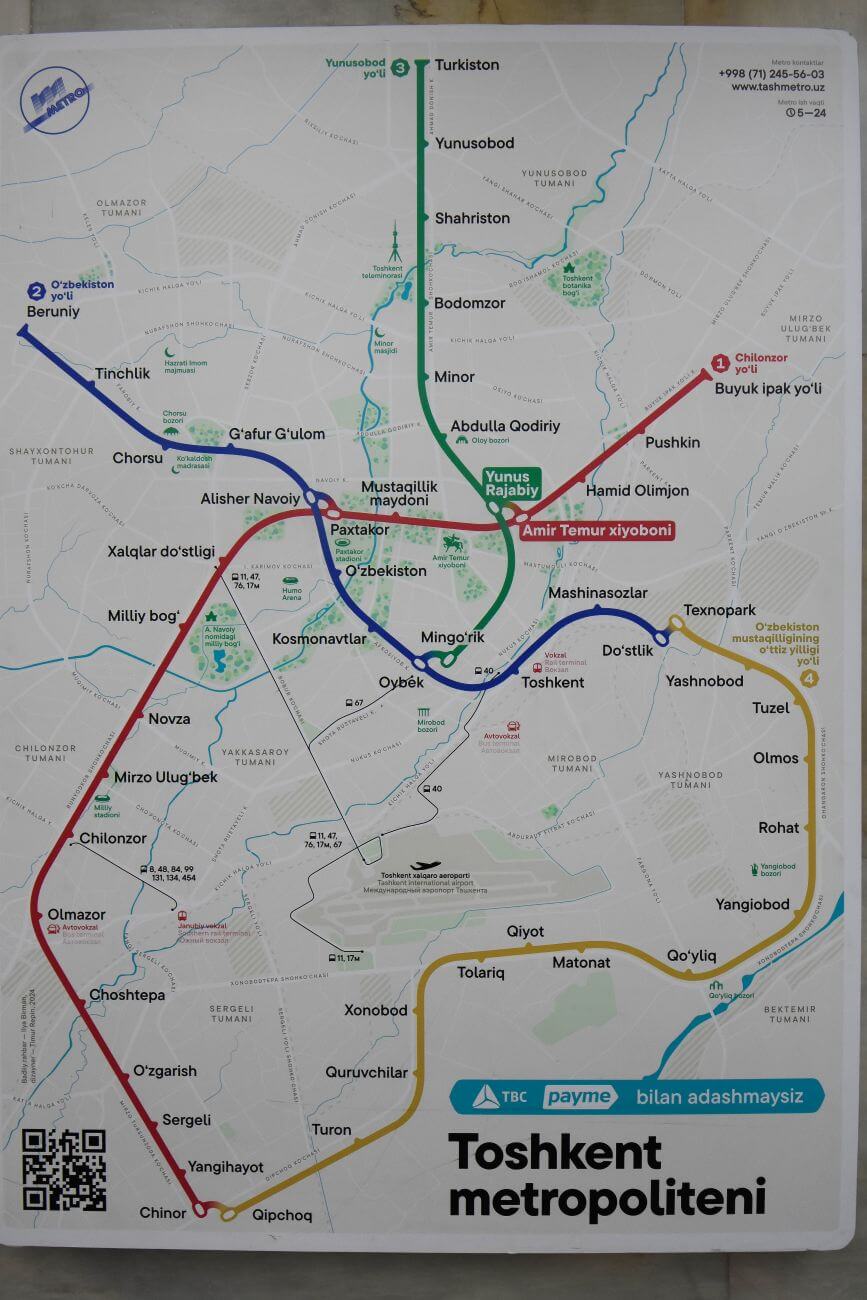
At first glance, the network map may look complicated, but it’s actually one of the simplest underground systems we have used. Today, it includes 50 stations across four colour-coded lines, making it easy to understand even if you’re visiting the capital for the first time.
Three of the main Tashkent Metro routes meet close to the city centre, creating a convenient transfer triangle. Changing lines is straightforward. The fourth line is different. Instead of passing through the middle, the elevated yellow Circle line forms a wide loop around the outer districts.
Each route serves a different part of the city. The red Chilonzor Line is the oldest and longest, stretching across 17 stations and carrying a large number of commuters. The blue Oʻzbekiston Line, with 11 stations, passes important places, including Chorsu Bazaar and the main railway station. The green Yunusobod Line runs north to south through 8 stations, while the elevated yellow Circle Line connects 14 stations around the city’s edge.
GOOD TO KNOW:
Changing lines is simple because transfer stations are connected by short underground passageways, even though each station keeps its own name. Another feature we appreciated was the clear signage. Station names appear in Latin script, which most international visitors can read easily. Older Cyrillic signs still appear in a few places, adding another memory of the city’s Soviet past.
How Much Does a Tashkent Metro Ticket Cost?
One of the biggest surprises we discovered while exploring the city was how incredibly cheap the metro was. In fact, it’s one of the best value attractions in Uzbekistan. For the price of a few pennies, you can spend hours visiting some of the most beautiful underground stations in Central Asia.
The Tashkent Metro uses a simple flat-fare system, which means you pay once and can travel anywhere in the network until you leave through the exit gates. You can change trains as many times as you like without paying again, if you stay inside the system. Good news for foreign visitors is that there is no separate tourist pricing. Everyone pays exactly the same fare regardless of nationality.
TWO DIFFERENT FARES:
As of August 2026, two different fares are available depending on how you choose to pay. A single journey costs:
- 1,700 Uzbek som (about 11 pence/ $0.14) if you pay electronically.
- 3,000 Uzbek som (about 19 pence/ $0.25) for a cash payment.
If you prefer to use cash, look for the yellow ‘Kassa’ sign at the station entrance. Here you can buy a single-use paper ticket from the ticket office. Some stations also have self-service machines.
The electronic option is clearly a better deal. During our visit, we paid with a contactless bank card and paid the lower fare instantly.
THE TRICK THAT SAVES YOU MONEY
If you tap a Visa or Mastercard directly at the turnstile or use your phone, you receive the cheaper 1,700 Uzbek som fare. Buying the paper QR ticket means paying 76% more for the same ride.
For longer stays, locals often use an ATTO card, including a 30-ride package costing approximately 20,000 Uzbek som (£1.26/ $1.67). For many tourists spending only a few days in the city, contactless remains the easiest option.
LARGE BAGS AND SUITCASES:
Normal daypacks and small cabin bags are without charge. If your luggage exceeds 120 cm x 65 cm, you’ll need to purchase a separate baggage ticket for 4,000 Uzbek som.
GOOD TO KNOW:
As mentioned earlier, the domestic and international airports aren’t connected to the underground network. If you need transport to or from the terminal, local buses are available. However, we recommend using Yandex Go, an affordable and popular taxi company in Uzbekistan.
Quick Overview of All 7 Tashkent Metro Stations
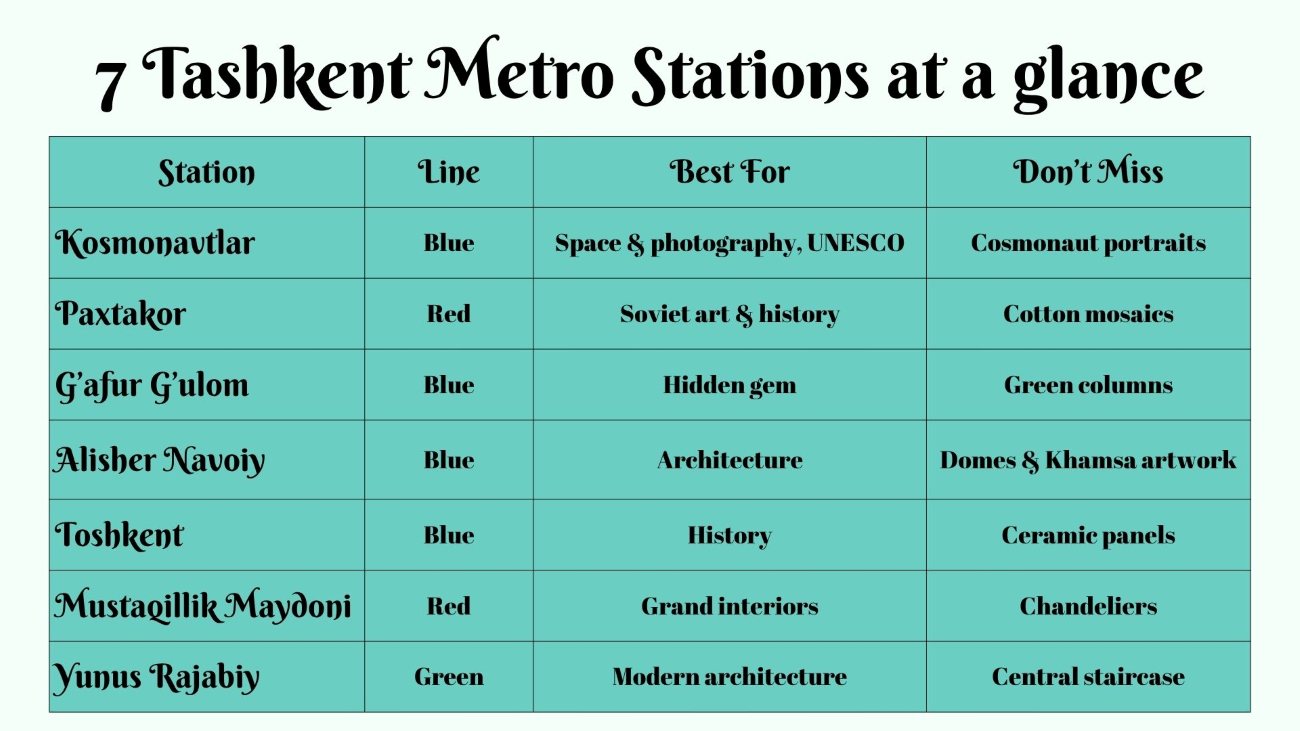
Now you have a complete guide to the Tashkent Metro in Uzbekistan!
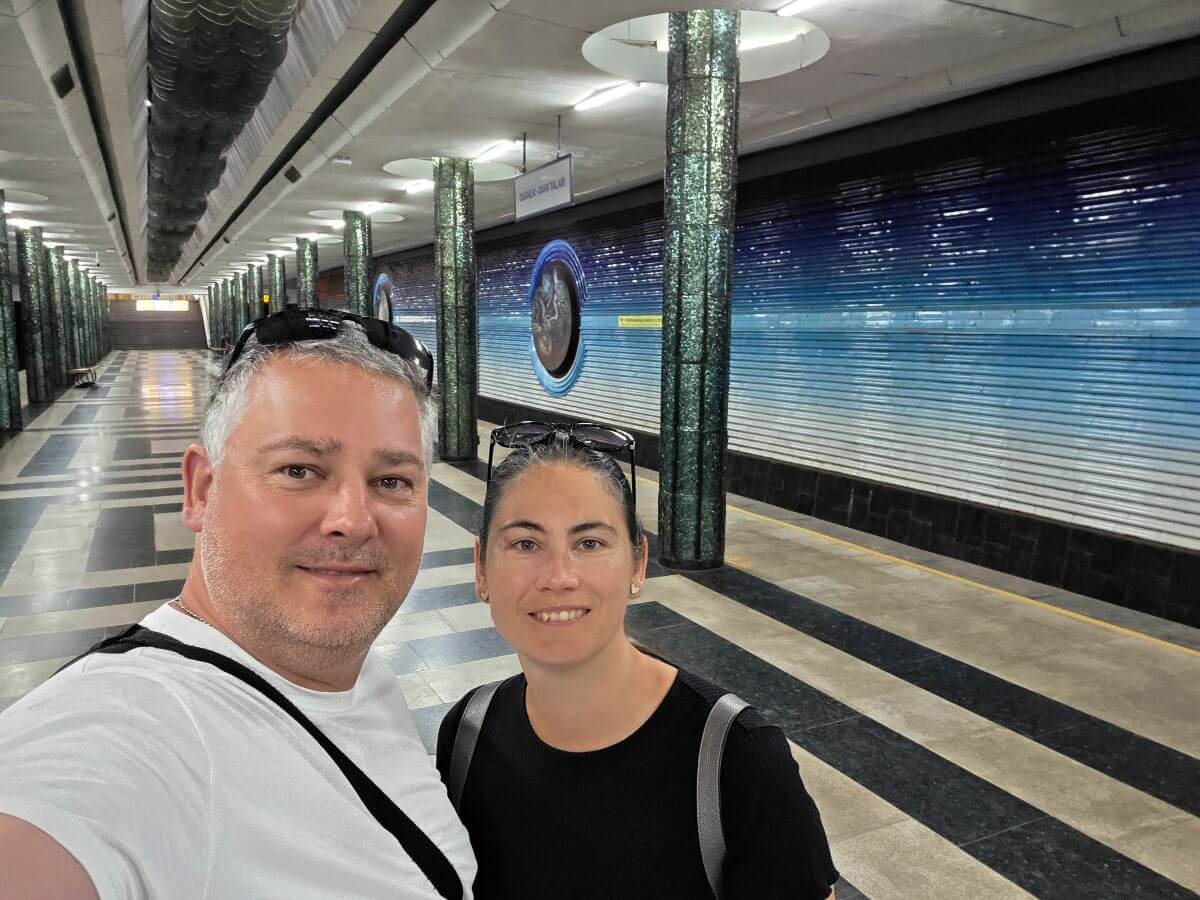
Thank you for staying with us until the end! If you’ve enjoyed this article, please consider sharing this post to extend its reach.
Pin this guide to the 7 Most Beautiful and Interesting Metro Stations in Tashkent for later so you don’t lose it!
YOU MAY ALSO ENJOY: