Seeing every object on display in London’s British Museum would take an astonishing 95 days of nonstop browsing, seven hours a day. While the total collection contains a vast 8 million objects, less than 1% (just 80,000 artefacts) are actually on display. Even so, exploring the museum’s 70+ galleries can easily feel overwhelming. This British Museum guide highlights 15 significant objects worth planning your visit around, with exactly where to find them, what to look for, and how to build your route. It’s especially useful for a short visit when you cannot possibly see everything. This article helps you focus on the most important artefacts without wasting precious time figuring out where to start.
Did you know that the British Museum is older than the United States? Parliament founded it in 1753, and it opened its doors in 1759, making it the world’s first national public museum. That means it opened 17 years before the American Declaration of Independence. That long history is only the beginning; the real challenge is deciding which treasures to see first.
Know the Building Before You Start
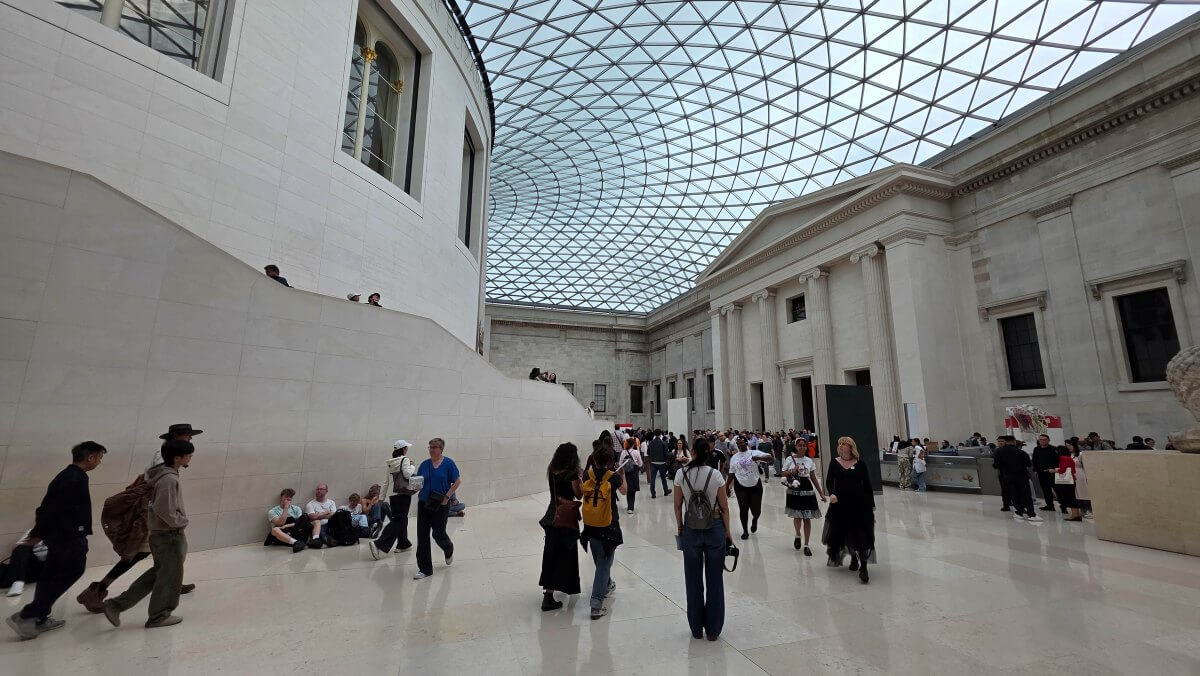
There is no single correct way to visit. You can stay for an hour, spend a whole day or take a slower route with a break in the Great Court. You can also use the museum’s audio app, which includes self-guided tours, an interactive map and information on 250 objects.
The British Museum has four main wings that surround a huge central courtyard. Norman Foster designed the beautiful glass roof that transformed the former open space into one of Europe’s largest covered public squares. The museum’s galleries spread around it over seven levels (level 0, -1, 1, 2, 3, 4 and 5). They cover regions and periods including ancient Egypt, Greece and Rome, the Middle East, Asia, Europe, Africa, and the Americas. An official museum map is worth checking before you arrive, as access can change.
British Museum London Map
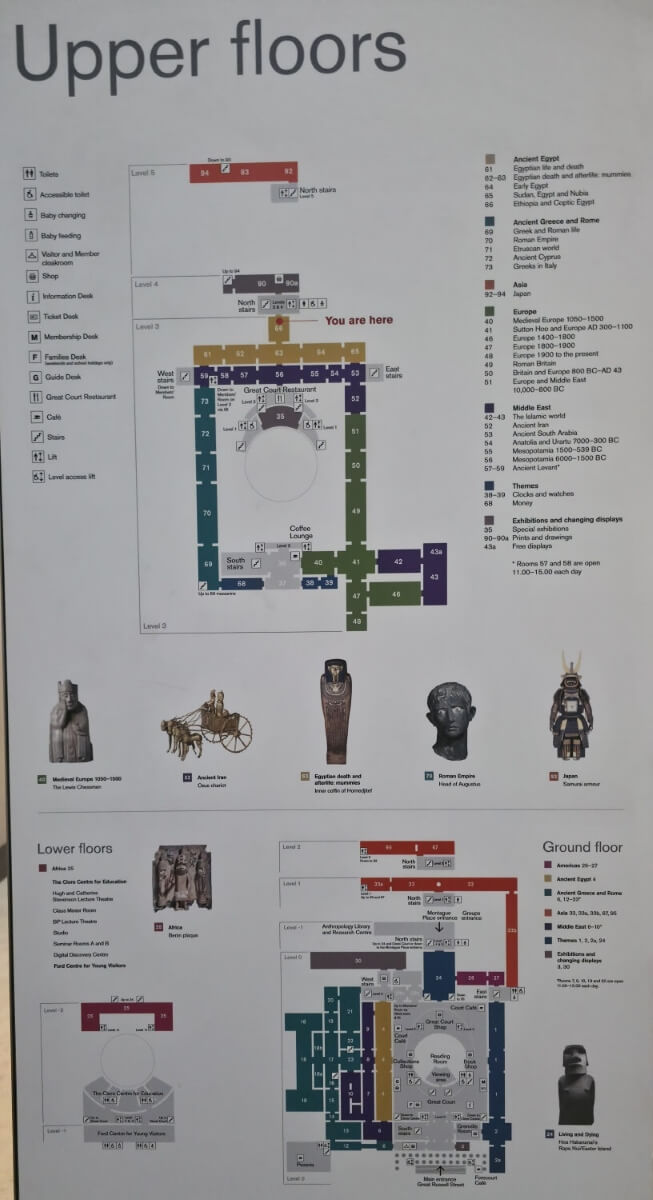
In this picture, you can see the official British Museum map from September 2026. Before you visit, check the map and view the planned gallery closure list to avoid disappointment.
Why Trust Our British Museum Highlights Guide?
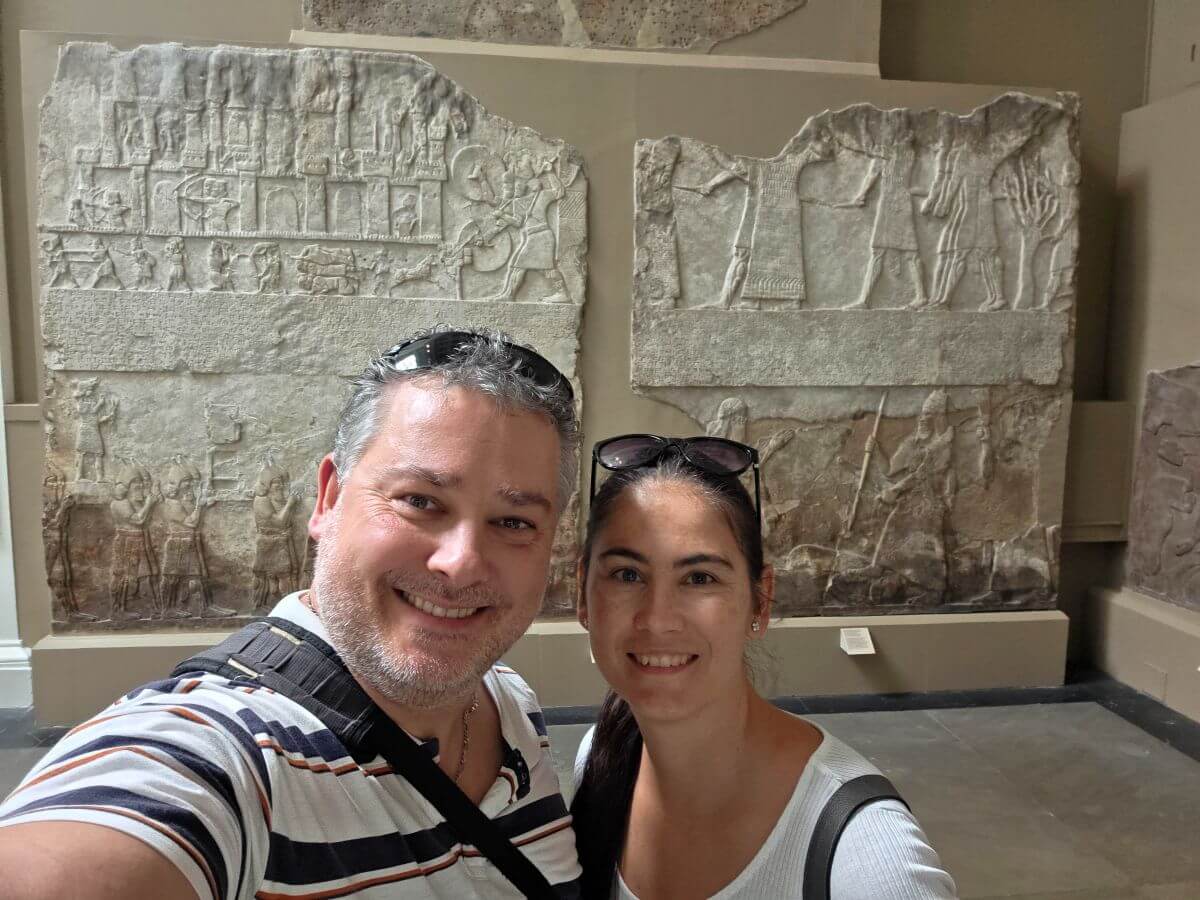
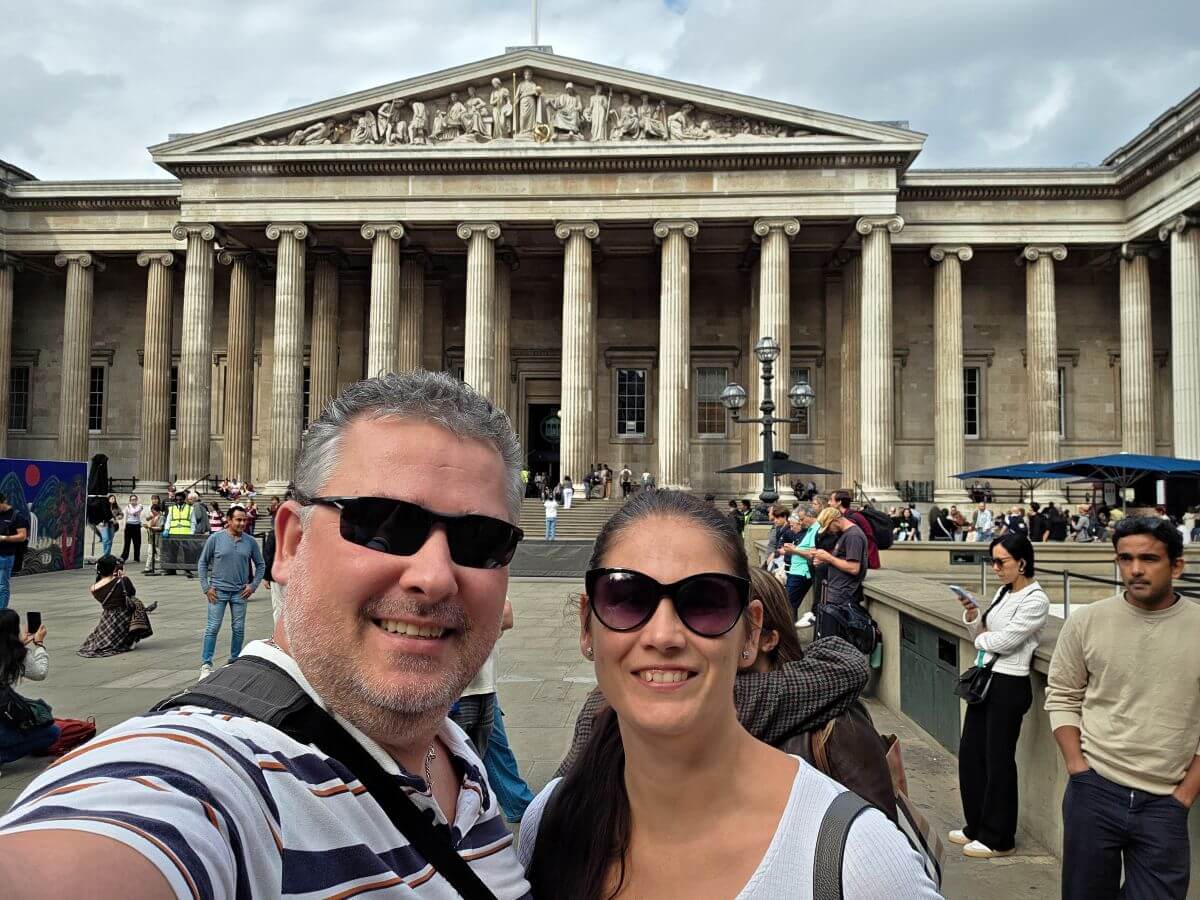
We returned to the British Museum in the middle of September 2026 and spent four and a half hours exploring the main galleries ourselves. Our visit was completely self-funded, so nothing influenced what we say here. We even bought the £2 map, which we found useful because its colourful coding makes the museum easier to navigate. The map lists ten suggested objects, but it sometimes gives only the gallery sections rather than the precise room. That matters when you are standing among hundreds of objects and trying to find one particular treasure.
There were also times when we felt the museum could explain some objects better. Not every artefact has enough information nearby to explain why it matters, and that can mean walking past something extraordinary without realising it. That experience shaped this guide.
We also want to be transparent about what we didn’t see. During our visit on Sunday, we couldn’t see the Bayeux Tapestry because tickets were already sold out on our September 2026 visit. The 70-m-long tapestry is on display from September 2026 to July 2027, with further ticket releases planned for later dates. As we live in West Sussex and regularly travel to London, we hope to return if we manage to get tickets.
Forget trying to see it all.
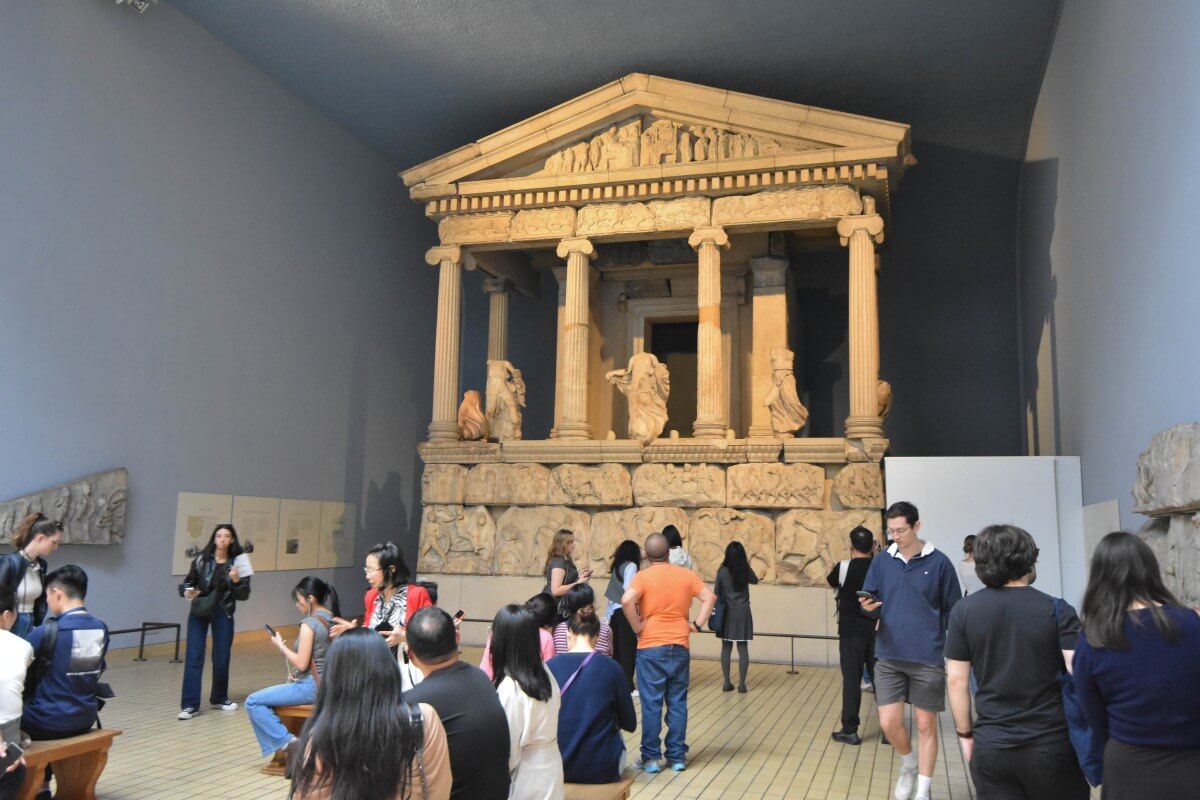
The building brings together objects from across the world and from thousands of years of human history. We have chosen pieces that tell very different stories, from ancient Egypt and Assyria to Greece, Rome, Asia, and medieval Europe.
This means our guide to what to see at the British Museum isn’t just a checklist of famous names. Instead, we handpicked these 15 objects to give you a taste of what makes this museum so remarkable. Some map the evolution of human communication and belief, while others capture the grandeur and propaganda of empires. Several offer a rare window into sacred rituals, while the rest redefine regional histories and the identities of ancient elites. For every single item, we will show you exactly where to find it, what you are looking at, and the unique detail that makes it worth stopping for.
Don’t forget to bookmark this British Museum highlights guide so you can quickly find it.
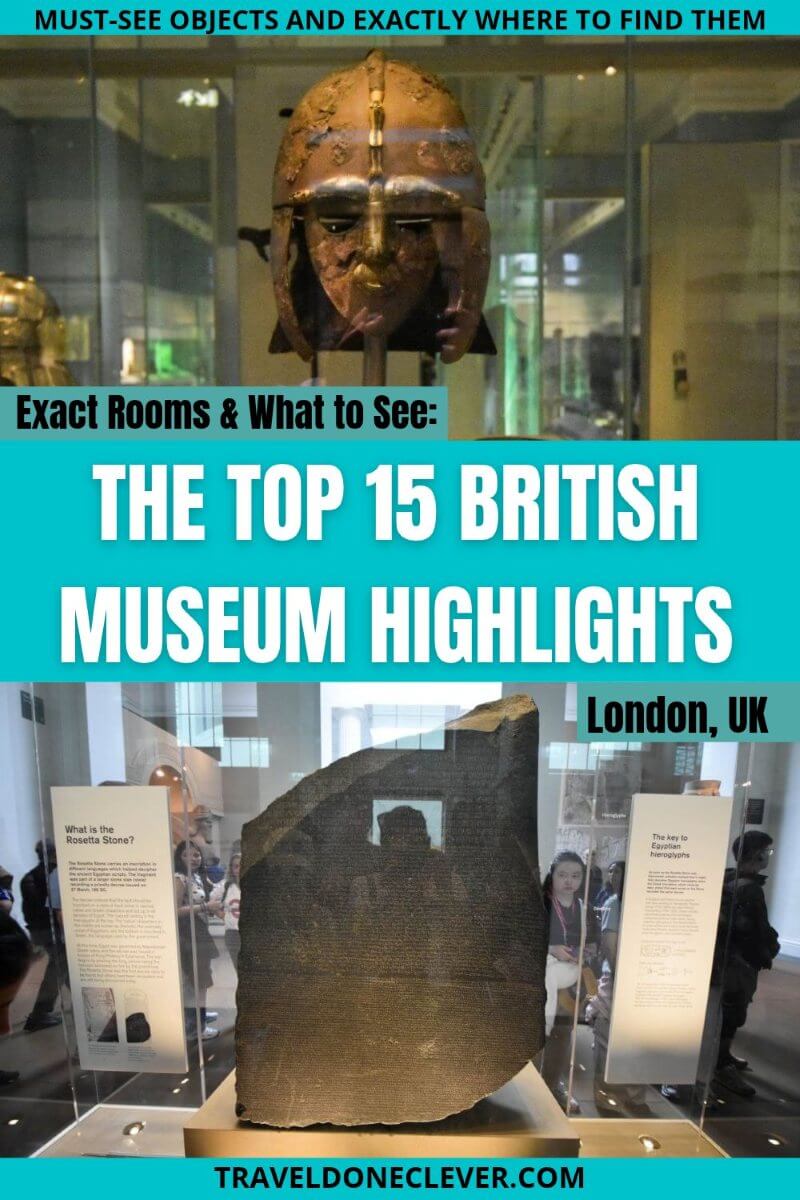
15 Must-see Highlights at the British Museum in London
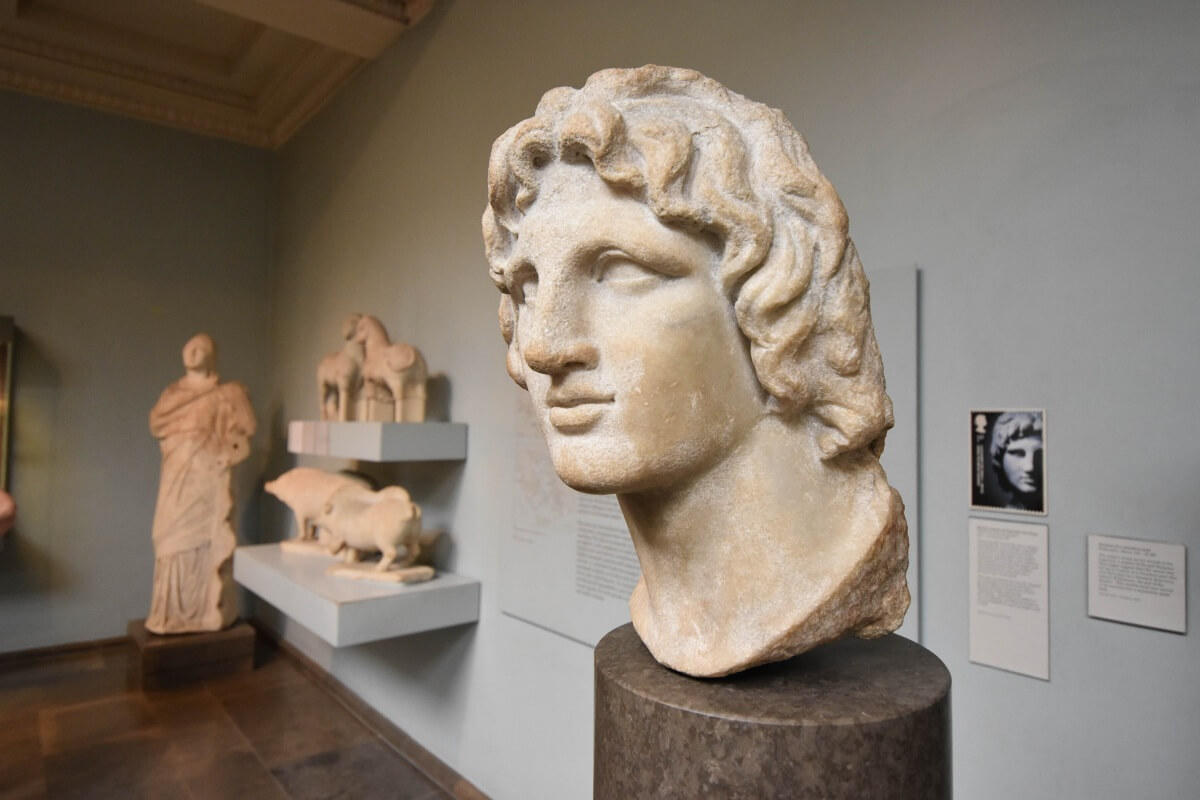
You don’t need an art history background to make a visit meaningful. Instead of trying to find every famous object, focus on a few pieces that completely changed human history or reveal how deeply connected different cultures are. Follow our list of British Museum highlights so you know what you shouldn’t miss.
We are arranging this British Museum guide by museum section, because knowing where the highlights are is half the battle in a building this large. This section starts with must-see artefacts from Ancient Egypt: Room 4 – Egyptian Sculpture on the Ground Floor. Ancient Egyptian civilisation lasted over 3,000 years, and much of the surviving evidence comes from temples and tombs. Here, among numerous statues and inscriptions, you’ll find two of the museum’s most recognisable objects.
1. Rosetta Stone
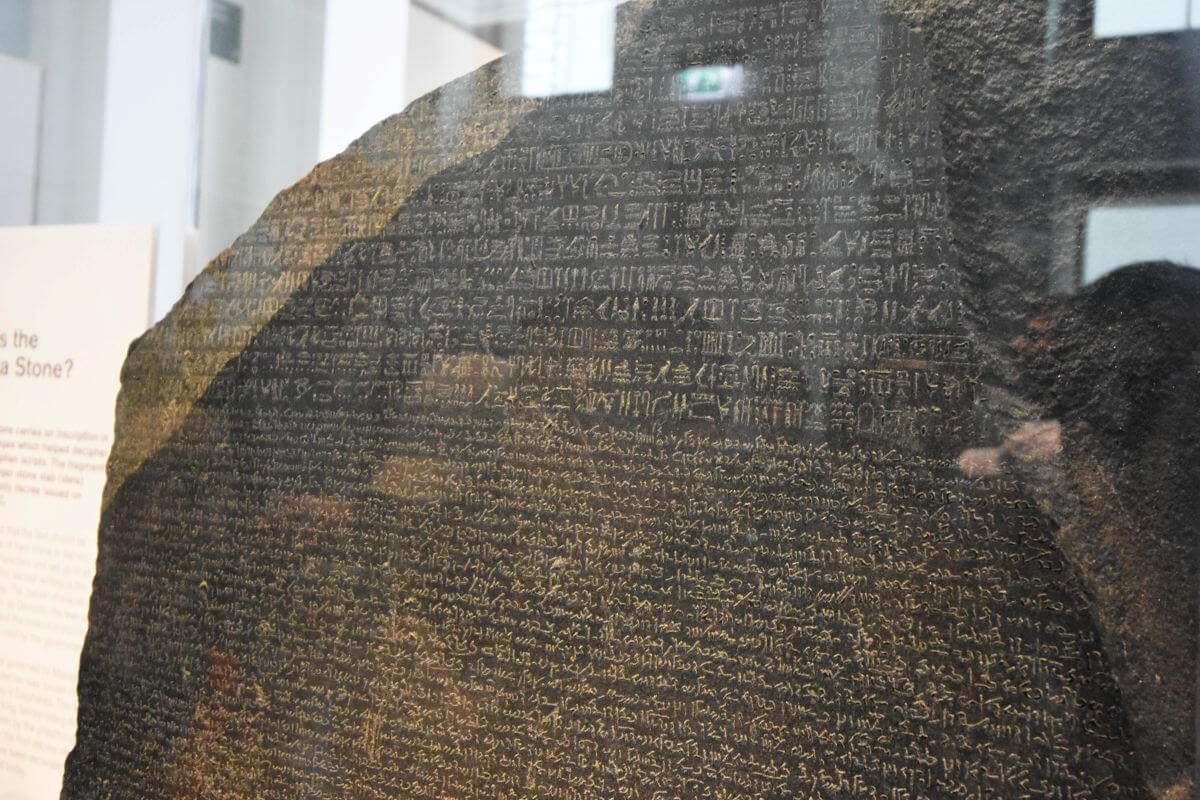
Did you know Egyptian hieroglyphs were first used around 3250 BC and they disappeared from everyday use after about 300 AD? For centuries, people could see strange signs carved into Egyptian temples and monuments but no longer understood their meaning. Early scholars struggled because many hieroglyphs look like pictures of animals, plants, and objects. They eventually discovered that these signs could also represent sounds, allowing hieroglyphs to record the ancient Egyptian language.
THE THREE-SCRIPT PUZZLE
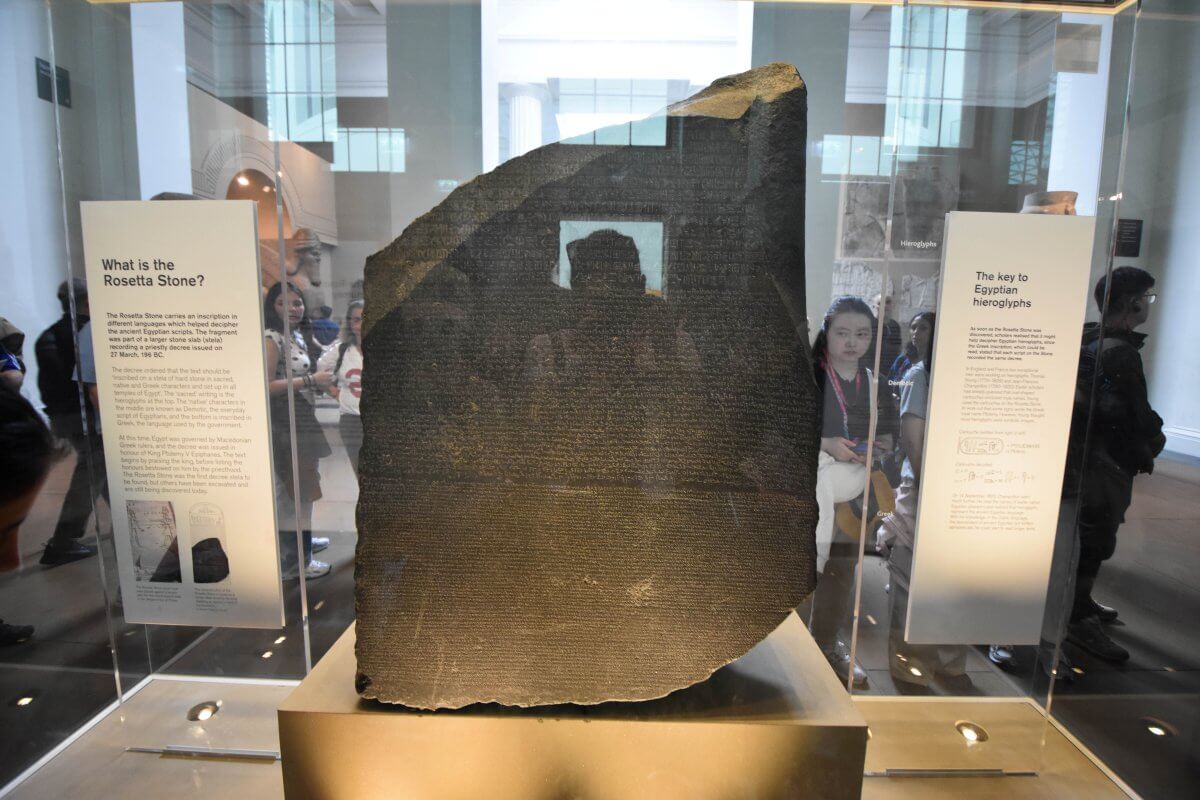
That is what makes the Rosetta Stone so important. Carved in 196 BC, this broken piece of a much larger stone slab is more than 2,200 years old. On-site information panels explain that the stone features a royal law. The decree marks the first anniversary of the coronation of the approximately 13-year-old King Ptolemy V. A council of priests created the text to support the young king’s royal court.
The stone became famous because the same decree appears in three scripts: Ancient Egyptian hieroglyphs, Demotic, and Ancient Greek. Because scholars could already read Greek, it provided the crucial comparison needed to understand the Egyptian writing.
DISCOVERY
In July 1799, French soldiers discovered the broken stone while digging the foundation for a fort in Rosetta town. After the British defeated Napoleon’s army, they took the Rosetta Stone under the 1801 Treaty of Alexandria. The British shipped it back to London, and it has been displayed here since 1802. The work of scholars eventually unlocked the scripts, and the result changed Egyptology forever. The Rosetta Stone became the key that allowed scholars to read ancient Egyptian text. It also provided direct access to massive evidence about the civilisation. That’s why the Rosetta Stone remains one of the must-see highlights at the British Museum, even if you only have a short time to visit. It may look like a damaged piece of rock at first, but its writing helped unlock an entire ancient world.
GOOD TO KNOW:
- WHERE TO FIND IT: Ancient Egypt, Room 4, Ground Floor.
- A QUIETER WAY TO SEE IT: Room 4 can become very busy around the original, with groups gathering around it to take photographs. If you want to study its three scripts properly, there is a clever alternative many people miss. Go to the Enlightenment Gallery in Room 1, where you’ll find a replica which you can also touch. We found this particularly useful because you can get much closer to the copy without fighting for space around the original. It is an easy addition if you want to understand what you are looking at rather than taking a photograph and moving on.
2. Bust of Ramesses II the Great
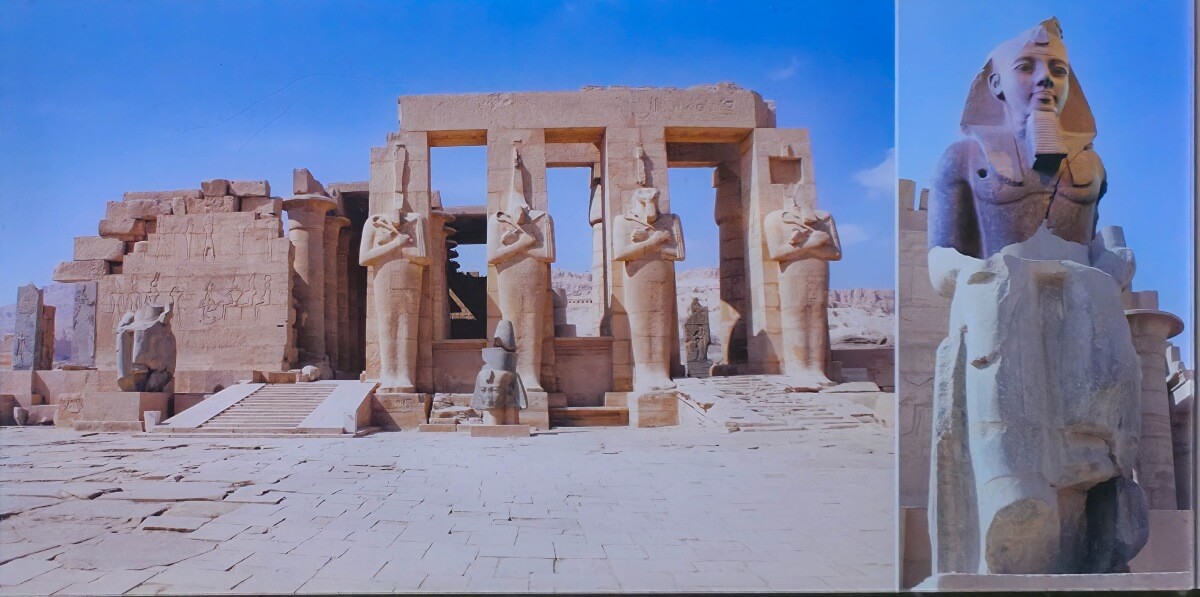
Now turn your attention to the enormous bust of Ramesses II, which is the largest Egyptian sculpture in the collection. Known as Ramesses the Great, he ruled during Egypt’s New Kingdom for about 66 years. He became one of its most powerful and long-lasting rulers. This powerful pharaoh led military campaigns and ordered enormous building projects and monuments that still dominate the Egyptian landscape.
On-site information panels note the surviving upper body originally formed part of a colossal seated statue at the Ramesseum. This was his memorial temple on the West Bank of the Nile at Thebes, in modern Luxor. The statue was carved from a single block of stone quarried at Aswan and then transported. The complete figure would have been around 7 m (23 ft) high and weighed approximately 20 tons. The bust you see today stands more than 2.5 m (8.2 ft) tall, stretches over 2 m wide, and weighs about 7 and a quarter tons.
OPTICAL ILLUSION
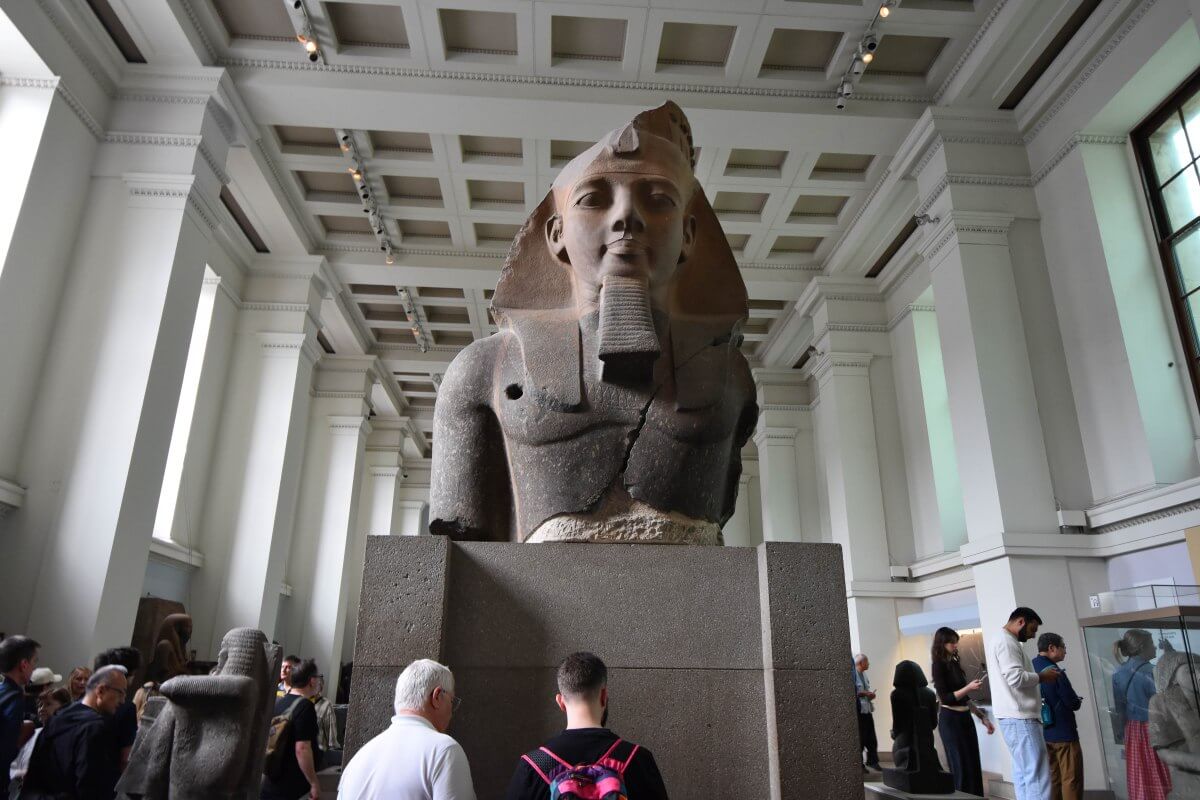
There is a clever detail you should look for. Stand in front of the statue and look up at the face. The eyes appear to look slightly downwards. This was intentional because the statue originally stood high above the entrance. From below, the pharaoh seemed to look directly down at those approaching him. This simple effect was also very powerful: the king was physically and visually above everyone else.
The museum’s official website notes the sculpture was carved from exceptionally hard stone. The builders used a single block of two-tone lighter pink granite and darker granodiorite. Traces of ancient paint remain, including red on the skin, blue and yellow on the headcloth, and black around the eyes.
BATTLE FOR ITS EXTRACTION
Its trip to London was almost as dramatic as the sculpture. Napoleon’s engineers attempted to move it in 1798 but failed. A large drilled hole in the right shoulder is physical evidence of that attempt. Years later, a former circus strongman, Giovanni Battista Belzoni, organised its removal and succeeded. An information panel explains that he used local labourers, a wooden sledge, and a boat to move it to the Nile. The huge sculpture travelled to Alexandria and then to London, arriving in 1818. When Europeans first saw it in London, the sculpture helped change European ideas about ancient art. The bust of Ramesses II changed the belief that the greatest monumental art came only from Greece. It also became one of the objects that helped change Western appreciation of Egyptian art.
GOOD TO KNOW:
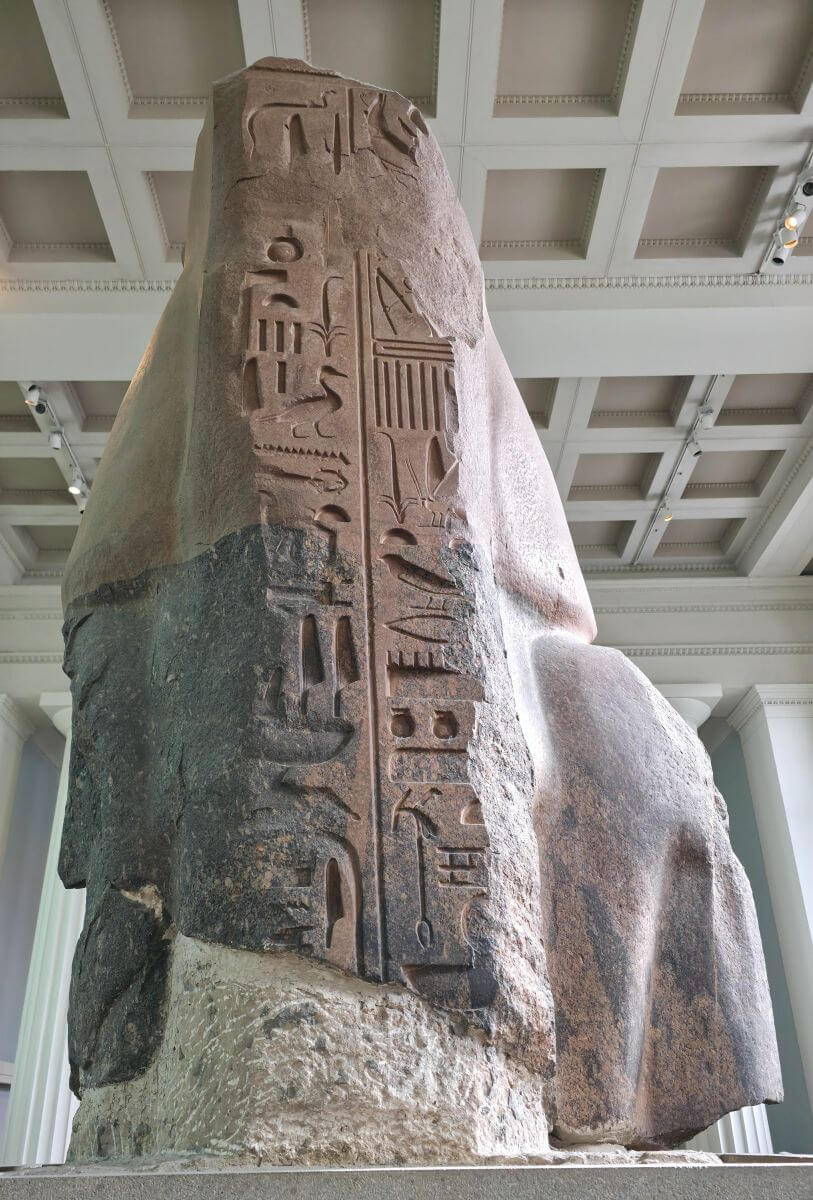
- Before moving on, walk behind the statue. You’ll find vertical bands of hieroglyphs carved into the back, including Ramesses’s name and titles. It’s an easy detail to miss when everyone is standing in front taking pictures.
- WHERE TO FIND IT: Ancient Egypt, Room 4, Ground Floor.
3. Hoa Hakananai’a
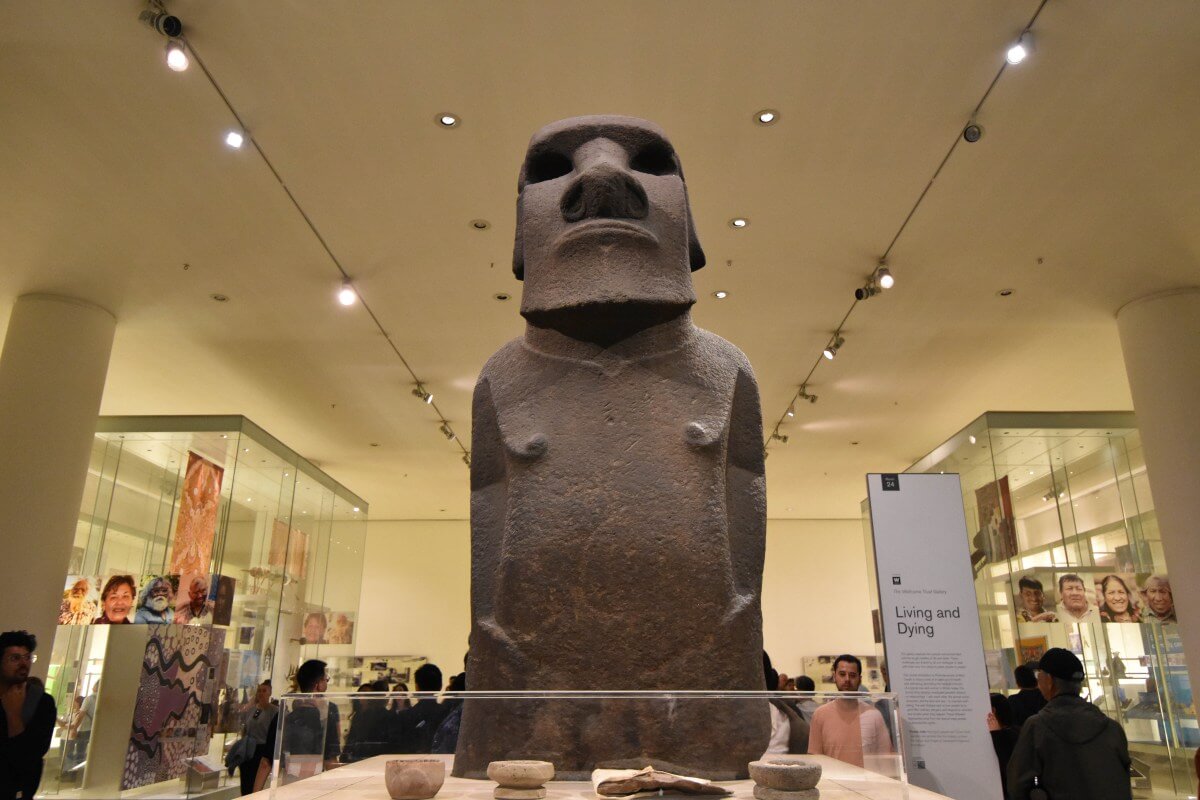
Our next highlight takes you far from Europe and into the Pacific. The Living and Dying gallery explores how communities around the world have understood life, death, ancestors, and spiritual power. Here you can find Hoa Hakananai’a, a distinctive stone figure (moai) from Easter Island (Rapa Nui). Its name translates as ‘lost, hidden or stolen friend’. When discovered by the British, it had been buried up to its shoulders inside a ceremonial house.
The Polynesian peoples of Rapa Nui carved Hoa Hakananai’a from basalt around 1000-1200 AD. That matters because most Rapa Nui moai were carved from softer volcanic tuff. This statue is one of only a small number made from basalt. This material is unusually hard, which helps to preserve its finely carved details. The statue is approximately 2.42 m (7.9 ft) high and weighs about 4.2 tonnes, excluding its base.
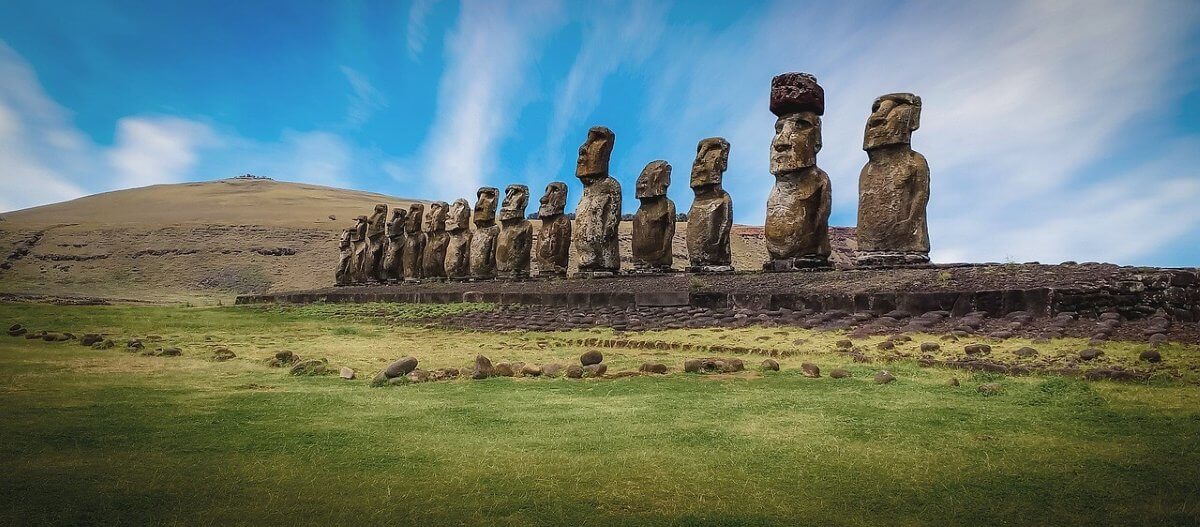
The museum describes moai as ancestral figures. Many were often placed on ceremonial platforms called ahu, facing inland towards the people and community. People associated these statues with the living presence of important ancestors. Hoa Hakananai’a is particularly fascinating because its later history is written across its back. This shows the statue’s history didn’t end when it was first carved.
THE DETAILS ARE EASY TO MISS
The face has another detail worth noticing. The deep eye sockets look empty today, but they originally held coral and red stone or shiny volcanic glass. The entire figure was also painted with red and white designs. Much of the colour disappeared when the statue was moved towards the ship in 1868. After arriving in England, the statue was offered to Queen Victoria, who donated it to the British Museum.
THE BEST DETAIL IS BEHIND YOU
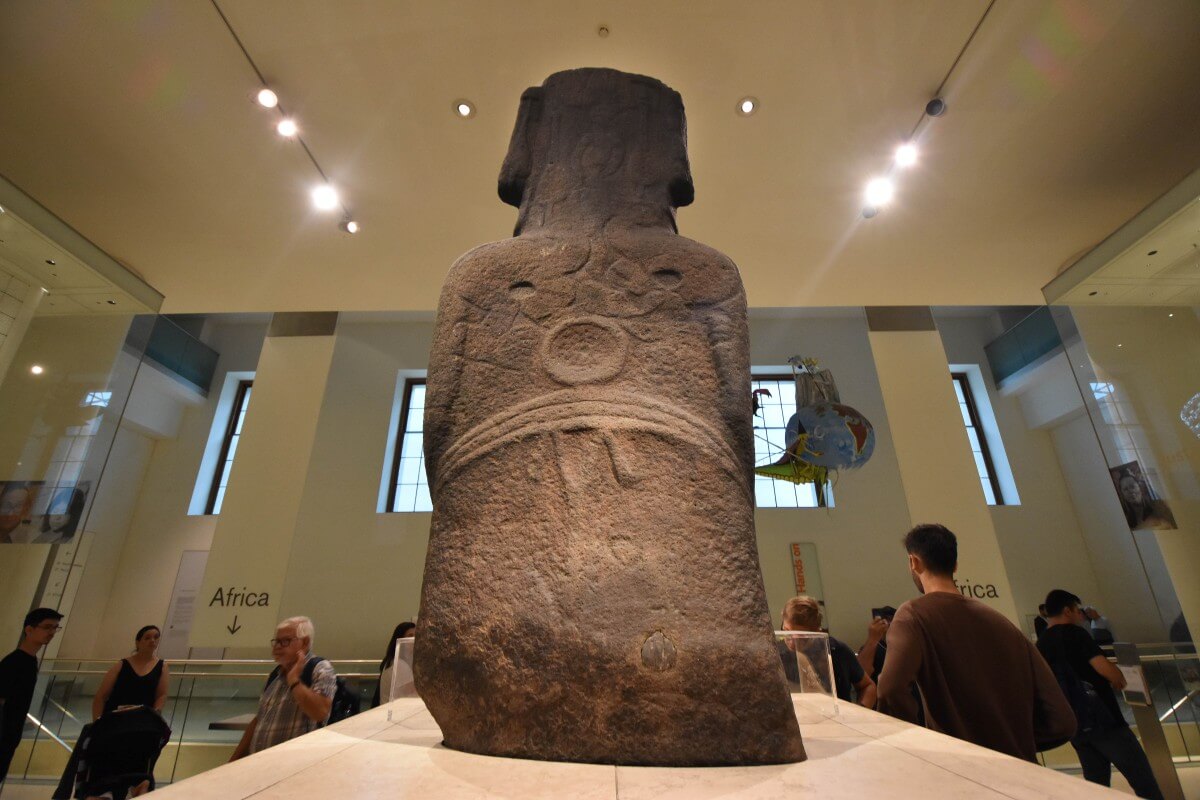
Walk around the statue and look at the carvings on its back. You’ll see frigate-bird heads and human-bird figures amongst other things. An on-site panel explains these relate to Birdman religion, which became important on Rapa Nui centuries after the statue was made. This makes Hoa Hakananai’a very unusual. The statue began as an ancestor figure, but its later history at Orongo became connected with a changing religious tradition. The museum explains that it was buried inside a ceremonial house at Orongo.
GOOD TO KNOW:
- The Hoa Hakananai’a statue remains one of the highest-profile repatriation demands the museum faces, alongside the Parthenon Sculptures and Benin Bronzes. In 2018, an official delegation from Rapa Nui travelled to London to plead for the return of their sacred statue. They even offered to carve an exact basalt replica. The islanders explained that the British people hold their soul, highlighting the emotional weight of this ongoing repatriation dispute.
- WHERE TO FIND IT: Africa, Oceania and the Americas, Room 24 – Living and Dying, Ground Floor.
4. Brass plaques from Benin
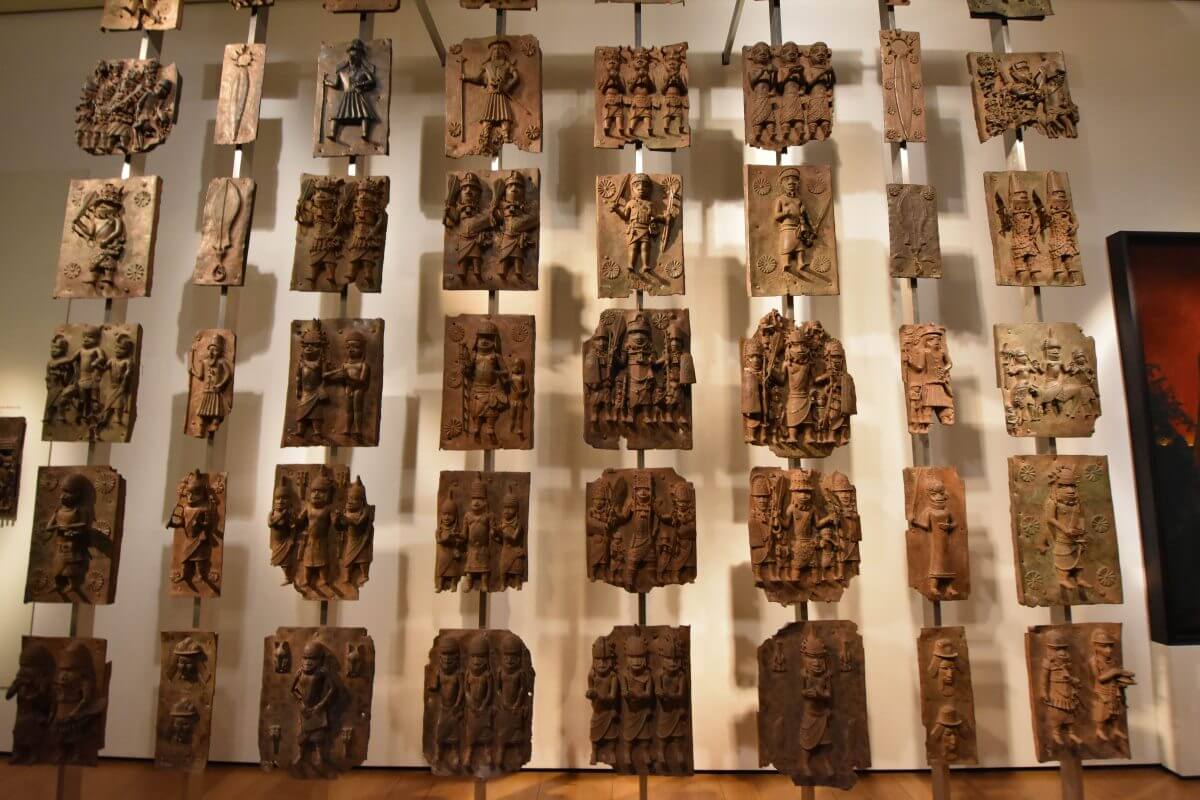
Now head downstairs to the Africa Galleries, where the displays reveal an extraordinary artistic and cultural diversity. The galleries cover religion, metalwork, textiles, masquerade, and some of the world’s oldest pottery-making traditions.
In Room 25, the Benin plaques deserve particular attention as celebrated British Museum highlights because they are some of the finest surviving examples of African art. They are commonly called the Benin Bronzes, but the famous plaques are actually made mainly of brass, including leaded brass. The museum’s website and on-site panels explain that they were created in the Kingdom of Benin, in what is now Nigeria. Highly skilled metalworkers working for the royal court of the Oba (the king) created them. Most of the plaques are roughly the size of an A3 sheet of paper and date from the 16th and 17th centuries. They were made to decorate the wooden pillars of the royal palace in Benin City.
LOOK AT THE DETAIL
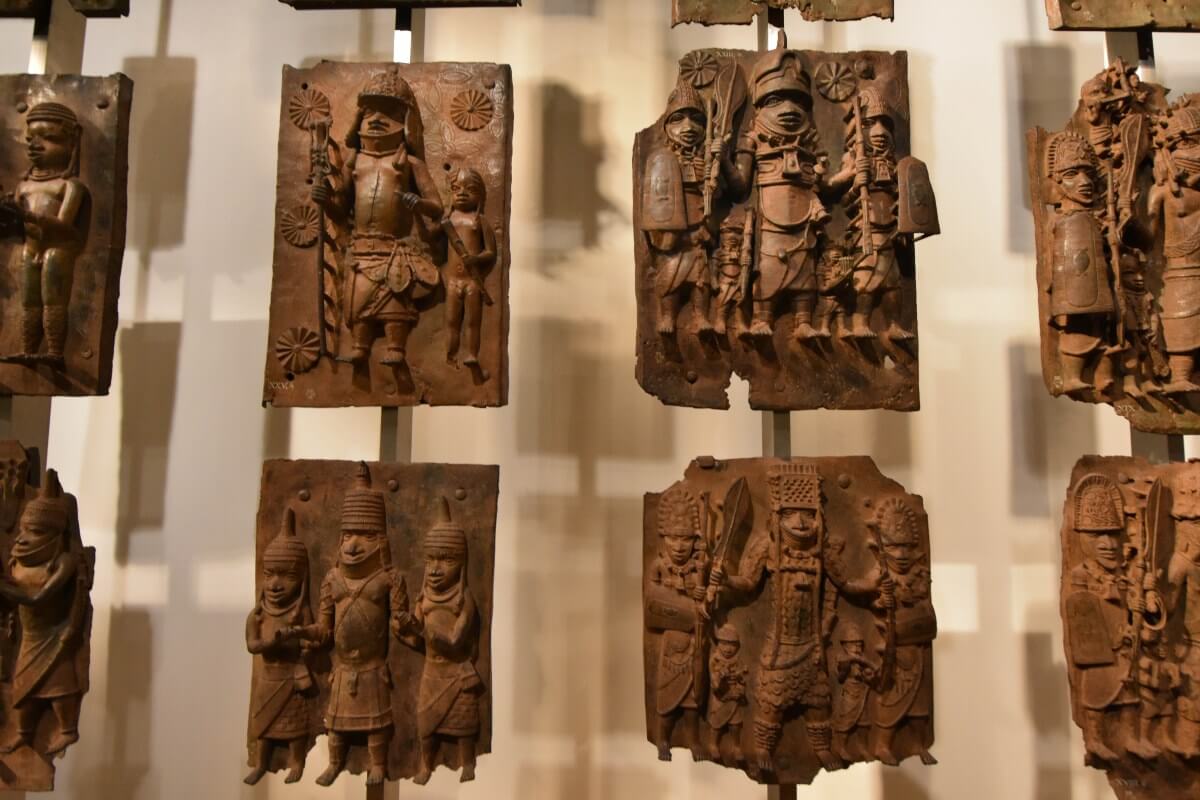
These are not flat pieces of metal. Edo metalworkers used sophisticated techniques to create highly detailed reliefs. The work is remarkably fine, and the relief gives some figures an almost sculptural quality. You can see rulers, warriors, and other figures wearing clothes with beautiful details and ornaments.
TWO DIFFERENT STORIES OF EUROPEAN CONTACT
On-site panels explain that they record royal life, court rituals, and military victories. Some also show Europeans and provide evidence of early contact between the Edo court and European traders. Their purpose wasn’t simply decorative. Together, they helped create a visual record of the kingdom and its royal court. But there is another layer to these famous objects.
In 1897, British forces attacked Benin City, occupied the capital and looted objects from the royal palace, shrines, and storerooms. They took thousands of treasures and later sold many. Today, the museum’s collection contains more than 900 objects from Benin (more than 100 shown in a changing display).
This means the plaques tell two very different stories of European contact. Their images preserve evidence of earlier peaceful trade and diplomacy between Benin and European visitors. Their journey to London, however, belongs to a different story of the violent conquest and looting of Benin City. The museum acknowledges this history and faces significant pressure regarding restitution. However, UK law restricts the museum from permanently returning objects.
GOOD TO KNOW:
- WHERE TO FIND THEM: Africa, Room 25, on the Lower Floor (-2).
5. Assyrian palace
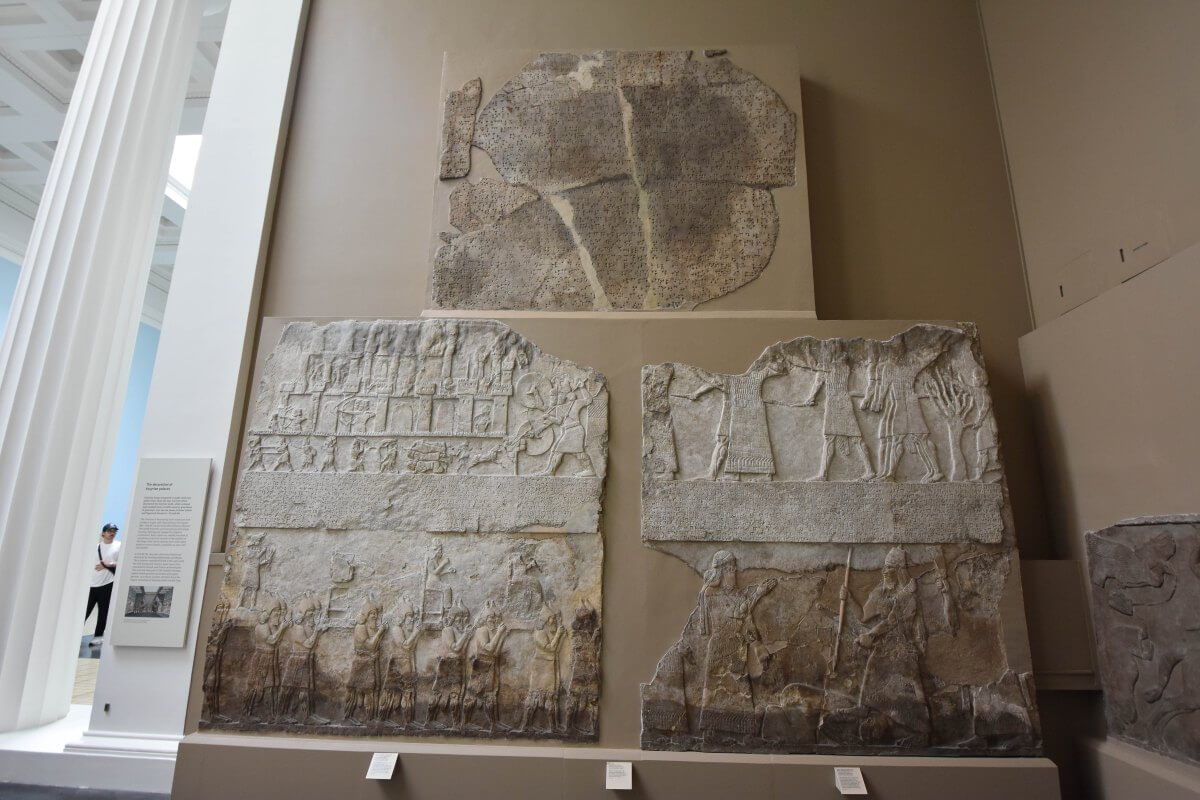
If you’re wondering what to see at the British Museum beyond the most obvious famous objects, make time for these Assyrian rooms. When you enter the palace of an Assyrian king, you are immediately surrounded by some of the most impressive ancient sculpture in London. The Assyrian Empire dominated much of the Middle East from around 900 to 600 BC. Sculptures in these rooms came from the royal capitals of the Assyrian Empire in Nimrud, Nineveh, and Khorsabad in northern Iraq. Its kings built massive palaces decorated with stone reliefs showing warfare, hunting, ceremonies, and royal achievements.
The British Museum holds the largest and most important collection of Assyrian antiquities outside Iraq. Its ground-floor Middle Eastern Galleries contain massive reliefs taken from royal palaces. Walking through them was one of our favourite parts of the museum because the scale makes the ancient world feel surprisingly close. You’re seeing surviving fragments of royal palaces from one of the most powerful empires of the ancient Middle East. That is exactly why these rooms belong among our British Museum highlights.
TIP – Follow this route through the Assyrian galleries.
If you want to see these rooms in a logical order, don’t simply walk through them as you find them. Start in Room 6, where the official map places the Assyrian sculpture and Balawat Gates. Afterwards, continue through Nimrud in Rooms 7-8, Nineveh in Room 9, and finish with Lion hunts in Room 10.
WHAT TO SEE:
Colossal Statue of a winged lion
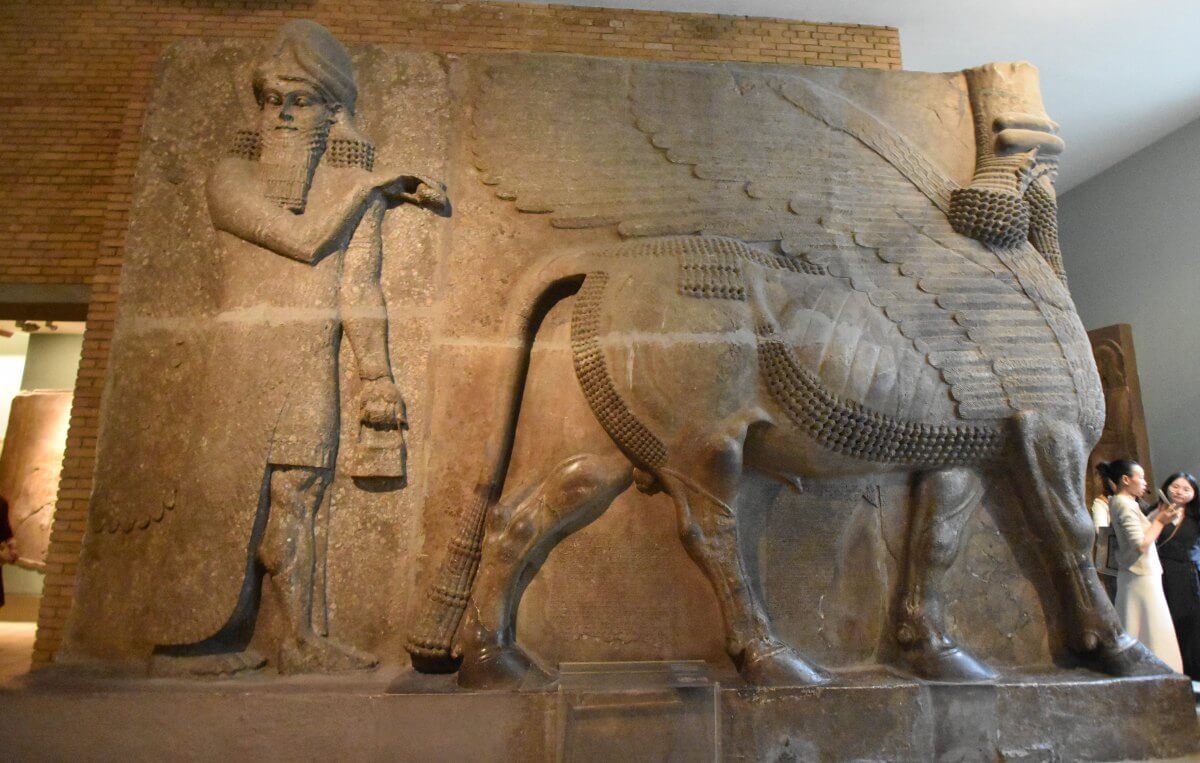
In Room 6a and 6b, look for the colossal human-headed winged lion. According to the museum’s website, this enormous guardian once stood at the entrance to Nimrud Palace’s throne room. King Ashurnasirpal II ruled from 883 to 850 BC, and his North-West Palace was decorated with monumental sculptures. When you look closely, you’ll realise that the guardian is approximately 3.5 m-high and more than 3.7 m-long, and combines several powerful forms. The figure has the body and strength of a lion, the wings of a bird, and a human head wearing a horned helmet. Assyrian rulers placed such supernatural guardians at palace entrances. They believed these protective beings guarded the palace from evil and destructive forces. An inscription between its legs records the titles, ancestry, and the king’s achievements.
WALK AROUND IT AND LOOK AT THE FEET
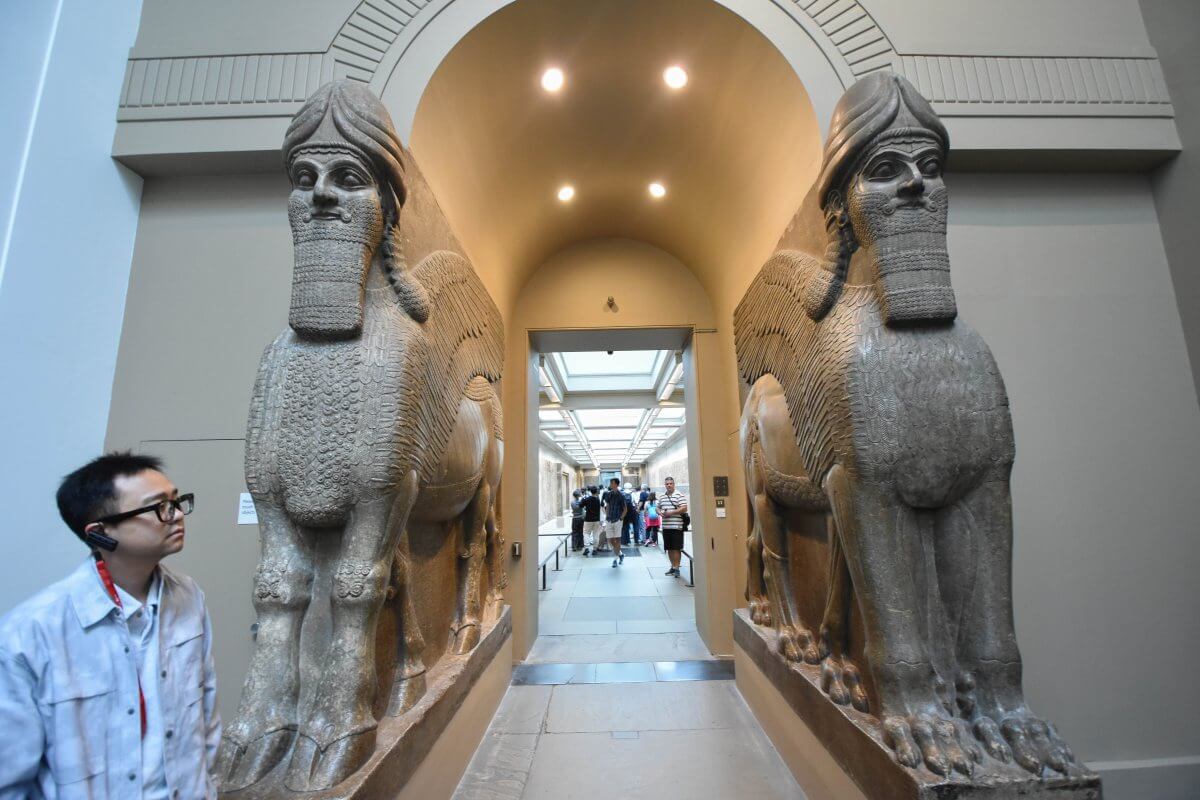
When you walk slowly from the front of a statue towards the side, you’ll notice something strange. If you stand directly in front of the sculpture, it looks like the lion is standing still. From the side, it looks as if it’s walking forward. The reason is the statue’s unusual five-legged design. The sculptor designed the statue to work from two viewpoints at once. This is one detail you won’t want to miss. You can easily walk past without realising why the figure has five legs.
Don’t rush past the Balawat Gates
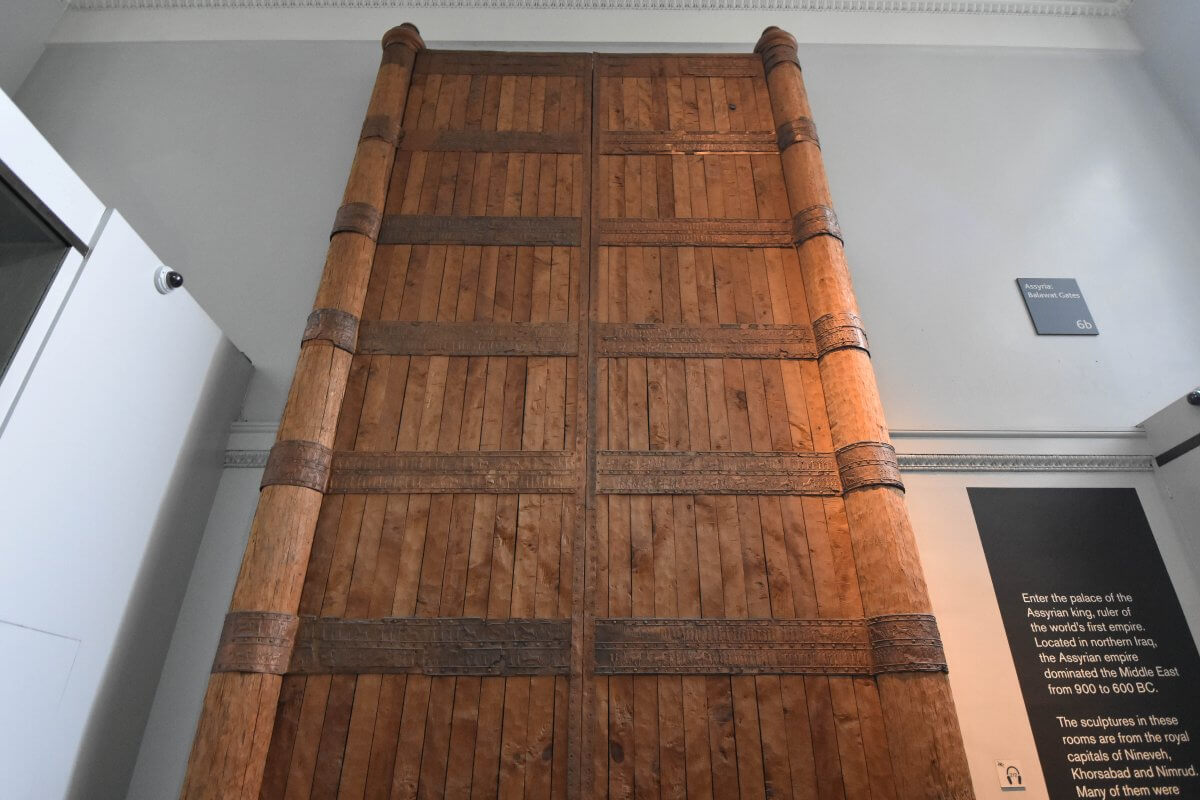
Room 6 has another fascinating feature. Nearby are fragments and a reconstruction of the Balawat Gates, associated with the reign of Shalmaneser III. On-site museum panels explain that the original cedarwood gates were almost 7 m (22.9 ft) tall. Bronze bands covered the wooden doors, and the decorated strips recorded military campaigns, conquered territories and land that paid tribute to Assyria. The reconstruction helps you understand what these gates looked like as architecture rather than separate bronze fragments.
Inside the palace at Nimrud
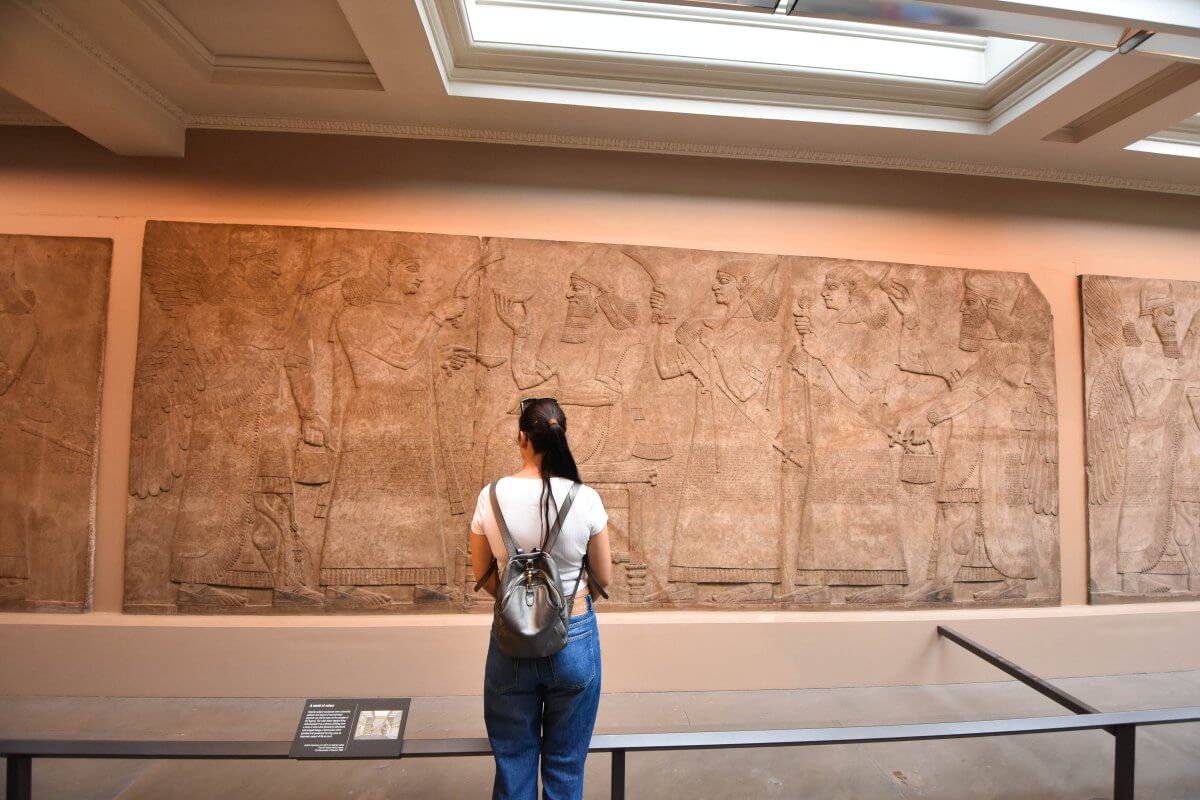
In Rooms 7 and 8, you are surrounded by carved stone panels. They once decorated the North-West Palace at Nimrud, which stood beside the River Tigris in what is now Iraq. The reliefs came from the throne room and other royal apartments. They show the king in different aspects of royal life. The king appears leading military campaigns, royal rituals, and hunting.
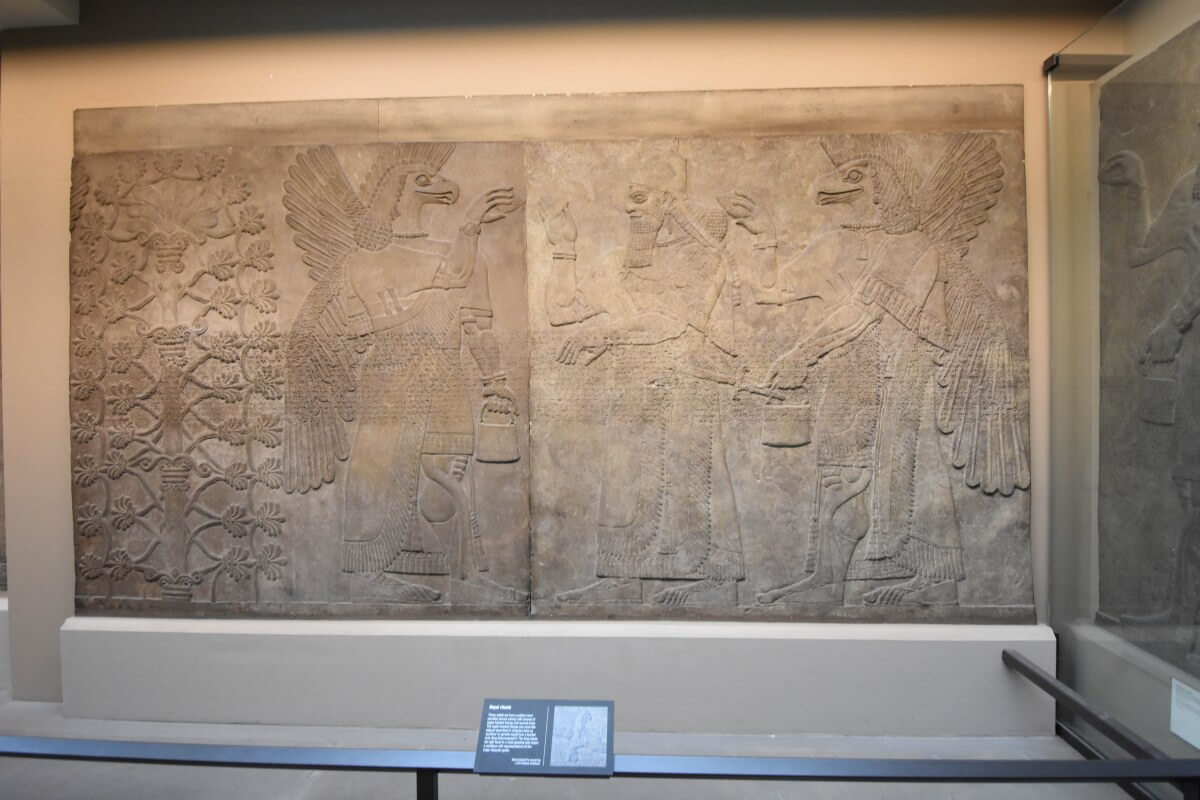
Look closely at the clothing, muscles, weapons, and hairstyles. The carved details are surprisingly precise, especially considering that these large panels are more than 2,800 years old.
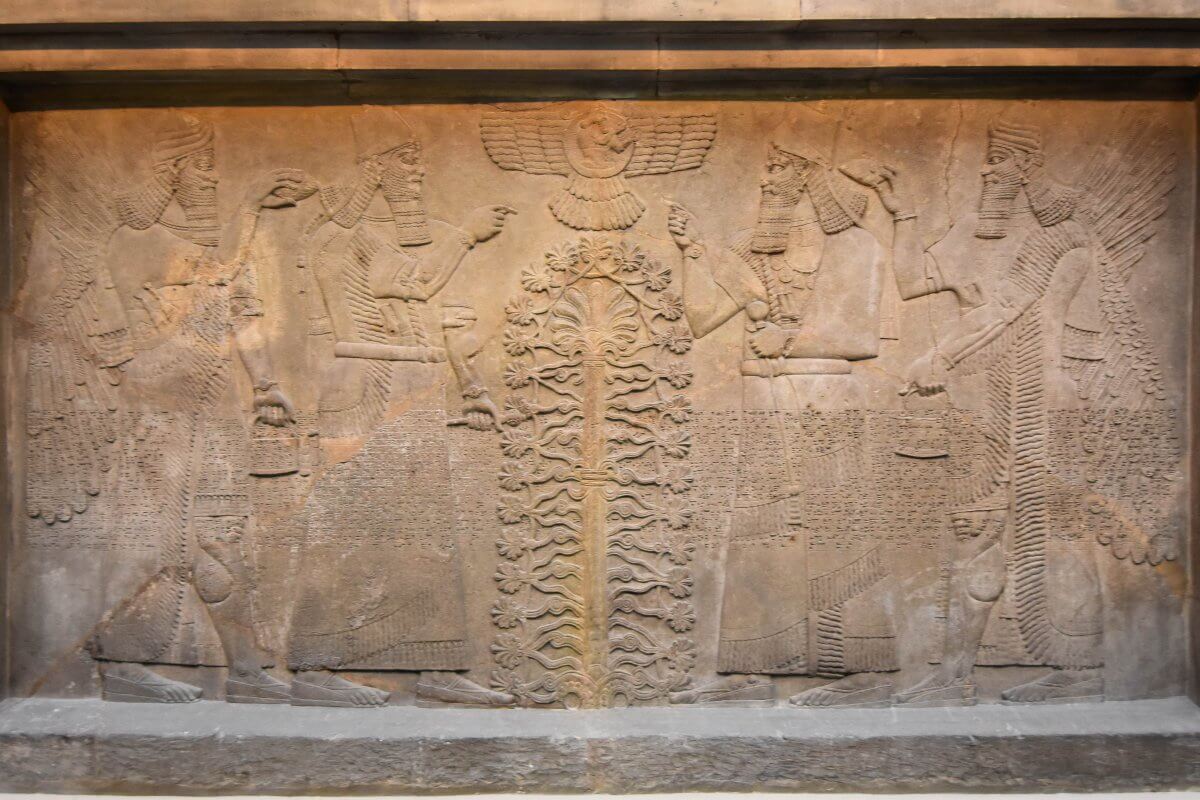
One of our favourite stone panels was the Sacred Tree imagery. The repeated design can look decorative at first, but it belongs to a much wider system of royal and religious symbolism. This famous Neo-Assyrian relief shows King Ashurnasirpal II appearing twice in symmetrical poses around a central Sacred Tree. The king is worshipping a god holding a ring of divine kingship inside a winged disc. On-site panels explain that this artwork had a powerful political and religious purpose. It sat directly behind the royal throne to visually reinforce the king’s God-given authority.
Nineveh and the building of a great capital
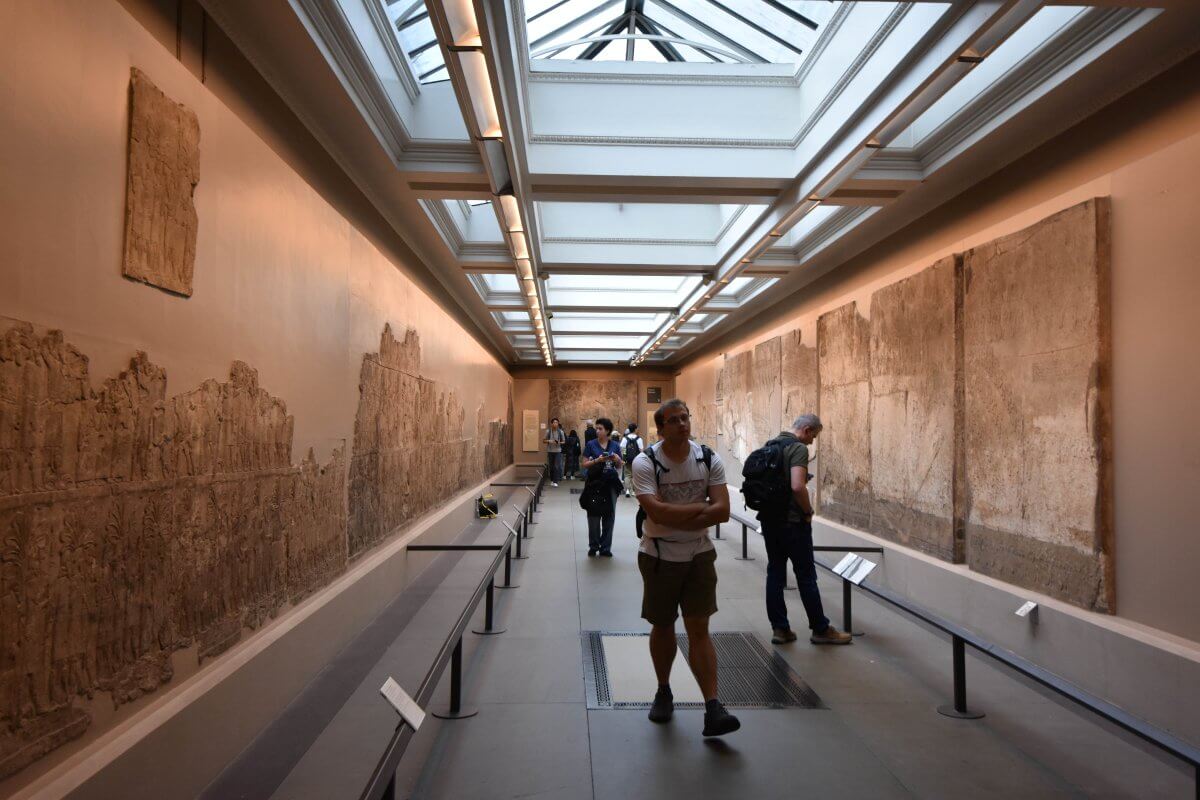
From Nimrud, continue to Room 9, which takes you to Nineveh, the powerful Assyrian capital in northern Iraq. This gallery contains carved panels from the South-West Palace of King Sennacherib, who ruled from 704 to 681 BC. The panels, which depict military campaigns and building projects, decorated the palace’s rooms and the courtyards. Some of them even illustrate ancient quarrying and transport techniques.
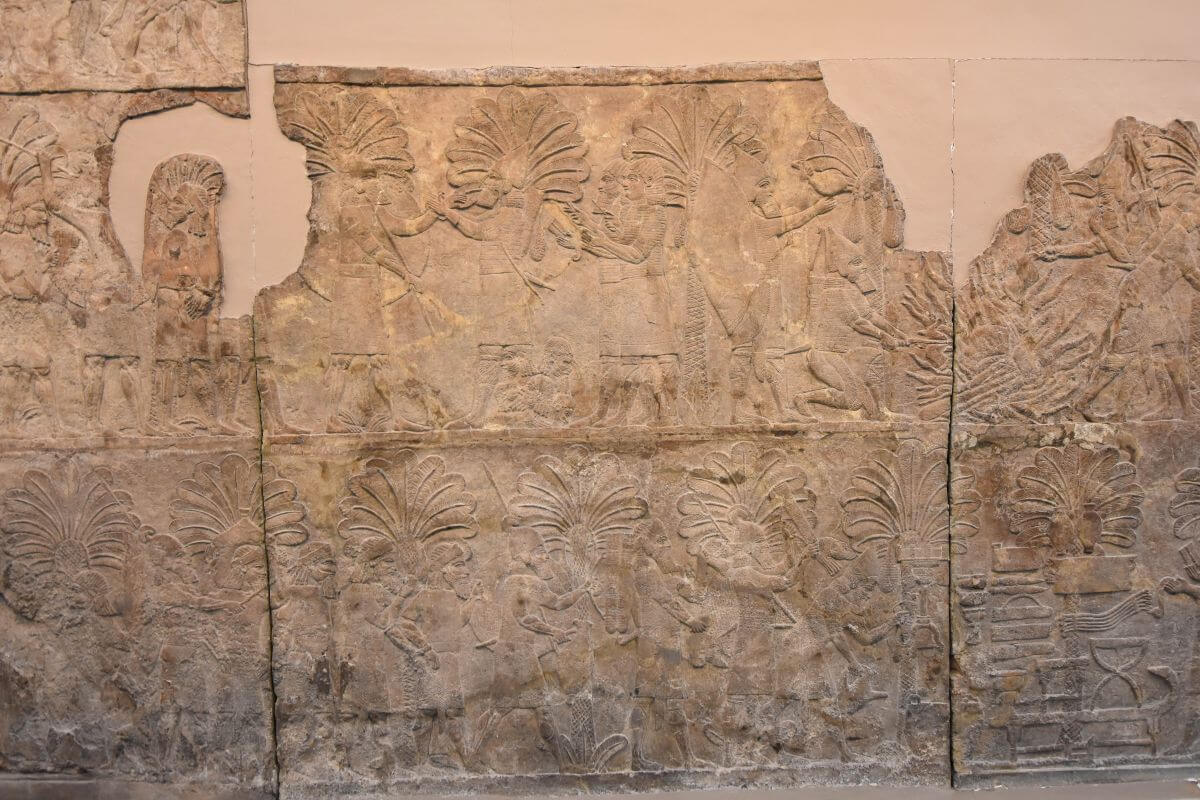
An image shows a wall panel dating from 640 BC – 620 BC.
6. Lion Hunt Reliefs
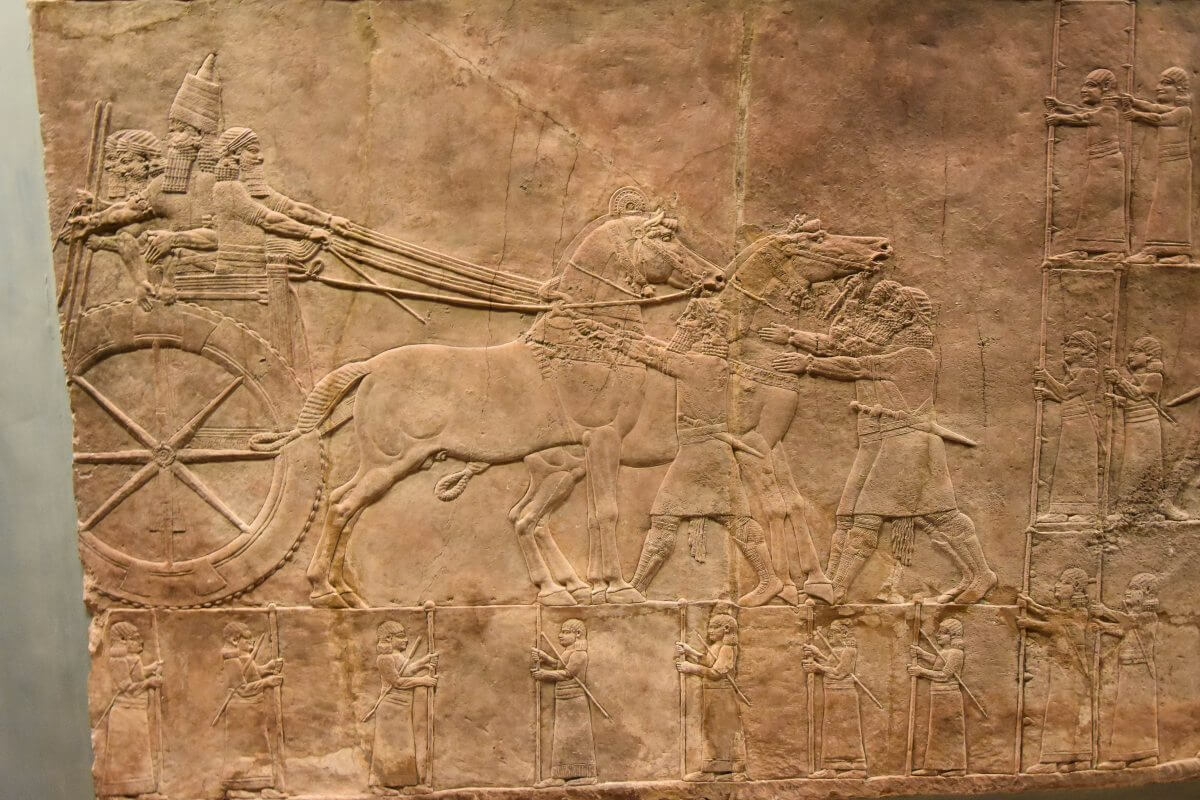
Make your way to Room 10a, then continue through 10b and 10c. Together, these three rooms cover about 50 years of Assyrian history. The reliefs cover royal hunting scenes, the siege of Lachish, and the palace of Sargon II at Khorsabad. This stone relief shows a king in his royal chariot preparing for a ceremonial lion hunt.
THE HUNT WAS MORE THAN SPORT
The Lion Hunt reliefs are among the most impressive highlights at the British Museum because they are masterpieces of Assyrian art. The panels combine art, power, and storytelling. Lion hunting was a royal sport and a symbol of the king’s duty to protect his people. These were staged spectacles, comparable to Roman arena games. Soldiers released lions from cages and formed a barrier while the king hunted the animals from his chariot. This controlled drama helped present the ruler as powerful, and his victory became a public performance of royal power.
TIP:
Look closely at the dying lions. One twists backwards after being hit by arrows, while another collapses but still seems full of movement. The sculptors captured the animals with such precision that you can almost follow the hunt frame by frame.
THREE ROOMS, THREE STORIES:
- Room 10a – Lion Hunts. In this room you’ll find the famous hunting scenes. Follow the hunt from the release of the lions to the chase and their killing. Look for the king and his chariot and the soldiers forming a protective ring around the action.
- Room 10b – Siege of Lachish. The story on these panels changes from royal sport to warfare. Reliefs show the Assyrian capture of Lachish in 701 BC, including fighting, weapons, and the defeated city.
- Room 10c – Khorsabad. Finish at Sargon’s palace, where two impressive human-headed winged bulls once guarded the entrance. Don’t miss the carvings of the king, crown prince, courtiers, and hunting scenes.
7. Parthenon Sculptures
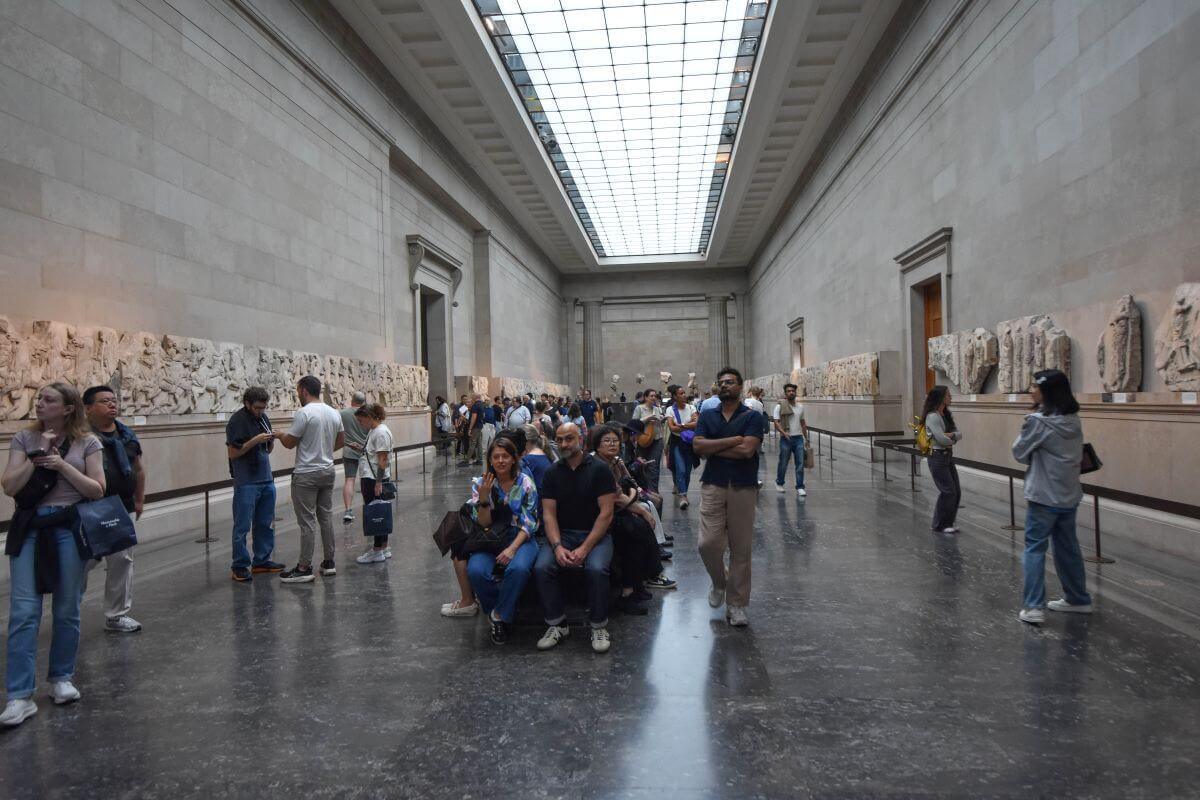
Room 18 contains marble sculptures from one of the most famous buildings of the ancient world. The Parthenon Sculptures came from the temple of Athena on the Acropolis in Athens and date from 447-432 BC. They are among the most important surviving examples of the sculpture that once decorated this enormous temple.
You may know these objects as the ‘Elgin Marbles’, but the museum calls them the Parthenon Sculptures. They aren’t one single artwork. The collection includes 75 m (246 ft) of the temple’s original frieze, 15 metopes, and 17 pedimental sculptures. Only about half the Parthenon’s original sculptural decoration survives, with the surviving pieces divided mainly between London and Athens.
LOOK CLOSELY AT THE CARVING
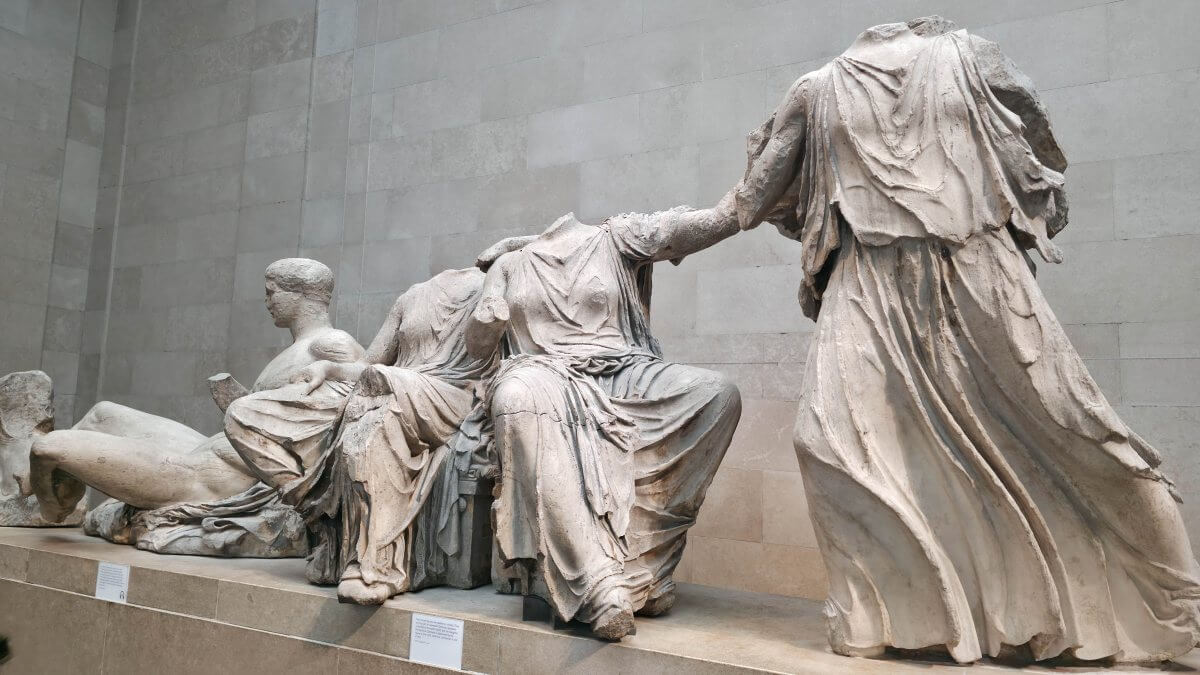
What makes the Parthenon Sculptures famous is not simply their age. Look at the horses, human bodies, and folds of clothing. The sculptors created the impression of movement, weight and flowing fabric from solid marble. These details are easy to miss if you only walk through the room looking at the sculptures as one enormous group.
WHY ARE THEY IN LONDON?
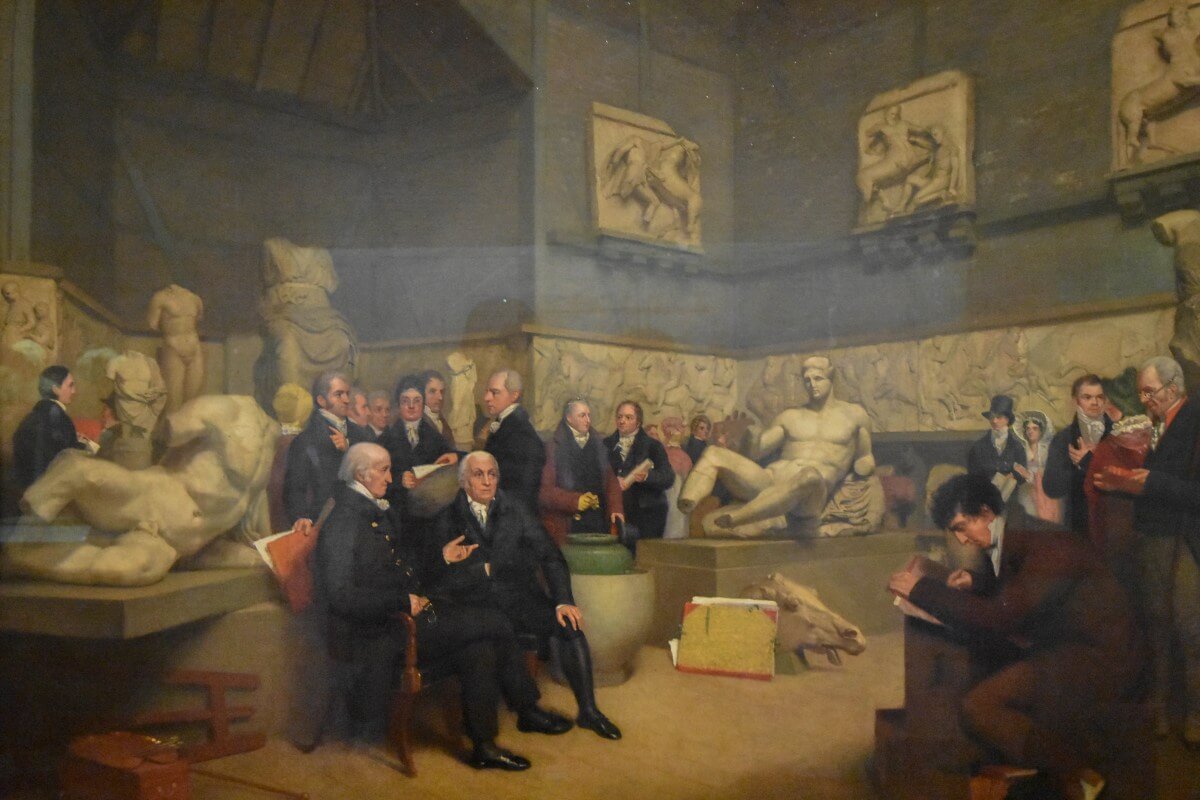
The story of how the sculptures reached Britain remains controversial. Between 1801 and 1805, Lord Elgin, the British ambassador to the Ottoman Empire, removed half of the surviving sculptures after obtaining permission from Ottoman authorities. They have been publicly displayed in London since 1817, after an Act of Parliament brought them into the museum’s collection. The question of where they should ultimately be housed has continued for generations.
GOOD TO KNOW:
- WHERE TO FIND THEM: Greece, Parthenon, Room 18, Ground Floor.
- Give Room 18 more than a quick photograph. Walk along the frieze, then stop at the larger figures and study the details. If you have visited the Acropolis, seeing these sculptures in London adds another perspective on the Parthenon.
8. Aztec Serpent
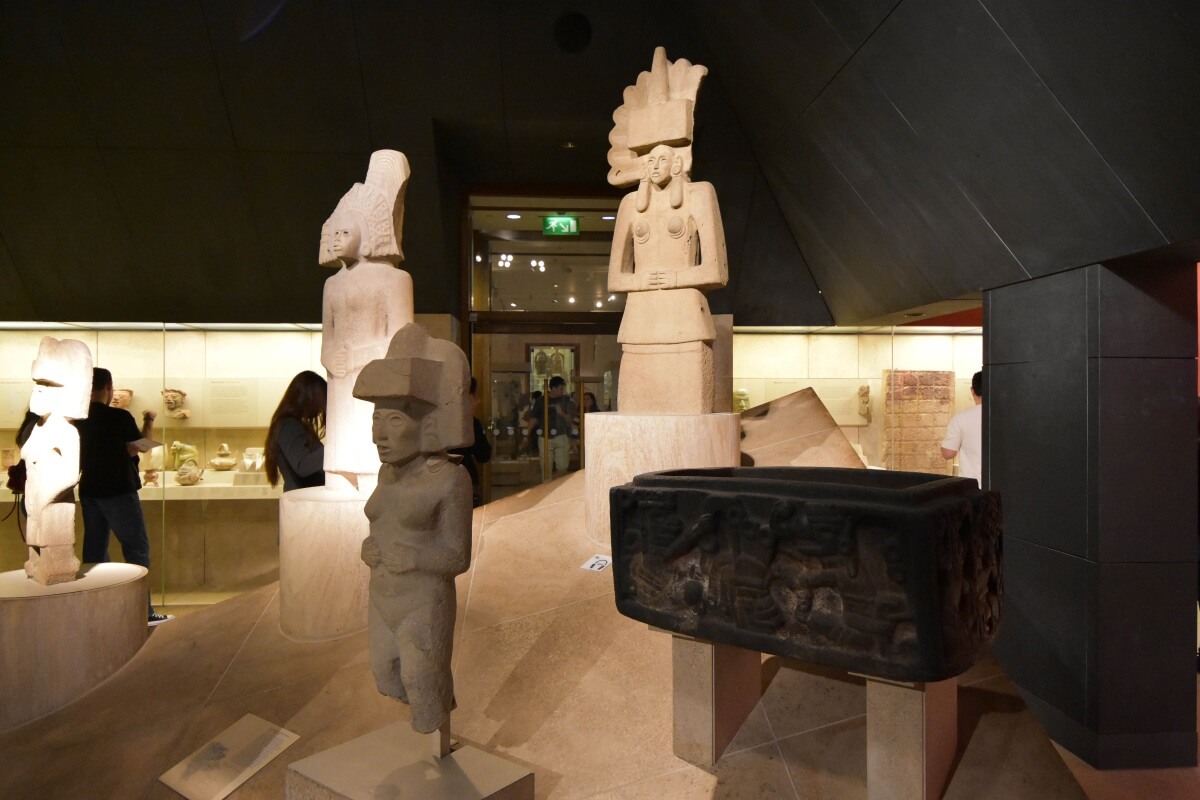
Did you know some of the most eye-catching objects are hidden in a gallery many visitors rush through? Room 27 on the Ground Floor (Level 0) takes you into Mexico. Here, you’ll find objects from cultures including the Olmec, Maya, and Aztec. Among the ceramics, jade figures, and statues, one object immediately stands out: an Aztec Serpent.
LOOK CLOSELY AT THE SERPENT
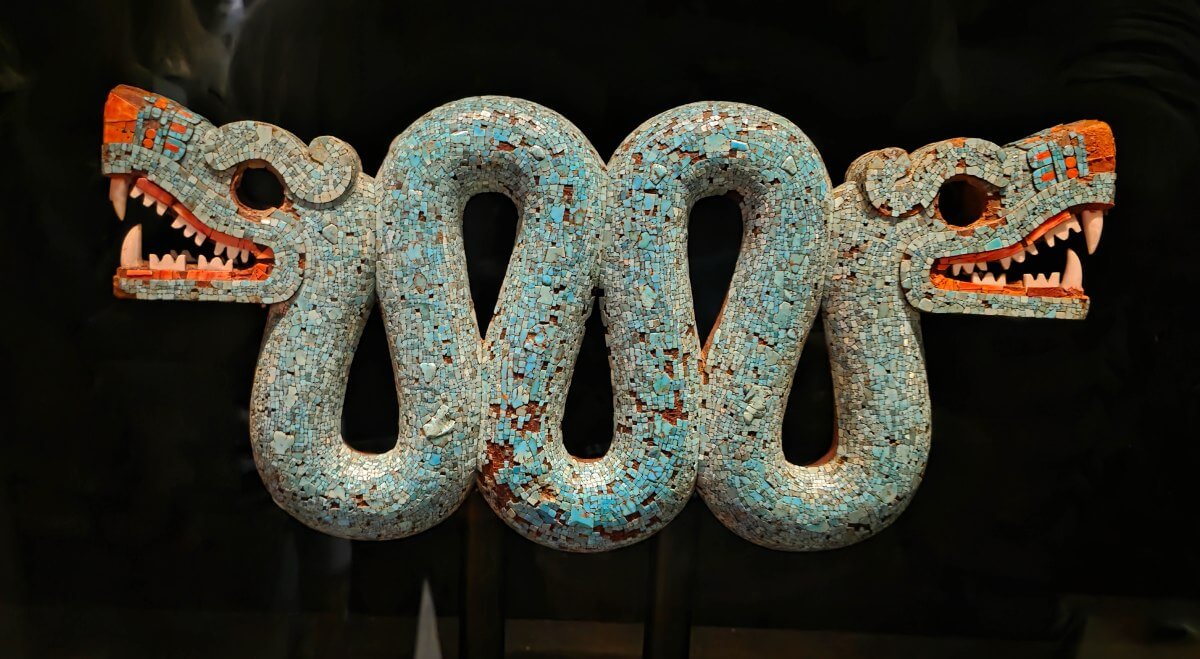
The extraordinary double-headed serpent is one of the most striking objects in the Mexico gallery. It’s a masterwork of Aztec-Mixtec turquoise mosaic sculpture that survived the Spanish conquest. Its wooden body is covered with approximately 2,000 tiny pieces of turquoise, along with shells and other materials. The on-site panel notes that it dates back to the 15th to 16th centuries AD. The object was probably worn as a ceremonial chest ornament.
Serpents had an important place in the Aztec, Olmec, and Maya world. They were associated with several important gods, especially Quetzalcoatl, the Feathered Serpent. Turquoise carried important value for the Aztecs. Objects covered in this precious stone were used as a powerful display of wealth and status. The Aztec serpent also belongs to a remarkable period of first contact between Mesoamerica and Europe. Some early records show that the Aztec ruler Moctezuma II and the Spanish explorer Hernán Cortés exchanged turquoise gifts in 1519. However, we cannot prove that this exact double-headed serpent was one of those gifts before the fall of Tenochtitlan.
GOOD TO KNOW:
- WHERE TO FIND IT: Americas, Room 27 (Mexico), Ground Floor (Level 0)
9. Turquoise mosaic mask
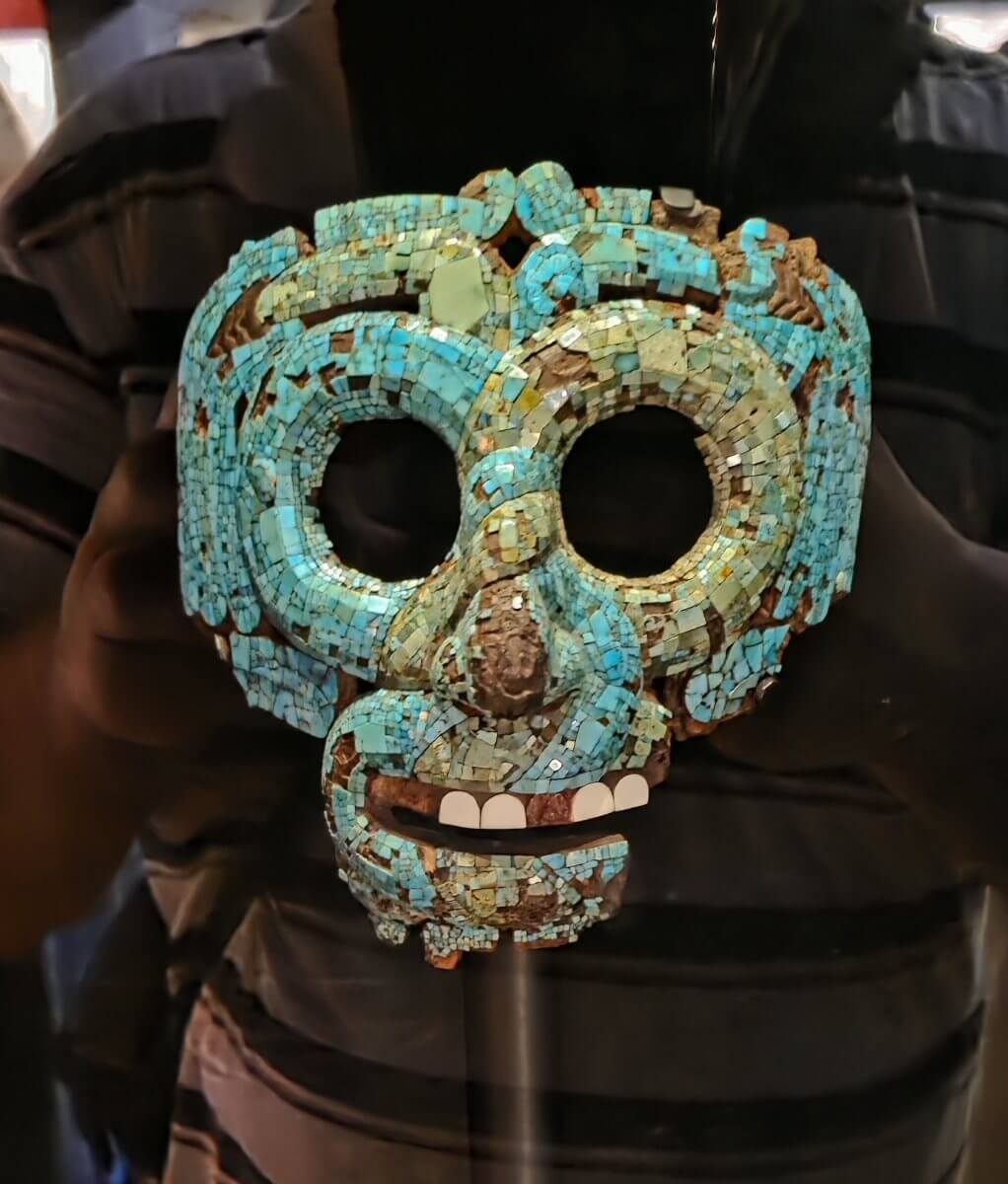
Now look for the smaller Aztec/Mixtec turquoise mosaic mask nearby. Two serpents twist around the face, cross over the eyes and meet around the nose. One serpent is blue and the other green. The teeth are made from shell. An on-site display explains that this turquoise mosaic mask is made from cedar wood and dates from between the 15th and 16th centuries. It’s associated with two Aztec deities: the Rain God Tlaloc and the Creator God Quetzalcoatl.
A 16th-century account by the Spanish friar Bernardino de Sahagún describes a similar turquoise mask as a gift from Motecuhzoma II to Cortés and connects it with Quetzalcoatl. According to this source, Cortés was thought to be the returning Feathered Serpent. This became part of the famous story surrounding the Spanish conquest. However, historians cannot prove or deny that his exact mask was the one described.
GOOD TO KNOW:
- WHERE TO FIND IT: Americas, Room 27 (Mexico), Ground Floor (Level 0)
10. Pair of Gold Armlets from the Oxus Treasure
Leave Mexico behind and head upstairs to Ancient Iran. In Room 52, you’ll find the Oxus Treasure, one of the largest surviving collections of Achaemenid gold and silver objects. It includes jewellery, coins, model chariots, and other items, found near the Oxus River, close to the modern border between Tajikistan and Afghanistan. Most date to the Achaemenid Persian period, around the 5th and 3rd centuries BC.
The collection includes around 180 surviving pieces, making it an unusually important survival from the ancient Persian world. It gives a rare glimpse into the wealth and craftsmanship of ancient Iran. That’s why the Oxus Treasure belongs on our list of the British Museum highlights.
PAIR OF GOLD ARMLETS
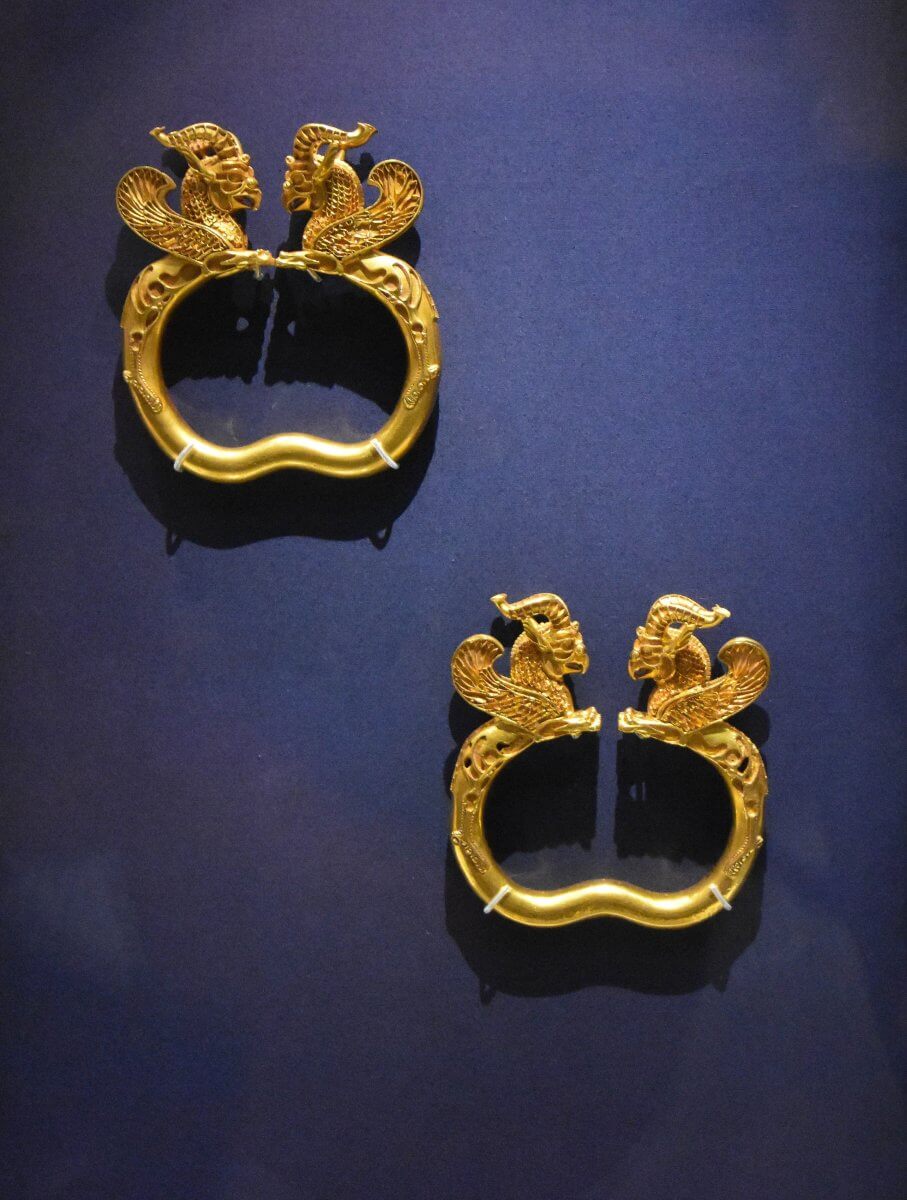
The pair of gold armlets is the one you shouldn’t miss. The museum’s site panels explain they date back to the 5th or 4th centuries BC. Both armlets are among the most important surviving items of Iranian craftsmanship. Their design looks almost like something from a mythical creature. At each end are griffin-like creatures, with heads, horns, and feathered wings. Originally, they would have looked very different. Look closely, and you can still see the empty spaces where the colourful stones once sat. The craftsmanship is tiny but extremely precise, which is why these armlets are such important examples of ancient Iranian metalwork.
The interesting question is whether these were originally bracelets, designed for everyday wear. The shape and the decoration suggest they may have been intended for display or ceremonial use rather than practical jewellery. Similar armlets appear in the famous reliefs at Persepolis, where a Lydian delegation presents them as gifts to the Persian king. That comparison suggests these objects could also represent wealth, status, and the power of the Persian court.
GOOD TO KNOW:
- WHERE TO FIND IT: Ancient Iran, Room 52, Upper Floor (Level 3)
11. Sutton Hoo Helmet
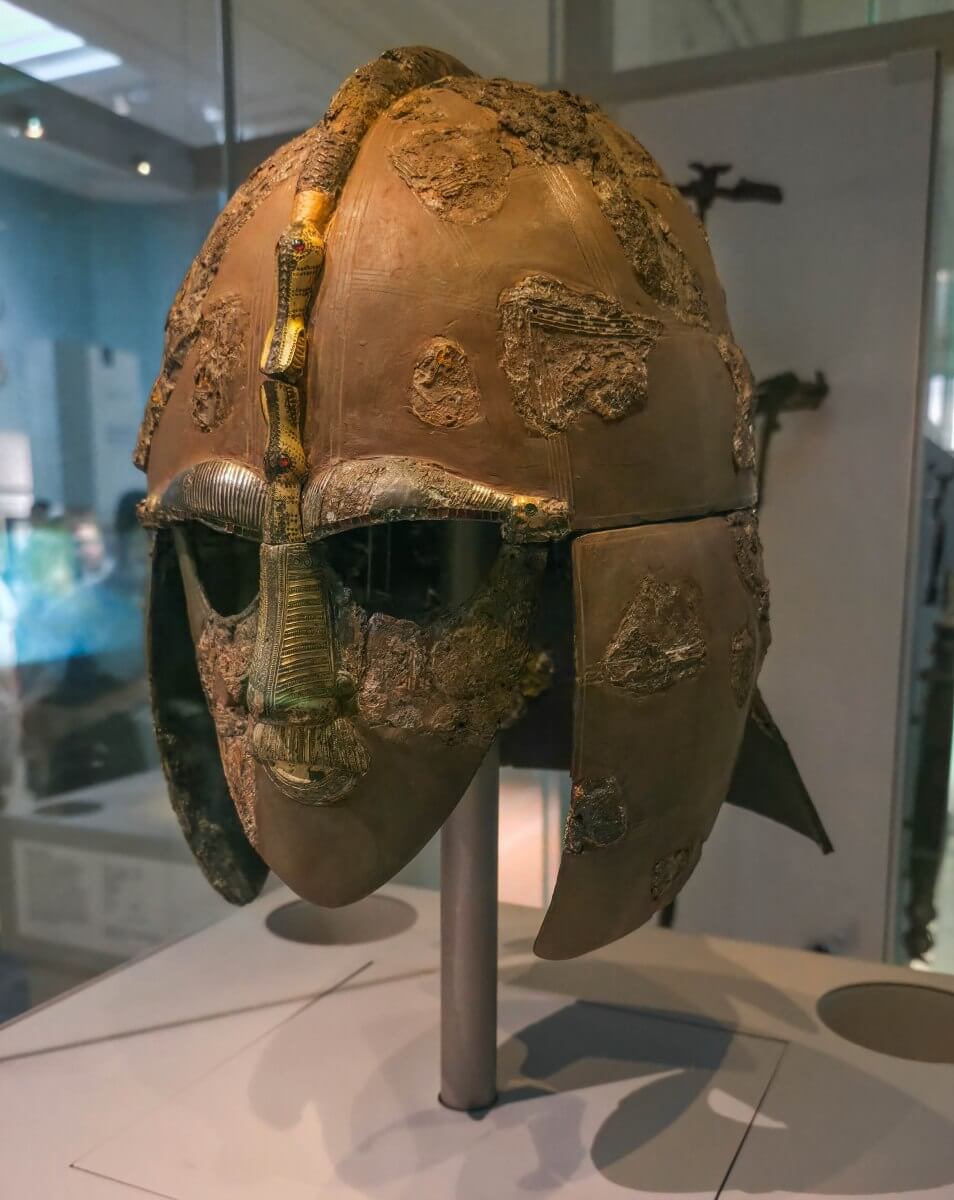
In the Room Sutton Hoo and Europe 300-1100 AD, you’ll find one of the most recognisable objects in early medieval archaeology. The Sutton Hoo helmet may look like a dark, damaged piece of iron at first, but it has become one of the defining images of early medieval Britain.
According to the on-site panels, it’s one of only four complete helmets known from Anglo-Saxon England. This makes it an exceptionally rare survivor of the entire Anglo-Saxon era and one of the must-see highlights at the British Museum. The helmet, made mainly from iron, dates from the late 6th or early 7th century. The face is particularly clever. The helmet’s mouth, nose, and eyebrows combined create the appearance of a flying animal. It was found in hundreds of fragments during the famous 1939 excavation of the Sutton Hoo ship burial in Suffolk. The burial itself dates to the early 600s AD. It contained an extraordinary collection of weapons, jewellery, silverware, and other objects. These point to the wealth and international connections of the person buried there.
GOOD TO KNOW:
- The helmet you can see in the picture is a painstaking reconstruction completed in 1971. Don’t miss a replica beside the original. It makes the lost colour and decoration much easier to understand. Also, it shows more clearly how spectacular the helmet would have looked when new.
- WHERE TO FIND IT: Sutton Hoo and Europe, Room 41, Upper Floor (Level 3).
12. Egyptian Mummies
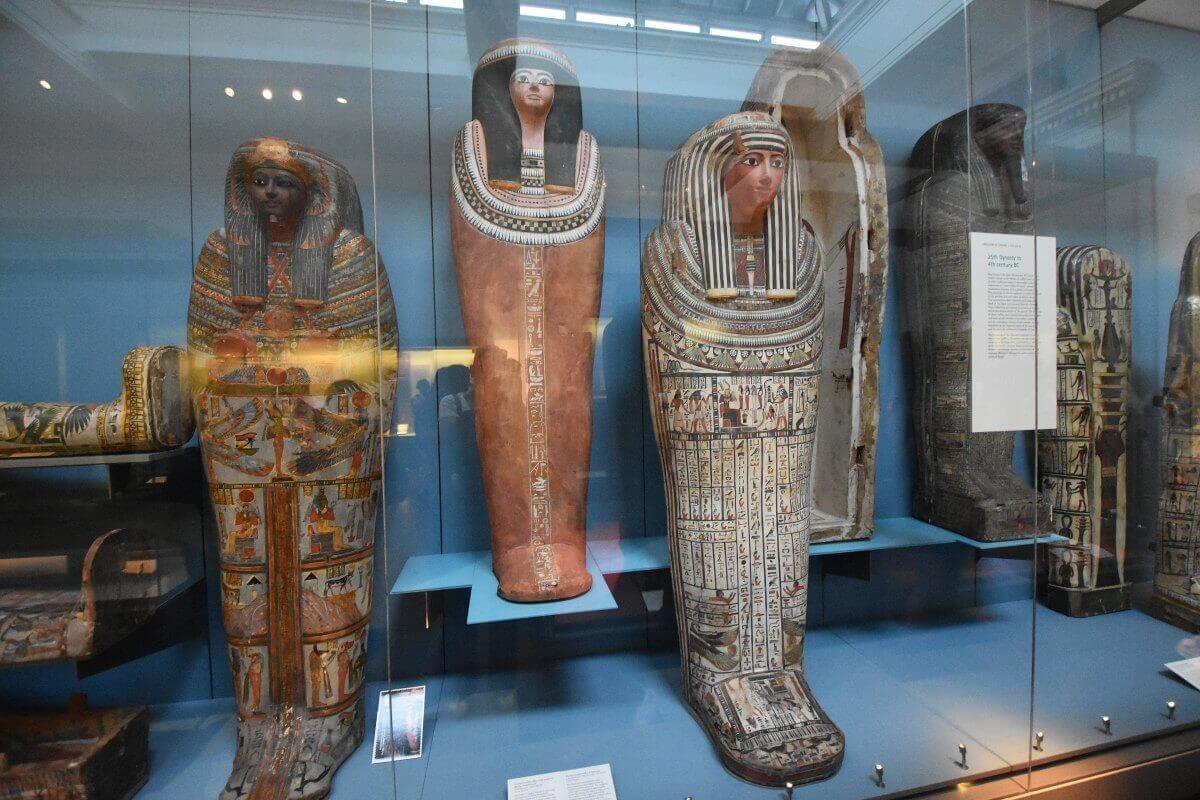
Continue to Rooms 62 and 63, which house the museum’s famous Egyptian mummy collections. These galleries explore one of the most important parts of ancient Egyptian life: death and the journey into the afterlife. It’s easy to underestimate these rooms, but we actually found them quite overwhelming. There are so many coffins, mummies, and funerary objects that it can be tempting to walk through quickly. However, you’ll get a much more rewarding experience if you slow down, pick just a few objects and focus on their details.
The inner coffin of Henutmehyt
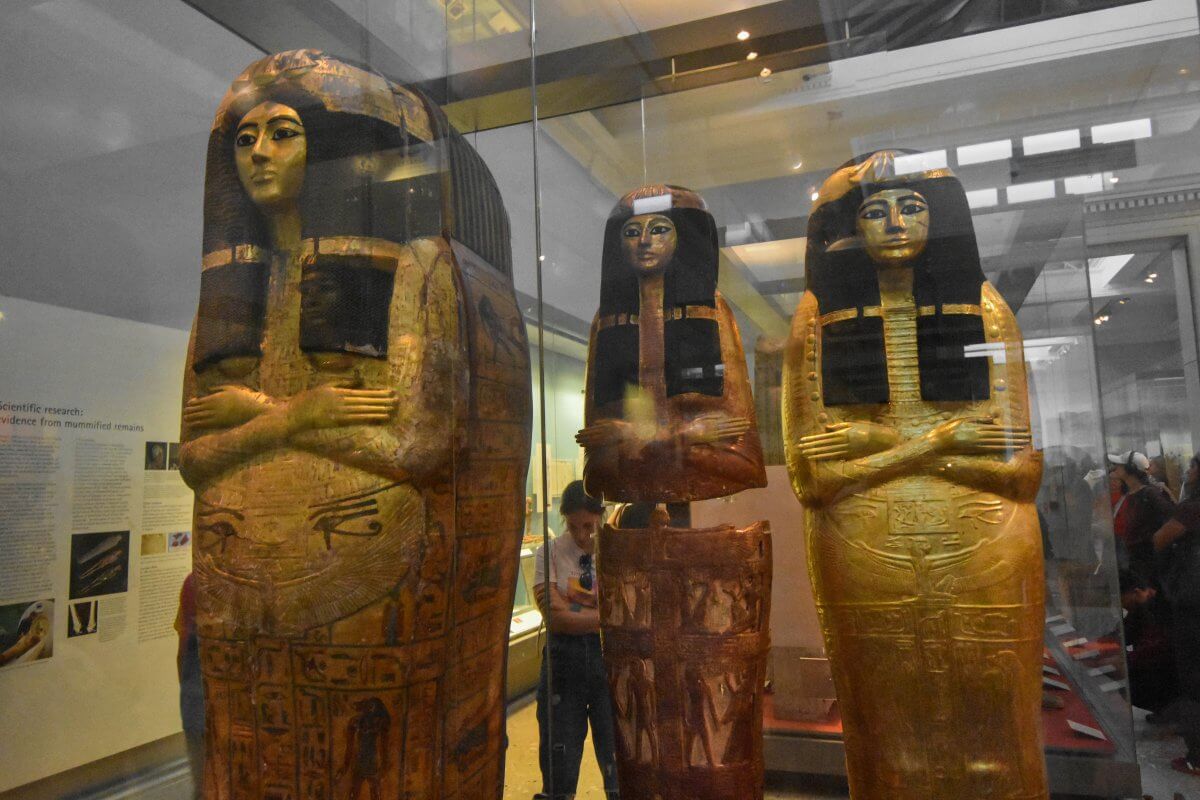
Among many artefacts, one piece immediately caught our eyes: the gilded inner coffin of Henutmehyt. According to the museum’s panels, this wealthy Theban priestess lived around 1250 BC during Egypt’s 19th Dynasty. It’s displayed alongside other objects connected with her burial.
What makes the inner coffin unusual is the amount of gold used for decoration. Ancient Egyptians associated gold with the gods, and its use here wasn’t simply about showing wealth. The decoration formed part of a much larger religious idea. It protected the dead person and helped her continue into the afterlife.
WHY IS IT COVERED WITH GOLD?
Almost the entire inner coffin is covered in gold leaf, apart from areas such as the wig, eyes, and eyebrows. This immediately attracts attention even in a crowded gallery. But the detail that caught our attention most was the hands. Rather than simply painting them onto the coffin, the maker modelled them in three dimensions. Look closely at the fingers as her hands cross over her chest. It is a small detail, but it makes the figure feel much more human. This is one of the details we found very interesting when standing close to the case. From a distance, the coffin looks like a beautifully decorated golden figure. Up close, you can see how much work went into creating its form and decoration.
BURIAL COLLECTION
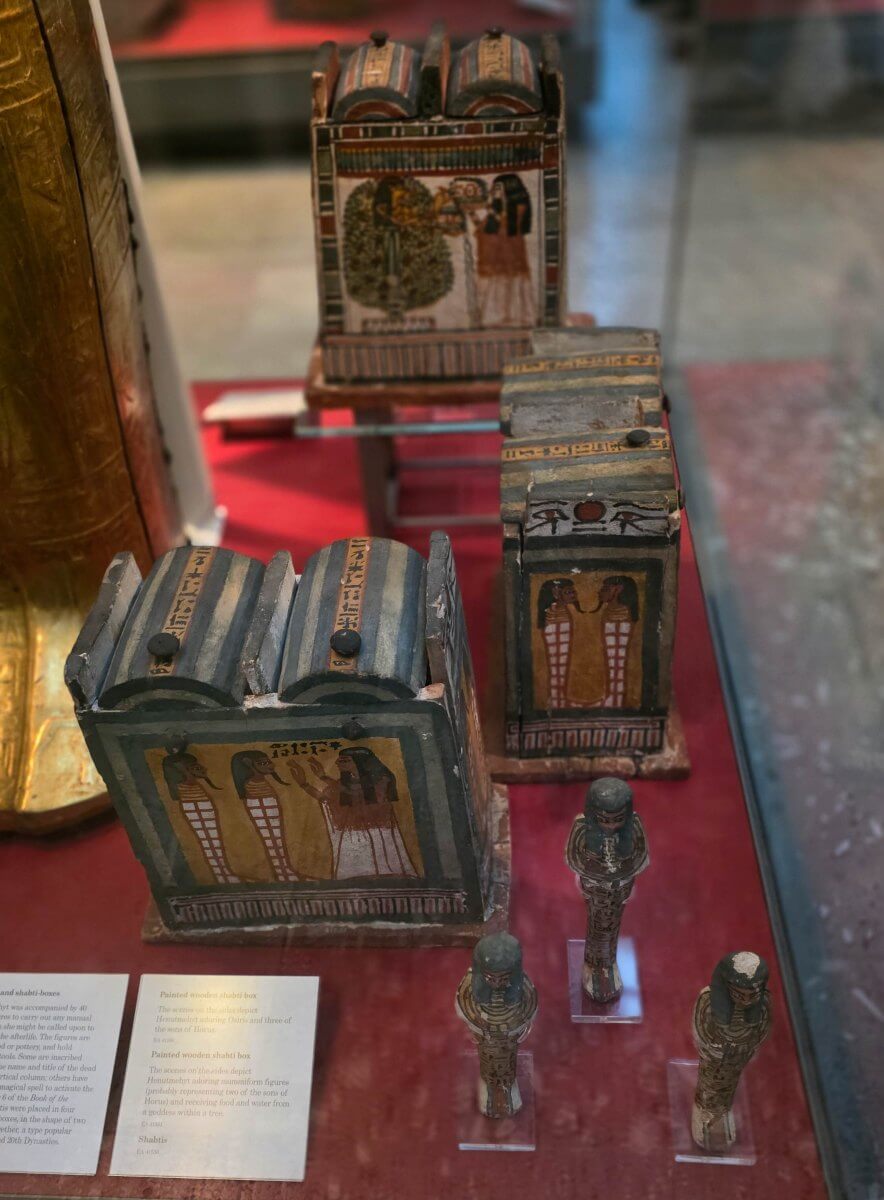
The quality of Henutmehyt’s burial suggests that she was a woman of considerable wealth and status. Her funerary equipment was extensive. The surviving collection includes her coffin and mummy-cover, as well as other burial objects. Don’t miss nine painted wooden shabtis, all displayed near the coffins. These small figures were placed in burials to act as workers for the deceased in the afterlife. Seeing them alongside the coffin helps turn what could otherwise feel like beautiful but anonymous objects into part of a much larger burial story.
GOOD TO KNOW:
The surrounding rooms are worth exploring too. Room 62 and 63 contain further mummies, coffins, funerary objects, and tomb models. When we visited on Sunday afternoon, both galleries were crowded. Take time to look at side cases rather than stopping only in the busiest central areas.
13. Ain Ghazal Statues
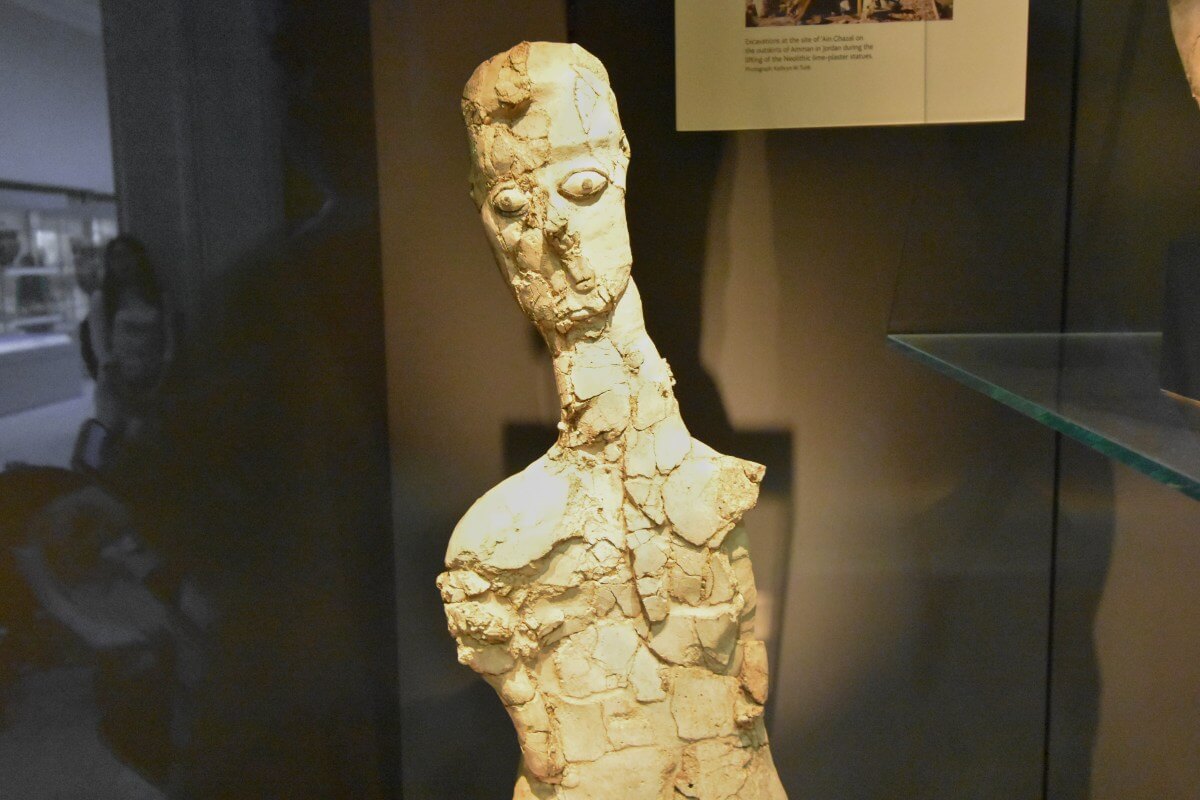
Now jump thousands of years back and head to Room 59 for the ‘Ain Ghazal’ lime-plaster statues from Jordan. They are among the earliest known large-scale representations of the human form. A study in Archaeology International describes the discovery as a cache of some of the earliest known large-scale human figures.
We saw Ain Ghazal statues in Amman a few years ago, so we knew how unusual they were. What surprised us here was how easily people walked past them. During our visit, nobody seemed to stop here. Instead, all visitors crowded around famous objects elsewhere. These figures deserve much more than a quick look.
FROM THE NEOLITHIC PERIOD
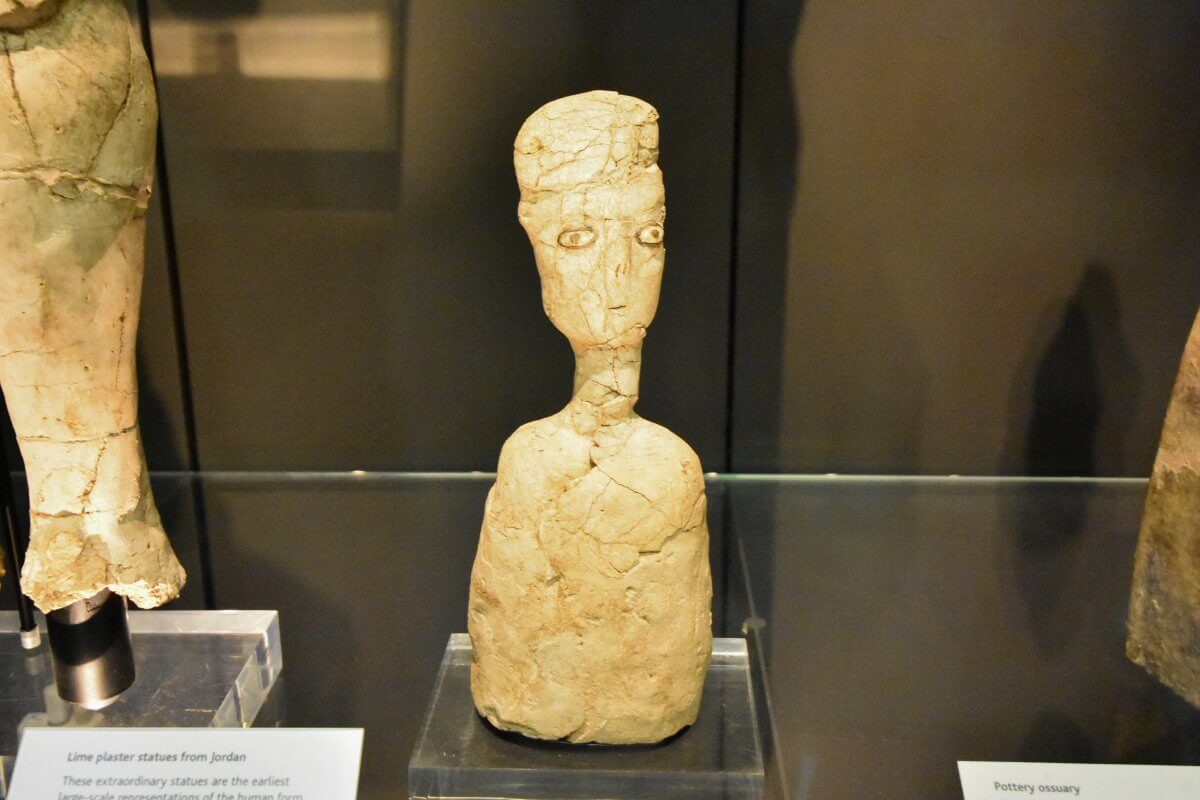
Dating to approximately 7200 BC, these figures are more than 9,000 years old and have detailed heads and minimalist bodies. Their original purpose remains unknown, and they were found buried in underground caches. According to conservator Kathryn Tubb, the statues were made by applying lime plaster over underlying reed frames. The prehistoric people of Ain Ghazal had to heat limestone, turn it into quicklime, add water, and then make a workable plaster. This technology was highly developed for such an early period.
The faces are the detail you shouldn’t miss. White chalk formed the eyes, while black bitumen outlined them, creating a strange, wide-open stare. Traces of paint suggest the statues were once decorated with stronger colours.
14. Jericho Skull
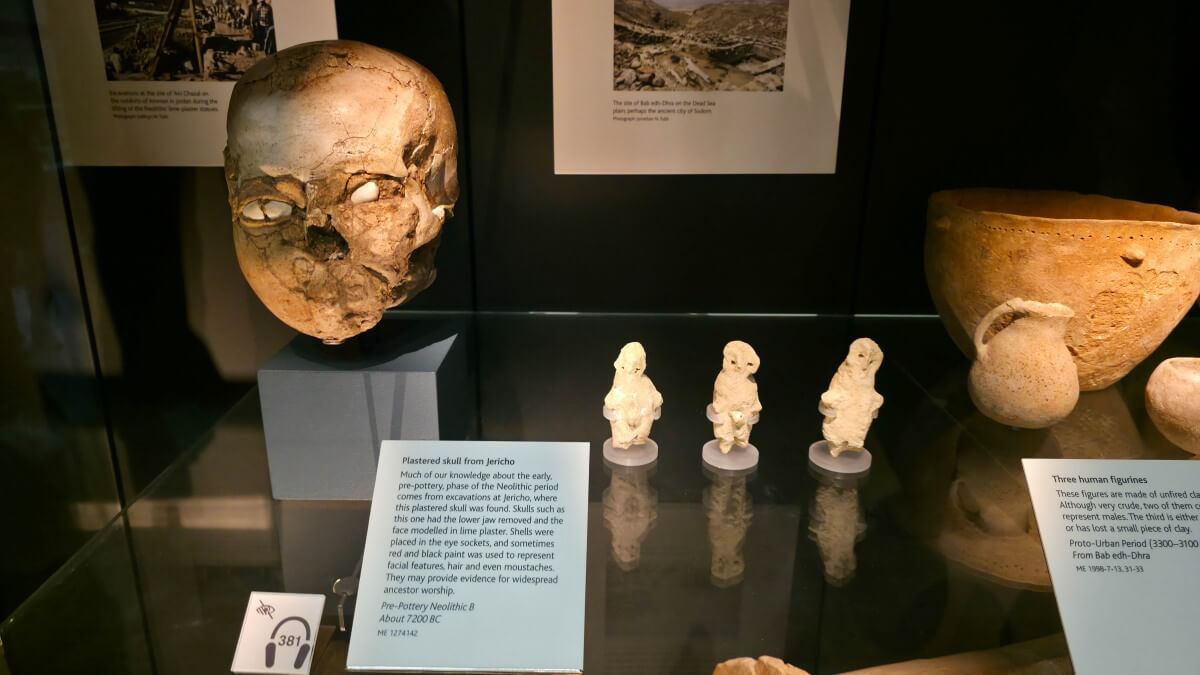
Don’t skip this one on your visit. In the same Room 59, keep a close watch for the plastered skull from Jericho. It’s small and easy to miss, yet it’s one of the most unique artefacts and highlights of the British Museum. The display panel explains an extraordinary fact: it dates to around 8200-7500 BC. At approximately 9,500 years old, this Neolithic artefact is the museum’s oldest-known human portrait.
We had actually missed a plastered skull a few years ago when we visited Amman. We didn’t pay enough attention to it in Jordan, just like many tourists who visit this museum. Seeing this plastered skull in London made us realise what we had overlooked.
A 9,000-YEAR-OLD PORTRAIT
The on-site panel notes that the ancient makers removed the lower jaw and modelled the face in lime plaster. They pressed shells into the sockets for the eyes, and used paint to add final facial details. People likely used these skulls in ancestor rituals. Over time, the community transformed these individuals into symbols of their shared ancestors. In 2016, researchers used the scan to recreate a 3D-printed skull and reconstructed the man’s face. For the first time in thousands of years, specialists could see an approximation of the face hidden beneath the plaster. You can see it here if you like.
15. David Vases
Choosing only 15 highlights from the British Museum is very difficult. Our shortlist included the Lewis Chessmen queen (Room 40), the Lindow Man (Room 50), Roman emperors, Michelangelo drawings and Greek objects. Our final choice is something we didn’t even manage to see: the David Vases from China’s Yuan dynasty.
Made in Jingdezhen in 1351, these blue-and-white altar vases are among the most famous Chinese porcelains in the world. The museum’s website explains that the long inscription around each neck makes them exceptional. The David Vases offer a remarkable story of global trade. The brilliant blue cobalt paint came to China from present-day Iran via the Silk Road during the Mongol Empire.
WHY WE MISSED
We simply ran out of time before exploring the Chinese galleries and Room 95. That is why this highlight is on our return list. We plan to come back and see the David Vases ourselves.
Useful Information Before You Visit the British Museum in London
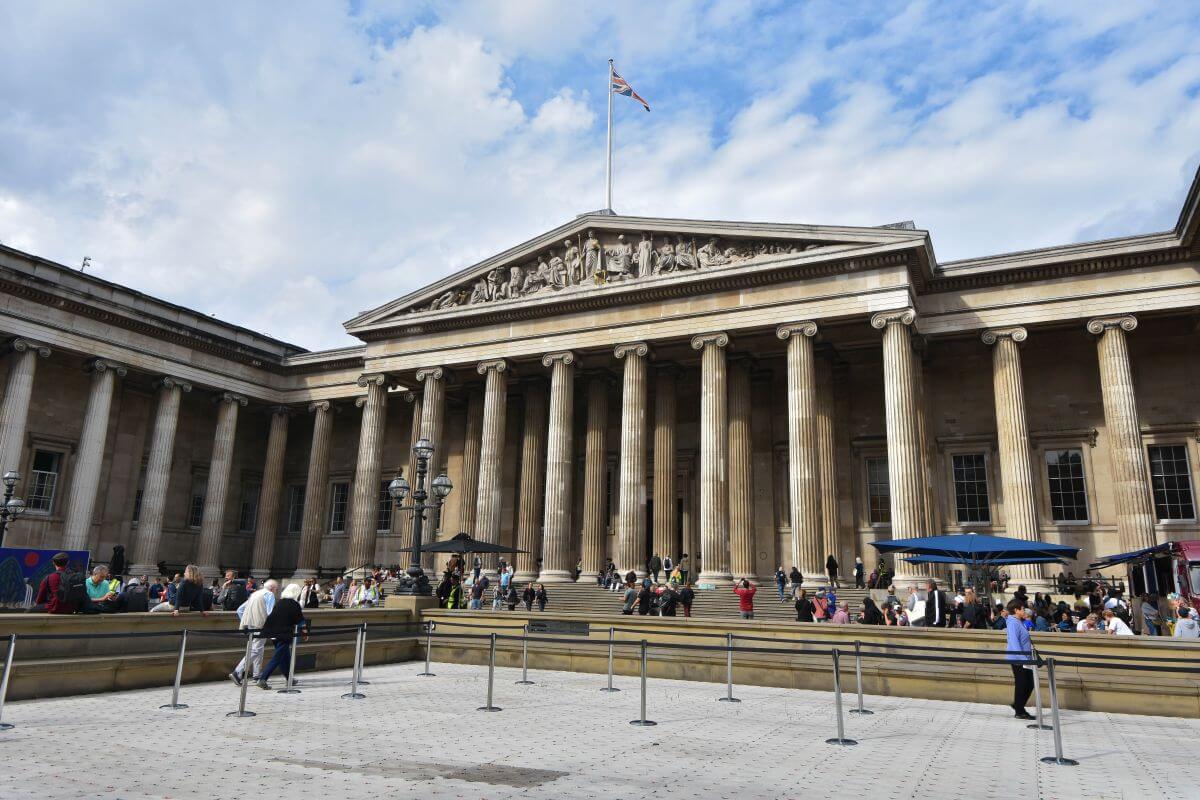
OPENING HOURS
The British Museum in London is open daily, but the hours change on Fridays. From Saturday to Thursday, the galleries are open from 10 AM to 5 PM (last entry 4:45 PM), as of October 2026. On Fridays, you have longer to explore, with opening hours until 8:30 PM (last entry 8:15 PM). The galleries begin closing 10 minutes before the published time. For that reason, don’t leave your visit until the final few minutes.
Opening hours and access can change (the museum is closed completely on 24, 25, and 26 December). Check the official visitor information and planned gallery closures before arriving.
ADMISSION FEE
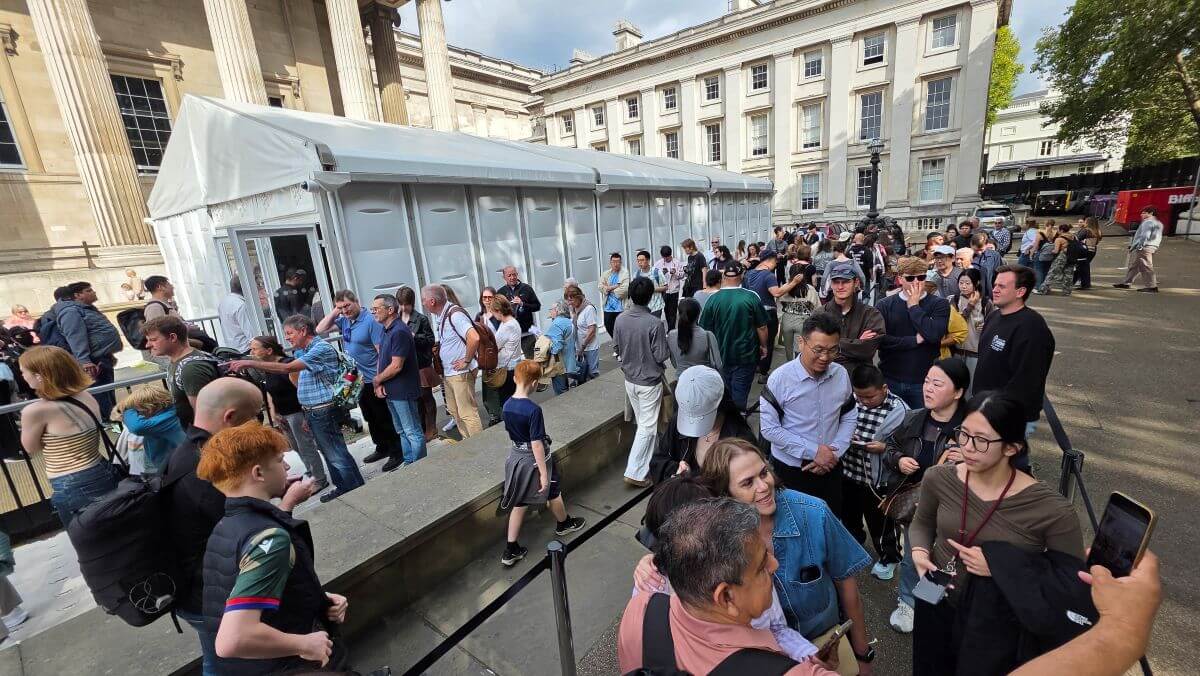
General admission to the permanent collection at the British Museum is free. However, we recommend booking a free timed ticket online. It guarantees your entry and gives you a separate reservation queue. You can still enter as a walk-up visitor, but during busy times you may have to wait. Special exhibitions are different and require a paid ticket.
FOOD, LIFTS AND ACCESSIBILITY
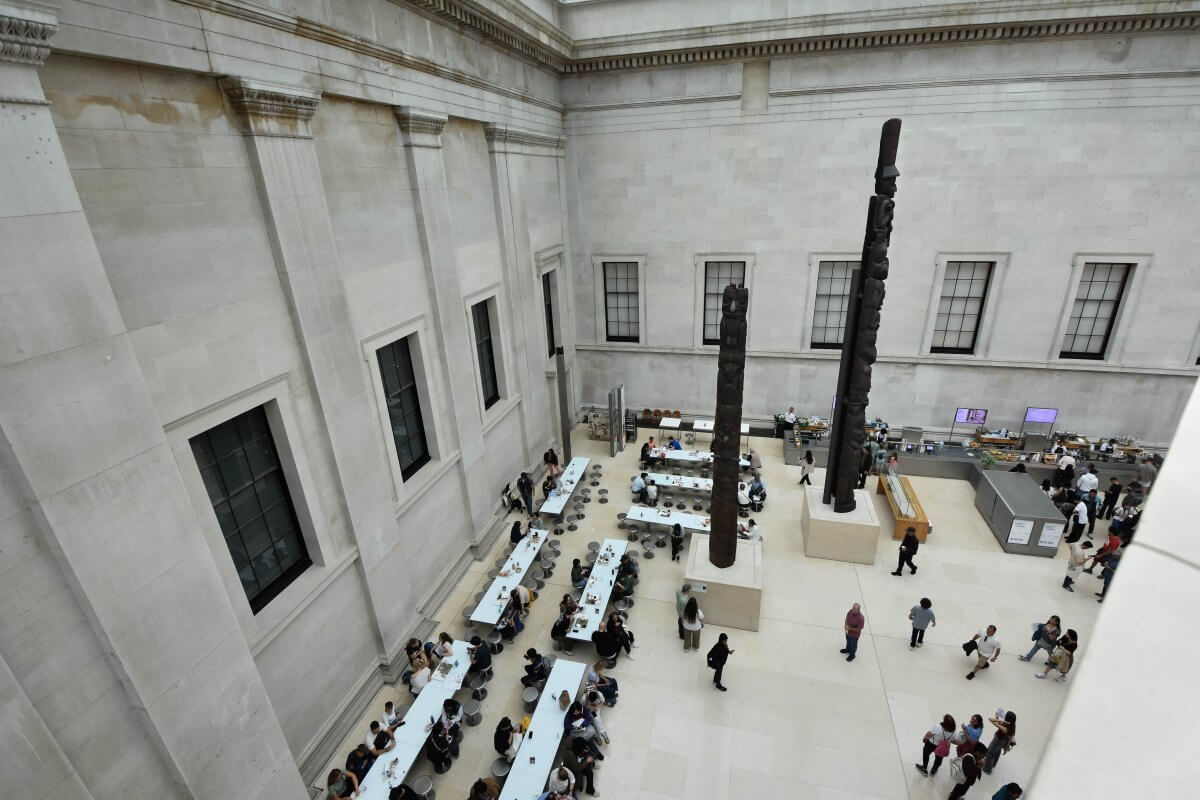
- Four or five hours among thousands of objects can be tiring. Luckily, you can stop for food or coffee inside the building. There is a main restaurant and several cafes and food outlets. Food and drinks are restricted to designated areas rather than the galleries.
- TWO PUBLIC ENTRANCES: Great Russell Street (the main entrance), Montague Place (designated for organised group visits, or as an alternative entry point)
- Approximately 95% of the building is wheelchair accessible, although a few rooms have restrictions. The Great Russell Street entrance has two open-air lifts beside the main steps. It’s the most popular entrance for many visitors.
GETTING THERE BY TUBE
Four Underground stations are within about an 8-minute walk: Russell Square, Tottenham Court Road, Goodge Street, and Holborn. Choose whichever works best for you rather than automatically heading for the nearest station.
TIP
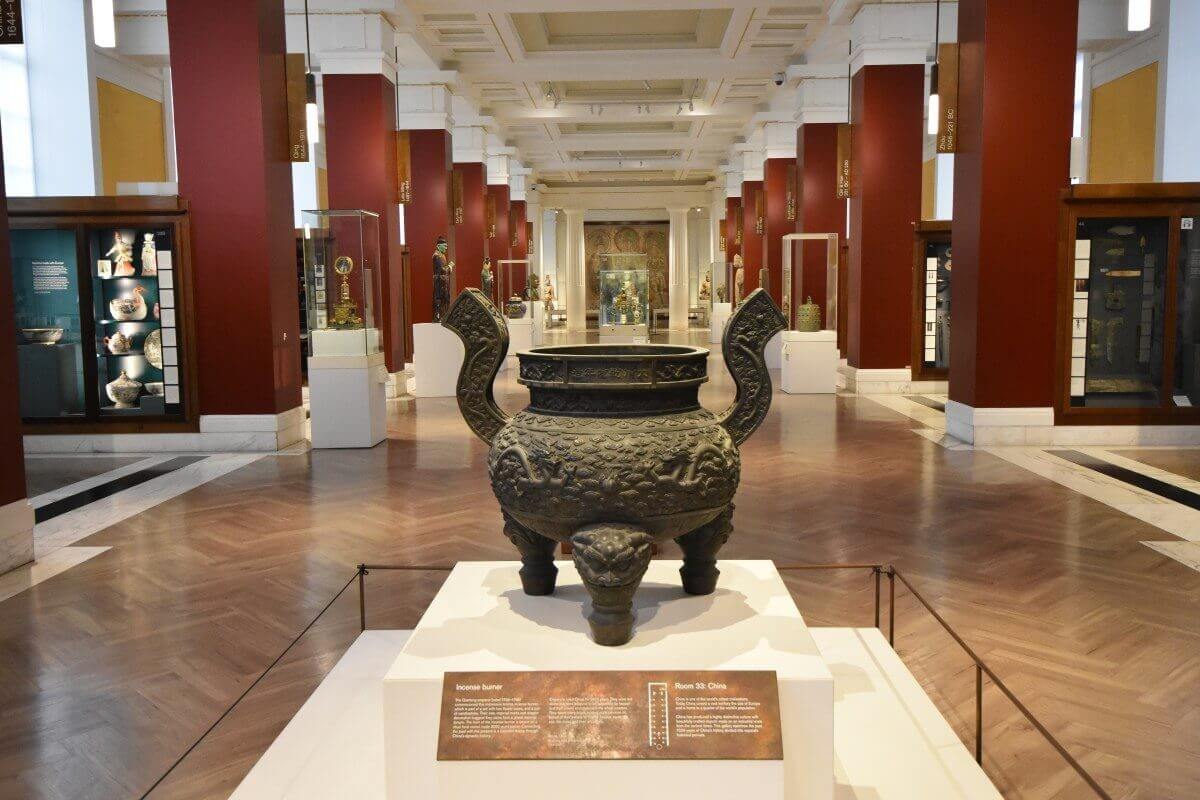
Don’t arrive without knowing where your first few objects are. The building is massive, and you will run out of time quickly. If you want to know what to see at the British Museum, start with the rooms that matter most to you and build your route around them. This is how we approached our visit, and finding the objects was far less stressful.
Now you know which British Museum highlights to prioritise and how to find them! 
Out of everything in the British Museum, what is your favourite piece, and which item completely took you by surprise?
If you found this article about what to see at the British Museum interesting, please share!
YOU MAY ALSO ENJOY: