What makes millions of travellers cross continents for one place? Petra is one of the world’s most famous archaeological sites, and nothing online prepares you for it. Located in southern Jordan, between Amman and Aqaba, this ancient city seamlessly blends Eastern traditions with Hellenistic architecture in a way that no other place does. Below, you’ll find 21 fascinating facts that reveal what truly makes Petra in Jordan one of the world’s greatest landmarks.

Petra is not just famous, but an unforgettable reminder of what humans can create. When you visit, expect to walk through dramatic landscapes, take in monumental views, and experience a strong sense of place that modern attractions rarely offer.
Surprising facts about Petra that will amaze you!
1. The Lost City, the world forgot for 500 years.

It’s hard to imagine how a city this monumental could disappear, yet that’s exactly what happened.
For centuries, this ancient city existed in near silence, hidden from the outside world and slowly slipping into legend. Once a vital stop along ancient trade routes, the city thrived on passing caravans carrying spices, ivory, silk, and textiles. But as global trade shifted toward the sea, the city lost its economic purpose, and its importance declined. Natural disasters damaged its infrastructure, especially the complex water system that once allowed life to flourish in the desert. Over time, people left, and by the early Islamic period, only a small nomadic group remained, according to the official website. Yet, it was never truly abandoned.
WHY NO ONE FOUND IT:
What truly earned it the name ‘Lost City’ was its isolation. Hidden among desert mountains and accessible only through a narrow canyon, the city became nearly invisible to outsiders. For centuries, it remained known only to nearby Bedouin tribes, who kept its location secret. To the Western world, it simply did not exist for over 500 years. That changed in 1812.

Wikipedia notes that Swiss traveller Johan Ludwig Burckhardt, already fluent in Arabic, heard stories of a ruined city that held Aaron’s Tomb. He then dressed like a local, spoke in Arabic, and convinced locals to lead him there. Burckhardt carried a goat as part of a religious offering with the intent of sacrificing it in honour of Aaron’s Tomb to blend in. After a single day of exploration, he knew immediately he had found something extraordinary. His writings brought global attention to a place the world had forgotten, but never truly lost.
2. The meaning behind the name

There’s a reason this city is called ‘Petra’. The name comes from the Greek word petros, meaning ‘rock’, a direct reference to a place carved almost entirely from stone. Long before the Greek name was adopted, the Nabataeans called it Raqmu, meaning ‘the carved’, according to historical records. In the Bible, the area was known as Sela, a name that also means ‘rock’ in Hebrew. Each name, from different cultures and eras, points to the same defining feature: a city shaped by stone rather than built upon it.
3. Natural beauty behind the name ‘Rose City’

A light that made this city famous
The reason this place is called the ‘Rose City’ comes from nature, not legend, and you can see it with your own eyes. The sandstone used for its structures contains iron-rich minerals that oxidise naturally over time. This reaction creates pink, red, and rosy shades across the stone. These colours are part of the rock itself, not the result of decoration.
COLOUR CHANGES BY TIME OF DAY:
What makes the experience unforgettable is how the colour changes throughout the day. The changing angle of the sun reveals layers and textures in the stone that are invisible at other times, making the city feel different with each visit. As the sunlight moves across the cliffs, the stone appears to shift from pale pinks to warm oranges and reds to deep roses. Winter can also surprise visitors, as clouds and rain deepen the natural hues while offering quieter moments to explore.

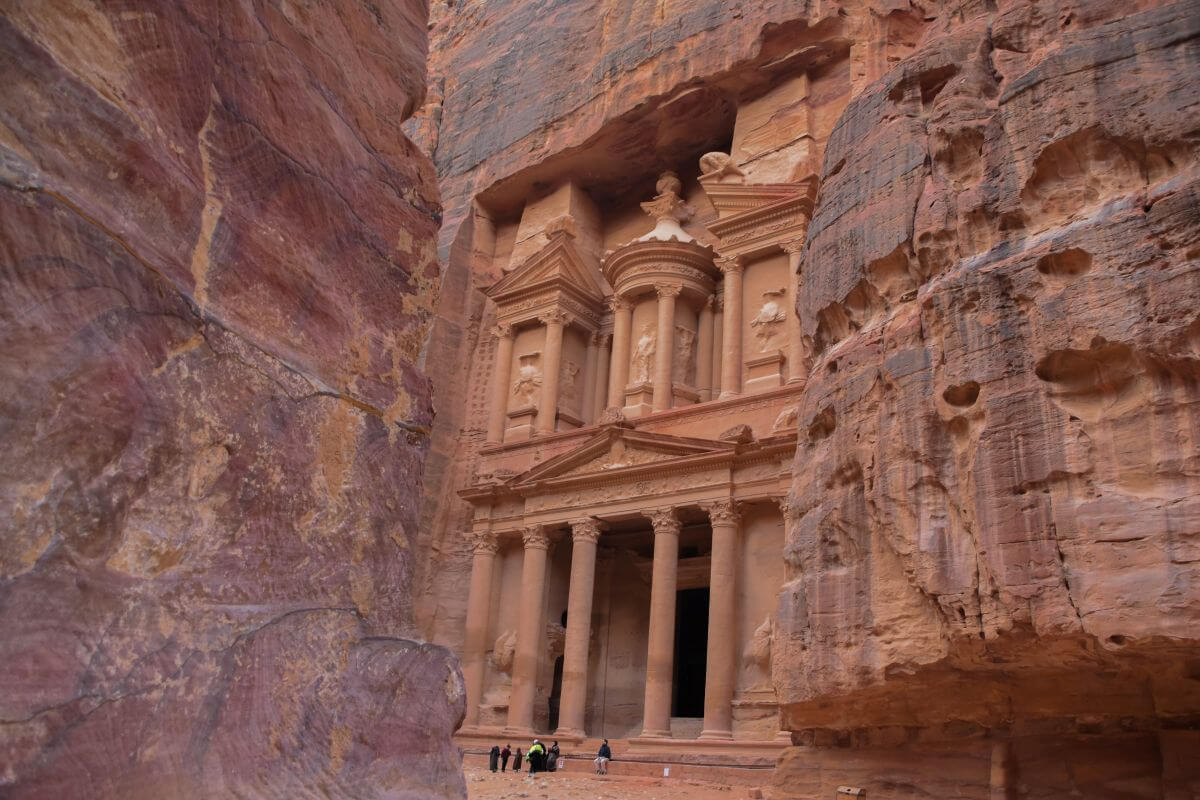
During our visit, we photographed the same landmark twice, and the difference is striking. The first image was taken in the middle of the day, while the second captures the same view at sunset. At midday, the intense sun brings out the full spectrum of colours, revealing hues of red, orange, and even purple within the stone. The sunset picture shows how the stones blush pink, creating a mystical, warm glow before fading into the cool desert night.
4. UNESCO’s seal of Global importance

In 1985, UNESCO officially recognised Petra in Jordan as a World Heritage property, marking it as one of the most valuable cultural landscapes on the planet. The site earned a precious status for more than its beauty. According to UNESCO, its Outstanding Universal Value lies in the vast collection of tombs, temples, and religious sites, alongside sophisticated systems that captured and stored seasonal rainfall. Archaeological remains also reveal copper mining, public buildings, churches, and religious sites, offering rare insight into a vanished civilisation.

The blending of Hellenistic façades with Nabataean traditions creates a unique architectural language. It also shows how a lost civilisation mastered both engineering and design.
5. A wonder chosen by millions
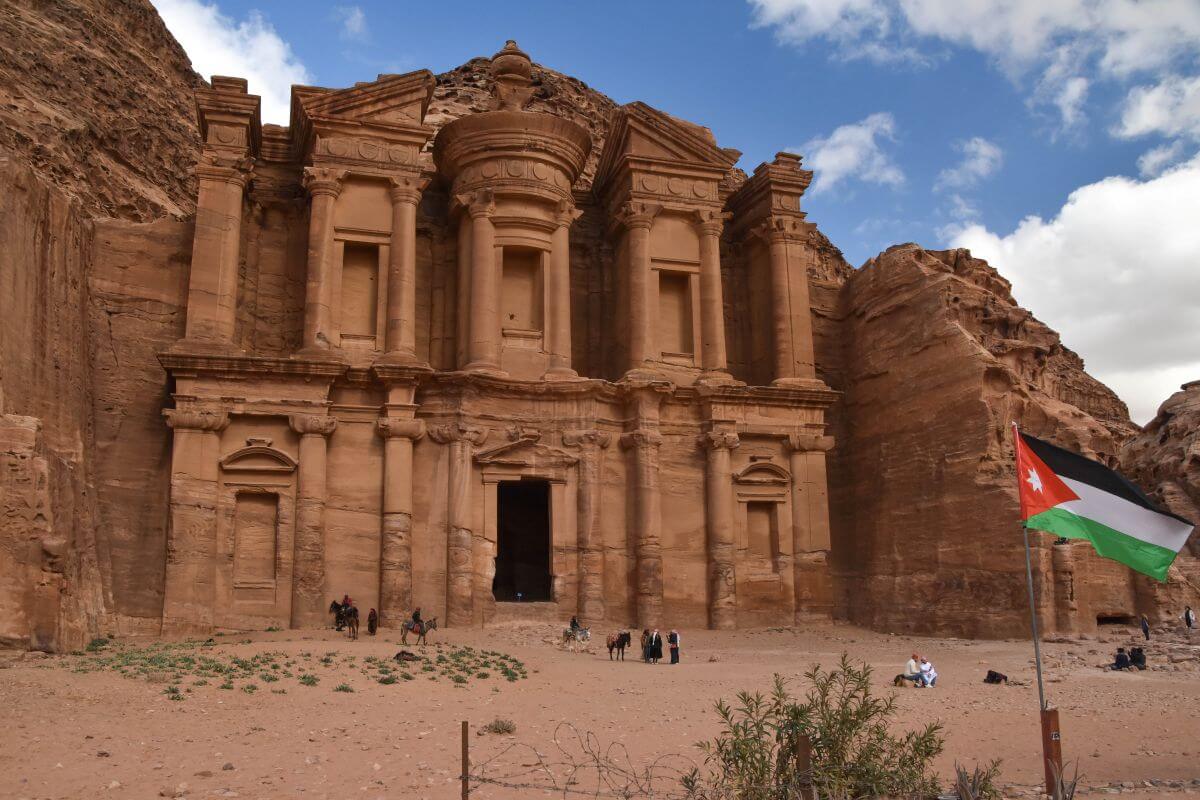
Global recognition didn’t stop with a UNESCO status. In 2007, Petra achieved worldwide fame after being voted one of the New Seven Wonders of the World. Over 100 million people voted in a worldwide poll organised by the New 7 Wonders Foundation. The monumental Treasury and the extraordinary craftsmanship of the Monastery became global symbols of ancient skill and imagination. The site confirmed its place among the planet’s most iconic sites. You can learn more about the full list and history of the New Seven Wonders through our guide linked in this article.
READ MORE:

6. One of the Oldest cities in the world

Few places on earth can trace life back this far. These facts reveal why Petra is one of the oldest cities in the world.
Archaeological evidence shows that the surrounding region was inhabited as early as 7000 BC, according to Wikipedia. Evidence from nearby Al Beidha (Little Petra) reveals farming communities dating back to 7200 BC. This places this region among one of the oldest settlements in the Middle East, thousands of years before the famous carved city appeared.
While people lived in the surrounding area for thousands of years, Petra rose more than 2,300 years ago. The city as we know it began to take shape in the 4th century BC, when the Nabataeans, a nomadic Arab people, settled there. By the 2nd century BC, it became the capital of the Nabataean Kingdom (the Universes Art website). They chose this location carefully, positioning it along key trade routes that connected Arabia and the Mediterranean, bringing wealth and influence.
READ MORE:

7. More than one civilisation called it home

Different communities have lived here across centuries, each leaving traces behind. Long before the famous stone facades appeared, the Edomites occupied the surrounding region. Archaeological evidence places their settlement around the 12th to 6th century BC during the Iron Age, according to Wikipedia. The Nabataeans later transformed the site entirely. Arriving as nomadic traders in the 4th century BC, they settled permanently and made the city their capital in the 2nd century BC. Wealth from trade routes funded ambitious construction and advanced engineering. Their independent kingdom lasted until 106 AD. Roman annexation followed, turning the area into the province of Arabia Petraea. Roman rule introduced new architectural influences and extended the city’s life well into the 4th century AD. Later, Byzantine Christians reused tombs and monuments, converting some into churches and adapting the city to new beliefs. After earthquakes and shifting trade routes, the settlement declined. By the early Islamic period, only small communities remained.
8. The city still hidden underground

Beneath the visible monuments lies a second, unseen city.
One of the most eye-opening Petra facts is that what you see today is only a fraction of the ancient city. According to the official site, archaeologists estimate that only one-fifth of the site has been explored so far. The remaining 80% stays hidden underground, protected by centuries of sand and stone. This isn’t theory anymore. New technology now supports this claim.
Ground-penetrating radar has revealed underground chambers even beneath famous landmarks. In late 2024, researchers documented a hidden tomb beneath the Treasury. These discoveries prove that even the most photographed places still hold secrets, and that discovery is ongoing.
9. Unique entrance to the city

Petra does not reveal itself all at once. The journey begins not with open views, but with restriction.
Walking the Siq creates tension and anticipation. You sense that something extraordinary waits ahead, long before it appears. A narrow gorge serves as the city’s main and most famous gateway. Known in Arabic as al-Siq (meaning ‘the shaft’), this winding gorge stretches for about 1.2 km before opening suddenly onto the Treasury. In some sections, the passage narrows to just 3 m wide, while its sandstone walls rise between 91 and 182 m high.
A NATURAL CORRIDOR TURNED MASTERPIECE:
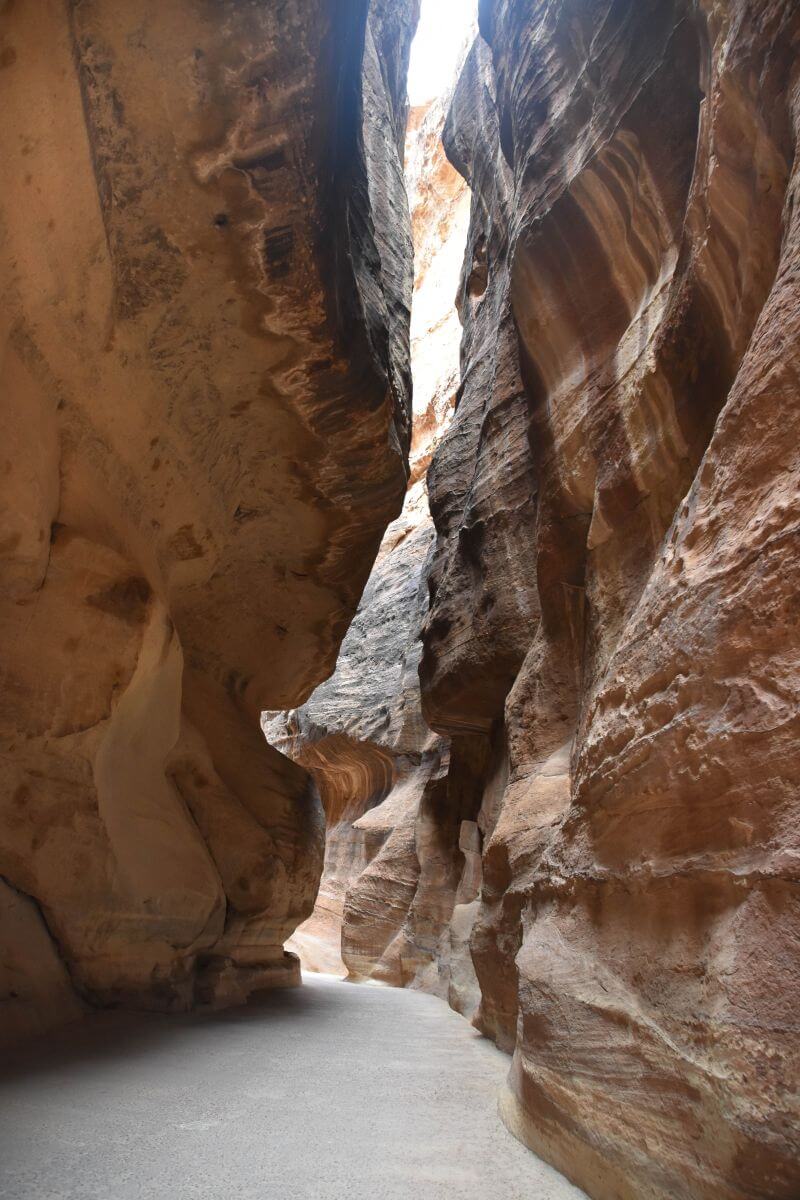
Unlike water-carved Antelope Canyon in Arizona, the Siq formed when tectonic forces split the rock along a fault line, according to Wikipedia. Water later smoothed its surface, creating the flowing curves you can see today.
The Siq served as the ceremonial caravan entrance, guiding traders directly into the heart of the city. At its entrance, a massive dam once controlled flash floods from Wadi Musa. Archaeologists reconstructed this dam in 1963 and again in 1991, according to the official website. A monumental arch once stood at the entrance, though an earthquake caused its collapse in the late 1980s. Its appearance is preserved in historical drawings by Matthew Boulby and David Roberts.

10. Petra didn’t have a river, so it built one

How did an ancient desert city survive where water barely exists? One of the most surprising Petra facts is that this city didn’t just find water – it mastered it.
Petra stands in a dry, unforgiving landscape, yet it supported gardens, homes, and public spaces for centuries. That was only possible because the Nabataeans built one of the most advanced water systems in the ancient world. The proof appears the moment you enter the Siq. Along both rock walls, two ancient water channels run quietly beside the path. These channels transformed a dangerous flood corridor into a controlled water system.

Look closely, remains of kilometre-long water conduits still line both sides of the Siq. The Universes Art website reports that engineers built them in the late 1st century BC alongside a flood-protection system.

On the northern side, clay pipes formed a pressurised pipeline that carried drinking water from the Moses Spring into the city. On the southern side, engineers carved a channel directly into the rock and sealed it with stone slabs. A local guide explained to us that sedimentation tanks along the way slowed the water, reduced pressure, and removed lime and debris.
11. Careful planning at every step

The most astonishing detail lies in the angle of the pipes. According to peer-reviewed research by Dr Charles Ortloff of the University of Chicago, the main pipeline followed a slope of 2 degrees. This precise angle is needed to maximise water flow without leakage. A single-degree mistake would cause failure. Other pipelines required a 4-degree slope. Calculating this precision requires advanced mathematics that Western science would not develop for nearly 2,000 years.
TIP:
After exploring the archaeological site, don’t skip the nearby museum. Inside, you’ll see two original clay pipes with tapered ends. Seeing them up close makes this engineering miracle feel real.
12. The water system that turned a desert into a city
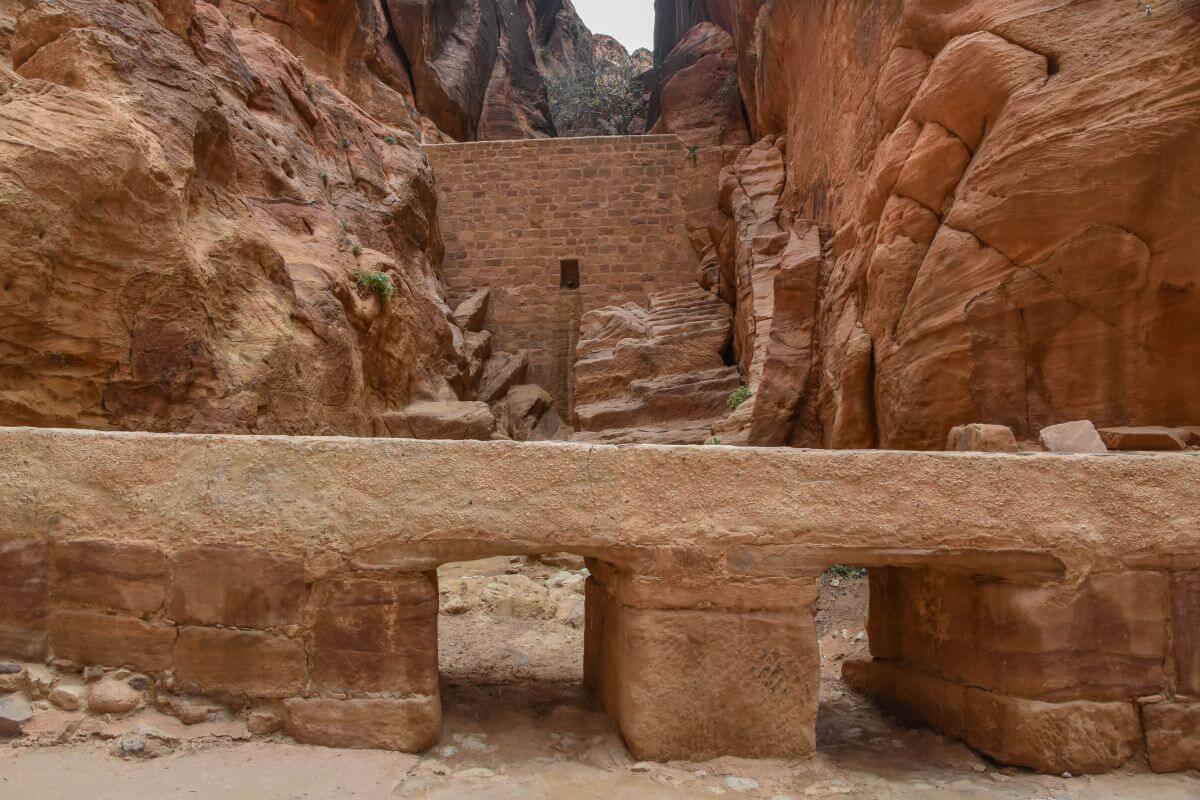
Petra’s water system extended far beyond the Siq. Hundreds of underground cisterns and tanks captured rainfall and flash floods, purified the water, and stored it safely underground. Dams redirect sudden floods into reservoirs instead of letting them destroy the city. This system supplied water for homes, farming, and allowed a large population to thrive in the city for centuries.
13. The Treasury was never a treasury

The most photographed façade hides a very different purpose.
The building known worldwide as Al-Khazneh has one of the most misleading names in archaeology. Translated from Arabic as ‘The Treasury’, it suggests gold and riches. Yet, it was never built to store wealth or used as a treasury. The official website attributes its construction to the early 1st century AD. Modern archaeological research indicates that it was carved as a royal mausoleum and crypt during the reign of a powerful Nabataean king, Aretas IV. The name itself came much later.
HOW LEGEND SHAPED THE NAME:

Local legend shaped the treasury’s identity, and the misunderstanding began with the legend. According to the official website, local Bedouin tribes believed the large stone urn crowning the façade contained hidden treasure, possibly left by an Egyptian pharaoh escaping the Red Sea. This belief led to the Arabic name Khaznat al Far’oun, or ‘Treasury of the Pharaoh’. The belief grew so strong that people fired bullets at the urn, hoping to release riches. Bullet marks still visible today tell the story of failed attempts to break it open.
What the carving actually reveals tells a different story. The façade blends Nabataean and Hellenistic design. Scholars point to funerary symbols, carved deities, and decorative motifs linked to the afterlife. This supports the theory that this was a tomb for an elite figure rather than a financial building.

Hollywood later added another layer to the myth. The structure gained global fame after appearing in Indiana Jones and the Last Crusade. Millions of people saw it as the final resting place of the Holy Grail, reinforcing its mysterious reputation. The façade became iconic overnight.
2024 DISCOVERY:
The monument’s fame came before legend, but its truth lies underground. In 2024, excavations confirmed what historians suspected. Beneath the monument, archaeologists uncovered a hidden tomb containing 12 skeletons and a range of artefacts. One skeleton held a ceramic cup resembling the movie’s famous chalice, a coincidence noted by researchers. The discovery confirmed decades of scholarly theory that this building was a tomb for elite Nabataeans.
14. A City of Tombs
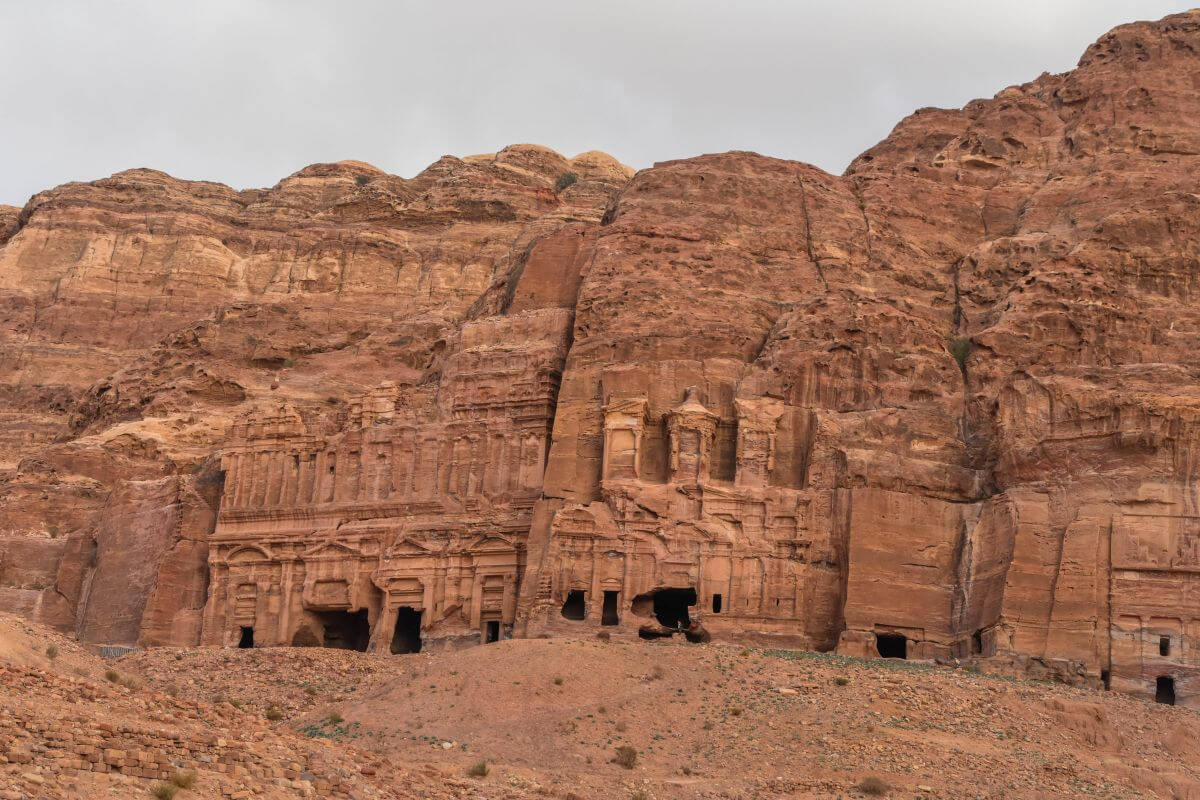
The Royal Tombs, carved high into the cliff, overlooking the ancient city.
Petra reveals that this ancient city was not only a place of trade and life, but also a sacred landscape of memory. The Nabataeans believed deeply in the afterlife and placed great importance on honouring those who had passed. That belief has shaped the city and remains dominant in the landscape today.
Archaeologists estimate that the site contains over 600 carved stone facades, according to National Geographic. Figures suggest there are hundreds of tombs, making it one of the world’s most important funerary landscapes (Wikipedia). These tombs range from grand ceremonial facades to smaller, carefully carved burial chambers hidden along cliff faces.
The most famous group is the Royal Tombs, which include the Urn Tomb, Silk Tomb, Corinthian Tomb, and Palace Tomb. These monumental facades combine Nabataean tradition with Hellenistic design, illustrating how status and belief influenced architectural design. Wikipedia reports that the Palace Tomb is widely believed to have served as a burial place for royal burials.
15. How was Petra Built?

How did ancient builders turn cliffs into iconic landmarks? The answer reveals one of the most surprising facts about Petra. Together with Ethiopia’s rock churches and India’s Ajanta and Ellora caves, Petra stands as one of the finest examples of rock-cut architecture in the world.
CARVED NOT CONSTRUCTED:
Instead of stacking blocks, the Nabateans carved their city directly into rose-coloured cliffs. They followed a method only a few cultures mastered. According to Science Focus, builders began at the very top of sandstone cliffs. They cut massive steps into the rock before shaping facades and chambers downward. This top-down method allowed workers to stand safely on solid stone, eliminating the need for scaffolding. It also made the process safer and more efficient.

Builders used basic hand tools such as chisels, hammers, and drills, yet achieved perfect symmetry. Once the stone was removed, it couldn’t return. This subtractive approach required absolute precision and advanced planning. Architects had to imagine entire structures before the first cut. They designed facades, interiors, and proportions from the start, knowing that even a single mistake could ruin months of work.
16. The Siq was once a grand paved road

One of the lesser-known facts about Petra reveals that this narrow gorge was once a carefully designed road. According to the Universes Art website, after a destructive flood in the mid-1st century BC, the Nabateans rebuilt the Siq into a fully paved road. They replaced the old gravel path with a stone road, completed between 30 and 20 BC. The road followed a uniform slope of 4.9% and measured at least 3 m wide. It even had sidewalks in certain sections. Today, fragments of the original paving still appear beneath your feet. Realising this turns a simple walk into something deeper.
17. A Sacred Path

Did you know that the Siq also functioned as a sacred processional route, not only as a simple passageway? During Nabataean times, pilgrims travelled from far beyond this region. According to Tourism Jordan, travellers walked this gorge as part of spiritual processions leading into the holy city. Wikipedia reports a dozen votive niches carved into the rock walls, each holding sacred stones linked to Nabataean gods, including Dushara. These niches made the canyon itself a holy zone. Pilgrims would stop along the way to pray, reflect, and leave offerings before reaching the main sanctuary.

The remains of the ancient statues in the Siq.
18. Petra is home to a theatre carved into the mountain
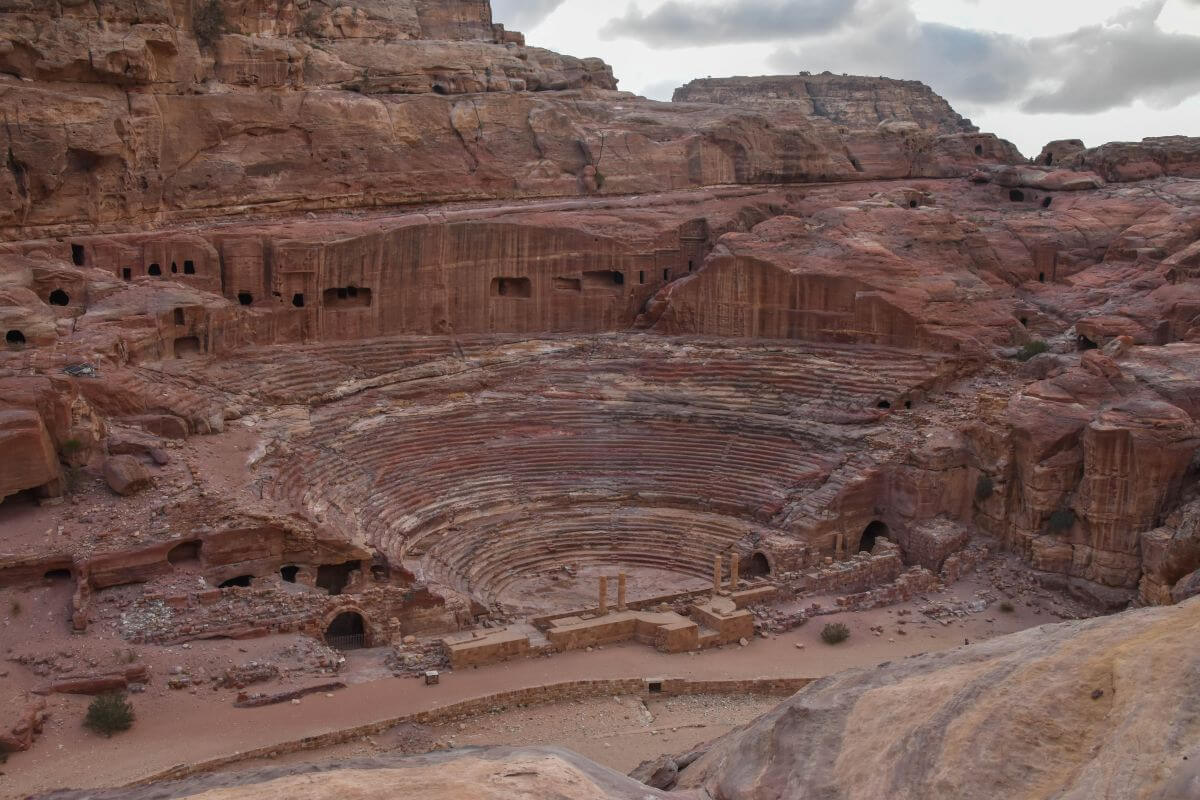
Few travellers expect to find a massive theatre carved into stone here. Yet one stands just 600 m from the ancient city centre, cut into the mountain slope below the High Place of Sacrifice.
Despite its Roman-style layout, historians agree it was built by the Nabataeans in the 1st century AD, long before Roman forces arrived. Wikipedia reports that construction took place during the reign of King Aretas IV, when large civic projects reshaped this city. The structure could host massive crowds. The official site states around 6,000 spectators, while Wikipedia reports estimates as high as 8,500.
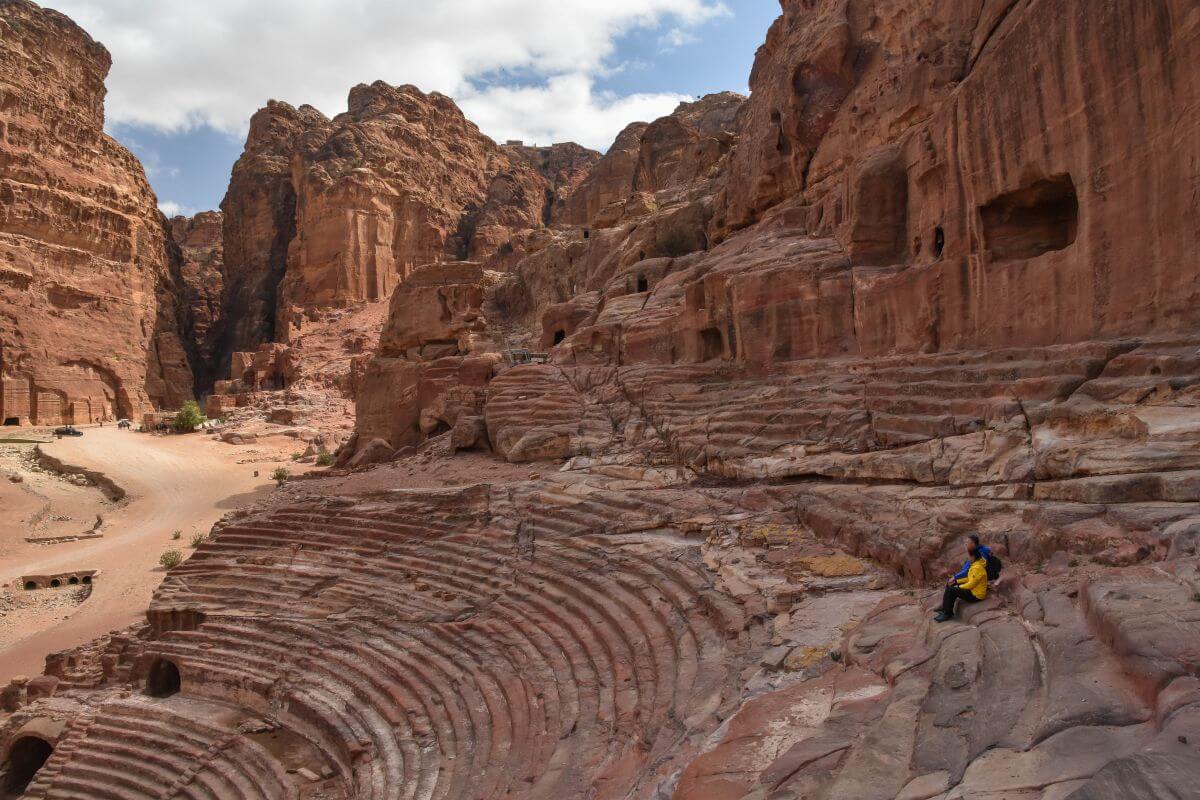
Although its layout mirrors Roman theatres, the technique does not. According to Wikipedia, carving a theatre from living rock reflects Nabataean tradition, not Roman practice. Decorative floral capitals carved into the stone further confirmed local artistic identity. Later rulers, including Romans, expanded parts of the structure, but its heart remains Nabataean.
19. Petra’s biblical connections

This site is more than just archaeology; it sits within one of the Bible’s most recognisable landscapes. In the Old Testament, the region is mentioned under the name Sela, a Hebrew word meaning ‘rock’, in Isaiah 16:1 and 2 Kings 14:7. However, the biblical story doesn’t end with the city itself.
WADI MUSA:

The valley below carries the name Wadi Musa, translated as ‘Valley of Moses’. According to traditions documented by the Holy Jordan website, this is where Moses struck a rock, and water poured out for the Israelites during their desert journey (Numbers 20:11). The spring linked to this event, ‘Ain Musa’, still flows today. You can find the spring inside a small domed building and drink its cool water today.
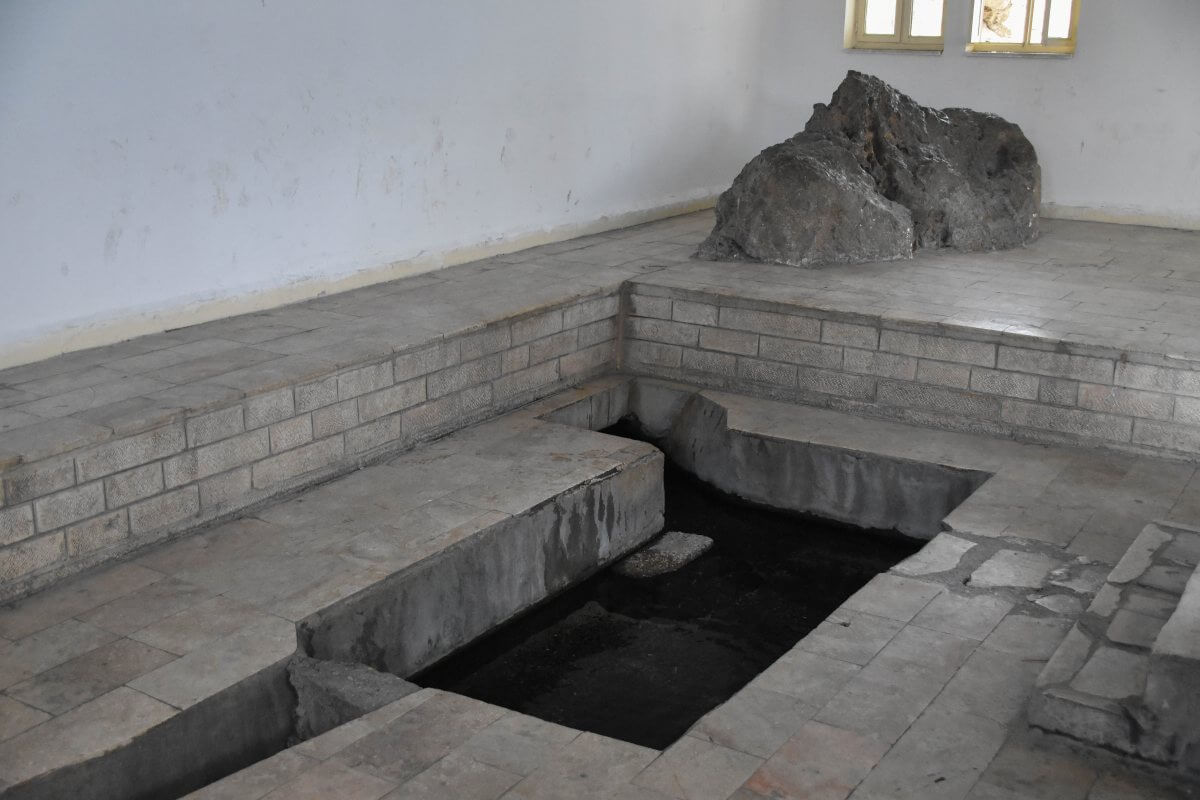
See the Ain Musa spring, collect water, and understand why this location holds lasting significance for believers.
MOUNT AARON:

Above the valley rises Jebel Harun, or Mount Aaron in English. At over 1,350 m, it is traditionally believed to be the burial place of Aaron, Moses’ brother. A white-domed shrine crowns the summit and remains sacred to Christians, Muslims, and Jews.
20. Climate design
One of the most practical Petra facts involves sustainability. Beyond sculpture, this architecture solved climate challenges. Science Focus explains that carving buildings into cliffs created natural insulation. Thick rock walls absorb heat slowly during scorching desert days and slowly release stored heat at night. This passive temperature control created comfort without the fuel, fire, or technology.
21. A living community inside the UNESCO site
 While the Nabataean civilisation disappeared centuries ago, Bedouin life continued here well into modern times. Today, a small number of Bedouins (mainly from the Bdoul tribe) still live within the archaeological landscape. For generations, their families made homes inside rock-cut tombs and caves, carved by earlier inhabitants.
Members of the tribe often claim Nabataean ancestry. While historians note there is no direct genetic proof, scholars agree the tribe has lived in the area for centuries. According to the Guardian, Bedouin families inhabited cave dwellings here for about 200 years.
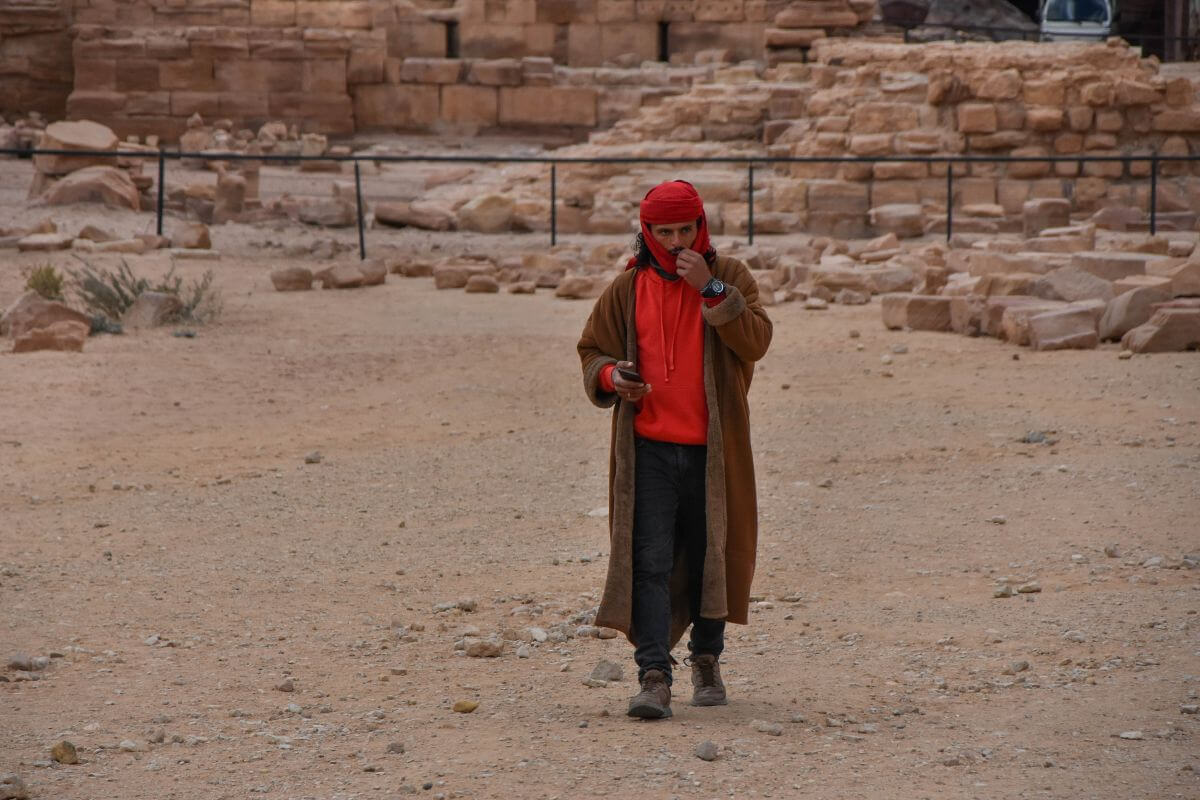
Everything changed in 1985. After UNESCO listed the site as a World Heritage location, authorities began relocating Bedouin families to a newly built village nearby. Many accepted the move, but some refused or later returned to their cave homes. A few still live quietly within the site today. Others remain closely involved through work. Many Bedouins operate camel rides, sell handmade crafts, or guide visitors. Their presence adds authenticity to the experience and shows that Petra isn’t just about ancient ruins, but also about people who continue to live alongside history.
Now you know all the fascinating facts about Petra in Jordan!
Thank you for staying with us until the end. If you’ve enjoyed this article, please consider sharing this post below.
Pin 21 Petra facts facts for later!
Have you ever visited this famous archaeological site? Which fun facts about Petra in Jordan surprised you the most? Let us know in the comments below!
YOU MAY ALSO ENJOY:


