Hidden among olive groves and the rolling hills, the Jerash Ruins stand as one of the most extraordinary ancient cities on Earth. Once part of the vast Roman Empire, this remarkably preserved site with over 2,000 years of history remains one of the top attractions in Jordan. In this article, we cover how to get there, what to see, fascinating facts, and essential tips. You’ll find everything you need to plan your visit and make the most of your day.
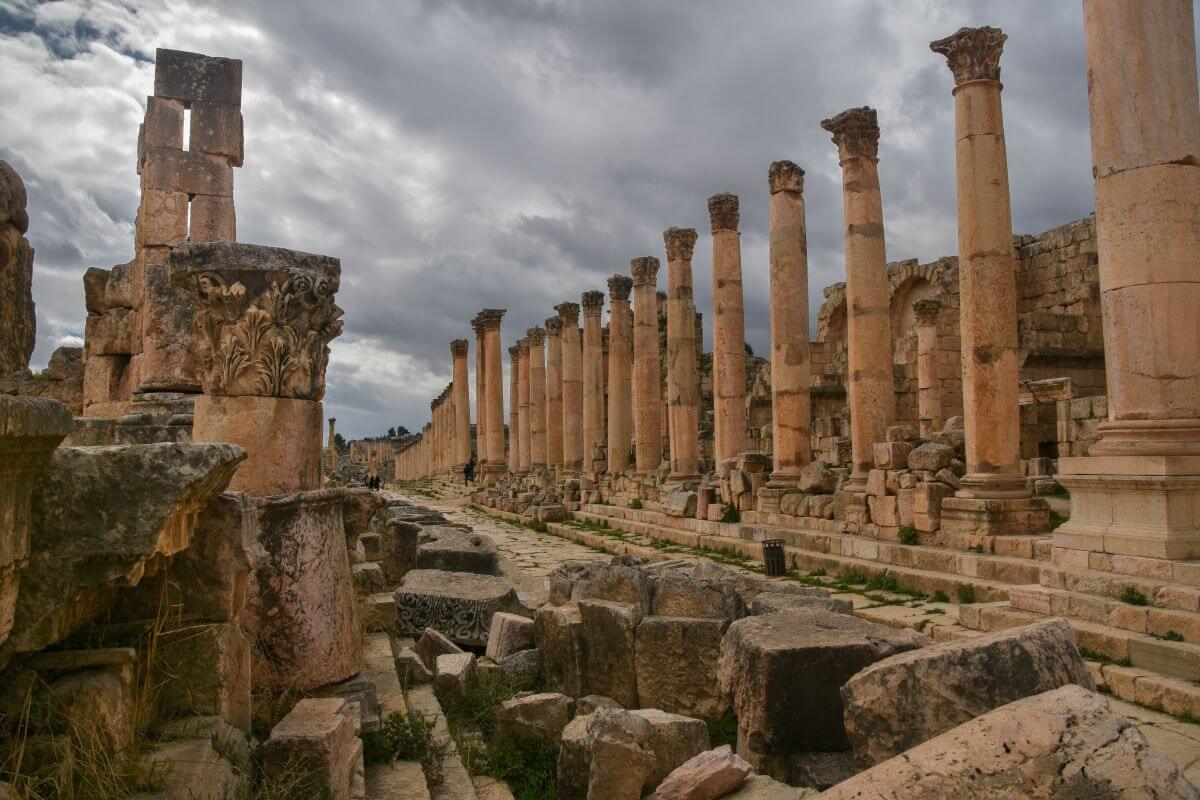
You don’t need to fly to Italy to see Rome’s power.
Why are the Jerash ruins famous?

The Jerash Ruins are famous for being one of the best-preserved Greco-Roman cities outside Italy. Once part of the Decapolis League, this beautifully preserved provincial town showcases Roman ambition in the heart of the Middle East. Though it’s not yet a UNESCO World Heritage Site, its spot on the tentative list recognizes its outstanding universal value.
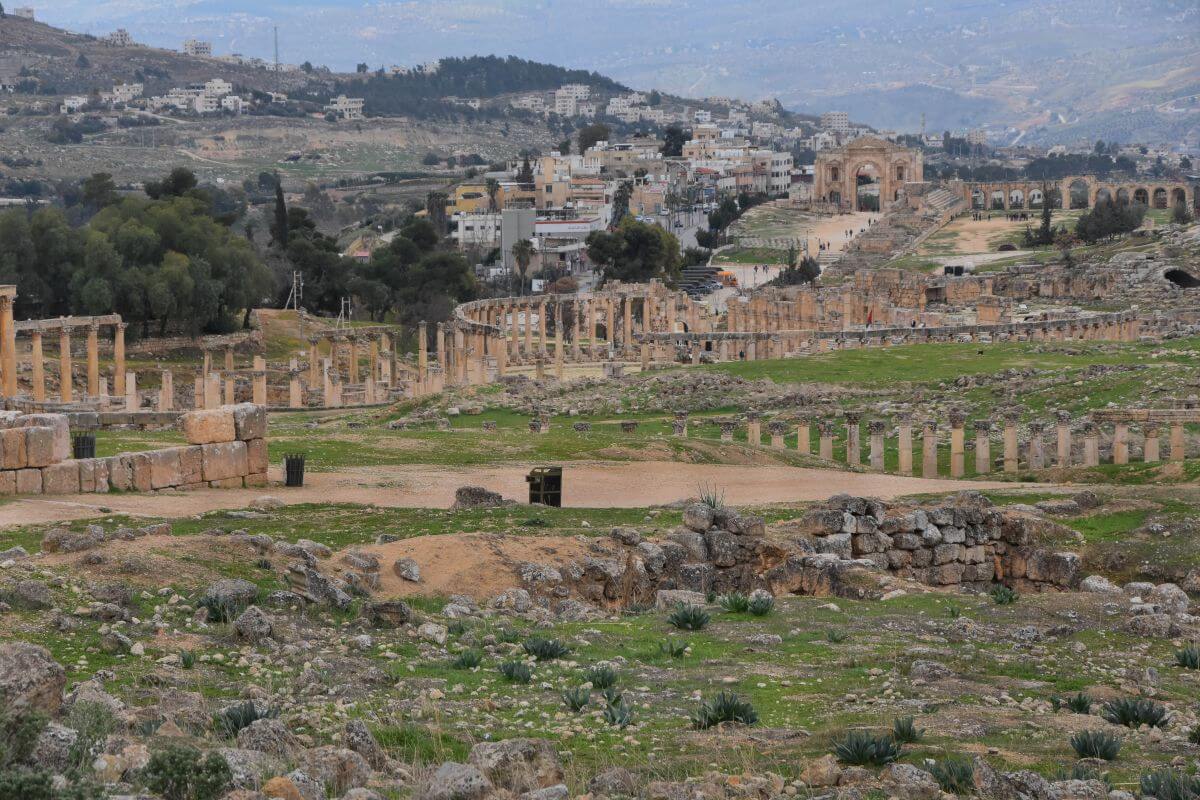
The city’s burial under a combination of sand and debris from earthquakes helped with its extraordinary level of preservation. Its grand theatres, temples, and stone-paved avenues remain incredibly intact after almost 2,000 years, earning it the nickname ‘Pompeii of the Middle East’.
Location
Located only 48 km (30 mi) north of Amman, Jordan’s capital, the Jerash Ruins are easily accessible. From Queen Alia International Airport, it takes roughly 90 minutes by car – perfect for a simple day trip.
Short history of the Jerash Ruins

Long before Jerash became a Roman city, people lived here as far back as the Neolithic period. According to the Jordan Times, archaeologists found human remains dating to around 7500-5500 BC. This shows that this land has been home to humans for thousands of years.
The city first flourished under the Greeks, and later under the Hellenistic, Roman, and Byzantine civilizations. Wikipedia also reports that ancient Greek inscriptions suggest that Alexander the Great and his general Perdiccas founded the city around 331 BC. They settled Macedonian soldiers in the city, known then as Gerasa, as he journeyed through Syria toward Mesopotamia. Some records, however, credit its creation to Seleucid King Antioch IV or even Ptolemy II of Egypt. Over time, this small settlement transformed into one of the most important cities in the Middle East.
ROMAN PERIOD:

Under Roman rule from 64 BC onward, the city prospered immensely. Gerasa became part of the Decapolis (a league of 10 Hellenistic cities), linked by trade and culture, according to Britannica. It benefited from its strategic position on one of the trade routes connecting Damascus, Amman, and Jerusalem. During the 1st and 2nd centuries AD, the city underwent major reconstruction and expansion. A remarkable urban plan brought colonnaded streets, new temples, and theatres. By the 3rd century, the city reached its peak with around 20,000 inhabitants and the status of a Roman colony. But time and nature began to turn against it.
FALL:
The Persian invasion in 614 and the devastating earthquake in 749 shattered the city’s prosperity, according to Wikipedia. Political instability and natural disasters drove its people away. By the Crusaders period, Gerasa had been arabized to Jerash and largely forgotten. For nearly a thousand years, the city lay hidden beneath sand and rubble. According to the Rough Guide, 19th-century explorers, guided by local Bedouin, rediscovered it.
Our experience
We visited Jerash on a day trip from Amman in late February 2025, and our trip turned out to be full of surprises. The morning started with pale sunshine, but soon clouds rolled in, bringing sharp winds and even a few flakes of snow. It was surreal to think that just the day before, we’d been basking in 22°C heat further south.
When we arrived at 10 AM, the vast car park was almost empty, and the site felt wonderfully peaceful. We spent about four and a half hours exploring the site, despite the cold and freezing hands. Most visitors stayed around the Oval Plaza and the main street, but just a few steps off those paths, silence took over. Despite the frost, the experience was unforgettable, and we definitely recommend adding it to your itinerary.
Top Things to see at the Jerash Ruins
1. Hadrian’s Arch

The first monument you see as you approach the Jerash ruins from Amman is the grand Hadrian’s Arch. Its position over 400 m south of the ancient city walls wasn’t accidental. This impressive southern gateway hinted at an ambitious city expansion that never came to life. Locals now call it ‘Bab Amman’ (the Amman Gate), as it faced the road leading toward Philadelphia (the modern capital).
Built in 129-130 AD to honour Emperor Hadrian’s visit to Gerasa, this triple-arched gateway once held wooden doors. It’s richly decorated and one of the largest triumphal arches of the Roman Empire, according to the Jerash Visit Jordan website. Measuring about 21 m (68.9 ft) high, 37.45 m (123 ft) long, and 9.25 m (30.3 ft) wide, it once served as both a commemorative monument and a ceremonial entrance. Wikipedia notes that the arch features unique, possibly Nabatean architectural features, such as acanthus leaf bases. You’ll also spot capitals carved unusually at the bottom rather than the top of the columns.

After careful restoration in 2007, the Arch of Hadrian now stands restored to its former glory.

2. Hippodrome

When the Romans abandoned their plan to expand the city, the empty land beside the road to Amman found a new purpose: as a Hippodrome. Built in the 2nd century AD, this vast arena became the beating heart of entertainment in Gerasa.

Wheel tracks and dedicatory altars still testify that real races thundered across the arena. The Hippodrome welcomed up to 15,000 spectators, eager to watch horse and chariot races, according to the International Visit Jordan website. This sporting arena had 16-17 rows of seats from where the Romans watched chariots storm from 10 arched starting gates. At 265 m (849 ft) long and 76 m (249 ft) wide, it’s the smallest yet best-preserved in the Roman world (Universes in Universe).
FROM CHARIOTS TO POTTERS:
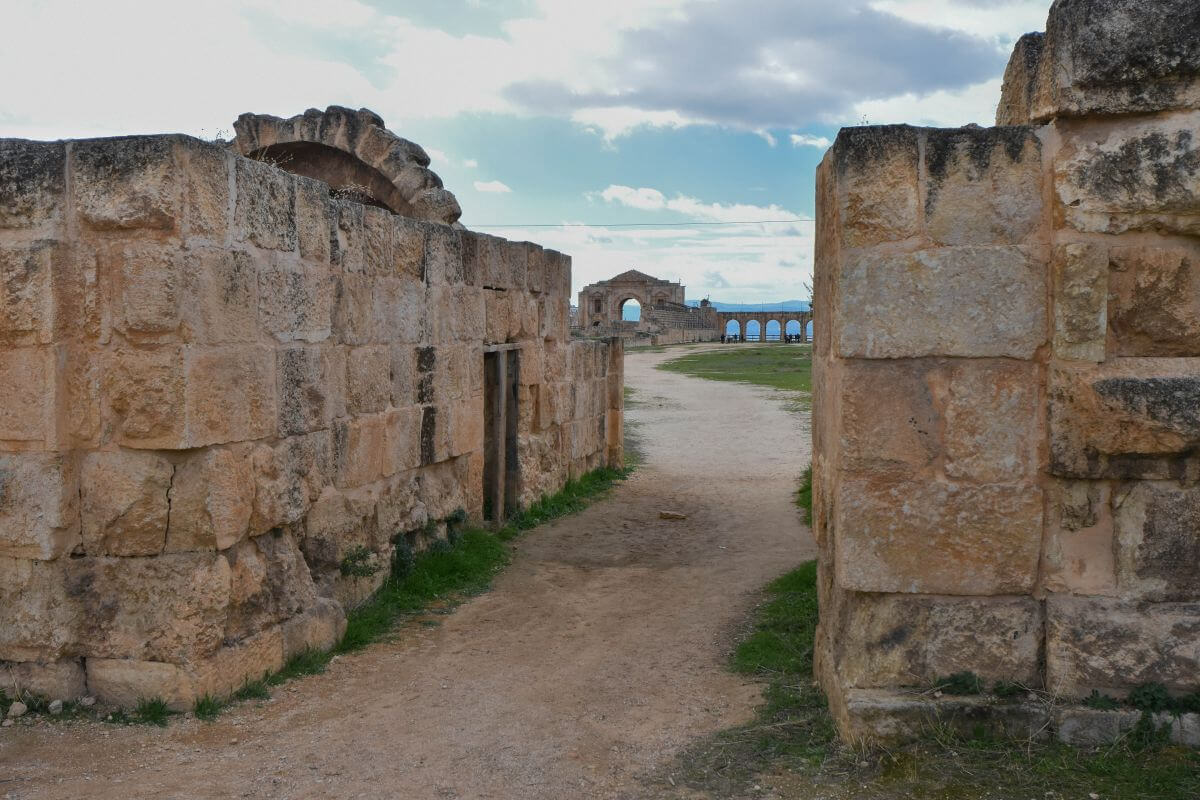
The Hippodrome’s glory was, however, short-lived. Weak foundations led to cracks, and by the 4th century, racing ended, according to Universes in Universe. The arena soon took on a new life: craftsmen and potters filled its vaults, turning the stands into pottery workshops. This made Gerasa a major pottery centre among the Decapolis cities in the Byzantine world. When the Persians conquered the city in the 7th century, they reused the arena for equestrian games. Later, in the 8th century, it became a cemetery containing a mass burial of over 200 plague victims.
GOOD TO KNOW:
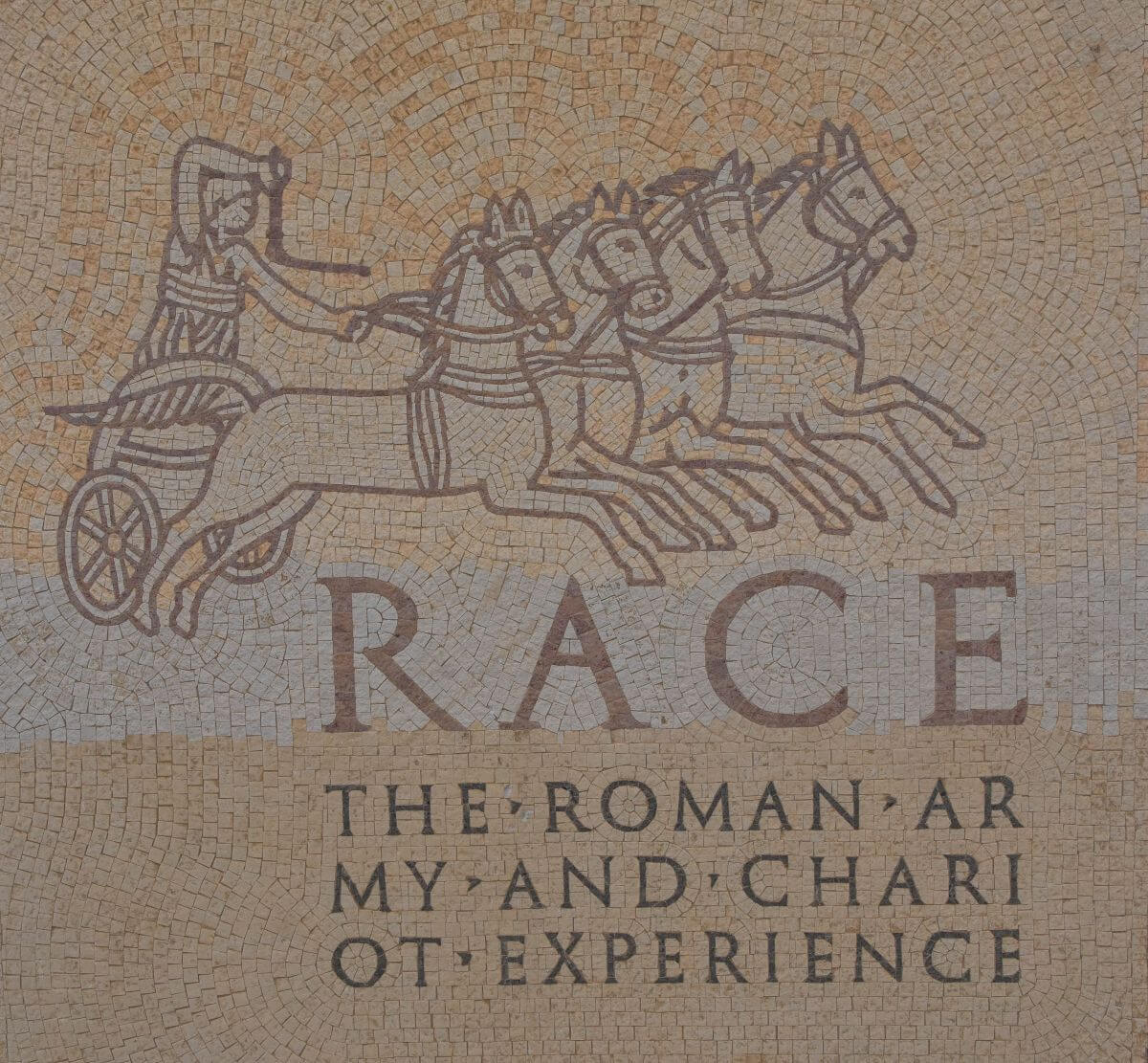
Did you know that this ancient arena hosts the Roman Army and Chariot Experience (RACE)? This live, informative show, featuring chariots and soldiers in full costume, depicts the Roman army and its battle tactics. Ask for showtimes so you don’t miss it, as we did.
3. Visitor’s Centre
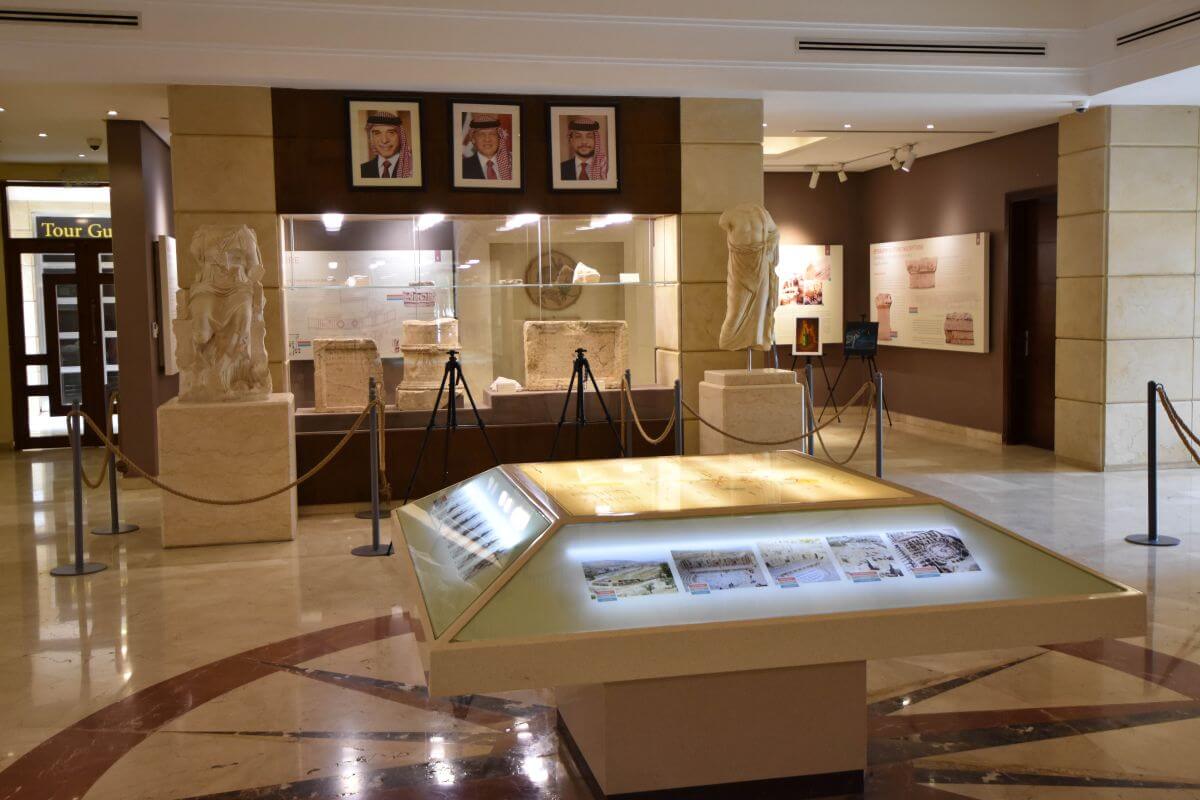
After passing the Hippodrome, on the right-hand side near the entrance to the archaeological site is the Visitor’s Centre. Don’t miss it – it’s the perfect introduction to the Jerash ruins. This welcoming space combines maps and informative boards, bringing Gerasa’s 2,000-year story to life. Knowledgeable guides are available for personalized tours, and a short introductory film tells the story of this Romany city.
4. South Gate of the Jerash Ruins

Beyond the Visitor’s Centre stands the South Gate, the main entrance into the heart of the ancient city of Gerasa. Built to celebrate Emperor Hadrian’s visit in 129 AD, this reconstructed triple-arched gate with elegant Corinthian half-columns mirrors the design of Hadrian’s Arch, though on a smaller scale.
In Roman times, the South Gate controlled the daily flow of people and goods. The wide central arch allowed carts and horses to pass through, while citizens entered on foot through the two narrower side entrances. Just behind it, archaeologists have found remains of 4 workshops from the 2nd century (Universes Art). Centuries later, soldiers built small military barracks over the ruins of a destroyed market as the city fortified itself once more. The defensive wall that surrounded the city stretched for around 3.4 km (2.1 mi) and averaged 2.9 m (9.5 ft) in thickness.

The 2nd-century AD East Souq, with 15 workshops and shops, lies in front of the South Gate. Universes art reports that archaeologists found evidence of carpenters, potters, and other skilled artisans working here.
5. South Theatre

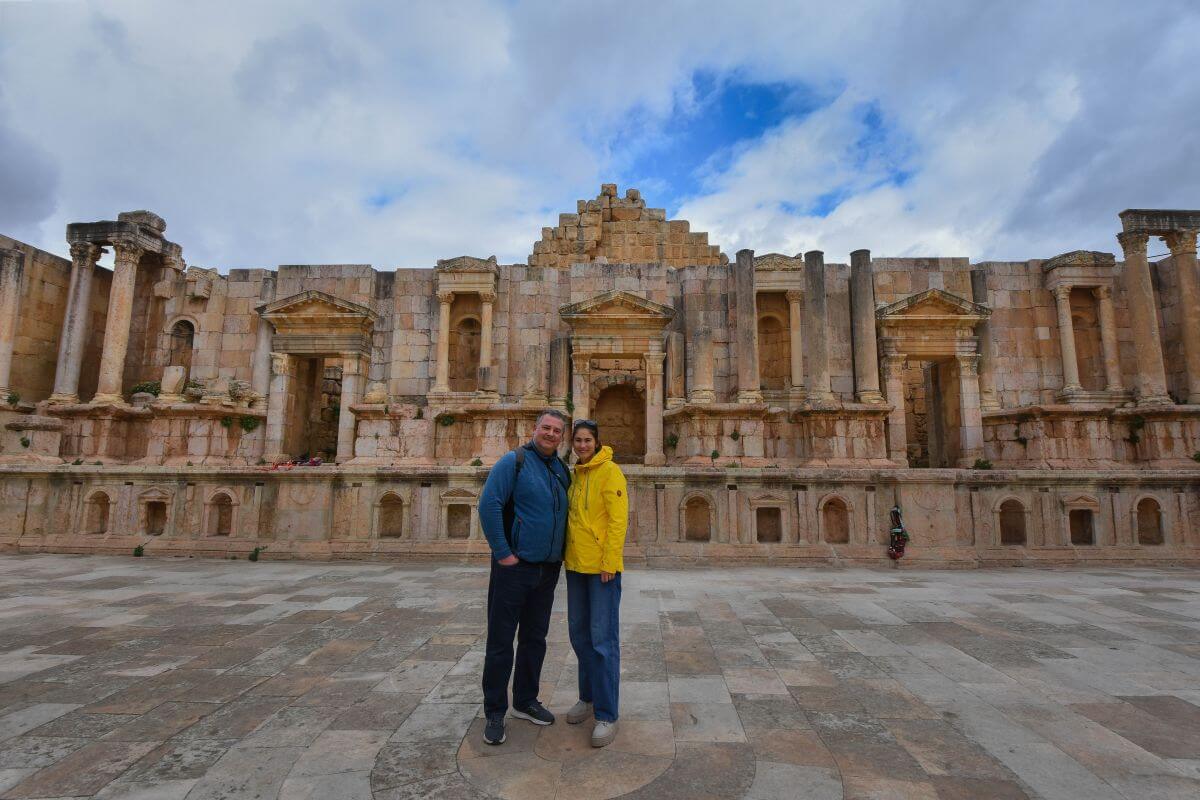
From the plaza, a trail winds upward to the extensively restored South Theatre. Built under Emperor Domitian in the 90s AD, it stands beside the Sanctuary of Zeus and likely played both civic and religious roles (Universes Art). Detailed stone inscriptions reveal its date and name the wealthy citizens who helped fund its reconstruction. Measuring 76 m (249 ft) across and 16 m (52.5 ft) high, the South Theatre was the largest of the city’s three theatres. While Visit Jordan reports that the theatre once welcomed over 3,000 spectators, according to the Universes Art website, the audience area could seat up to 4,700 people.

The semicircular audience area, partly carved into the hillside, faces north, ensuring the sun never blinds the crowds. Its acoustics are also astonishing; the speaker at the centre of the stage can be heard clearly from the top rows without raising their voice. Today, the South Theatre continues to host concerts during the Jerash Festival, keeping Roman culture alive in modern Jordan.

From its top seats, you can get panoramic views over the ruins and the rolling hills beyond.
6. The Great Temple of Zeus
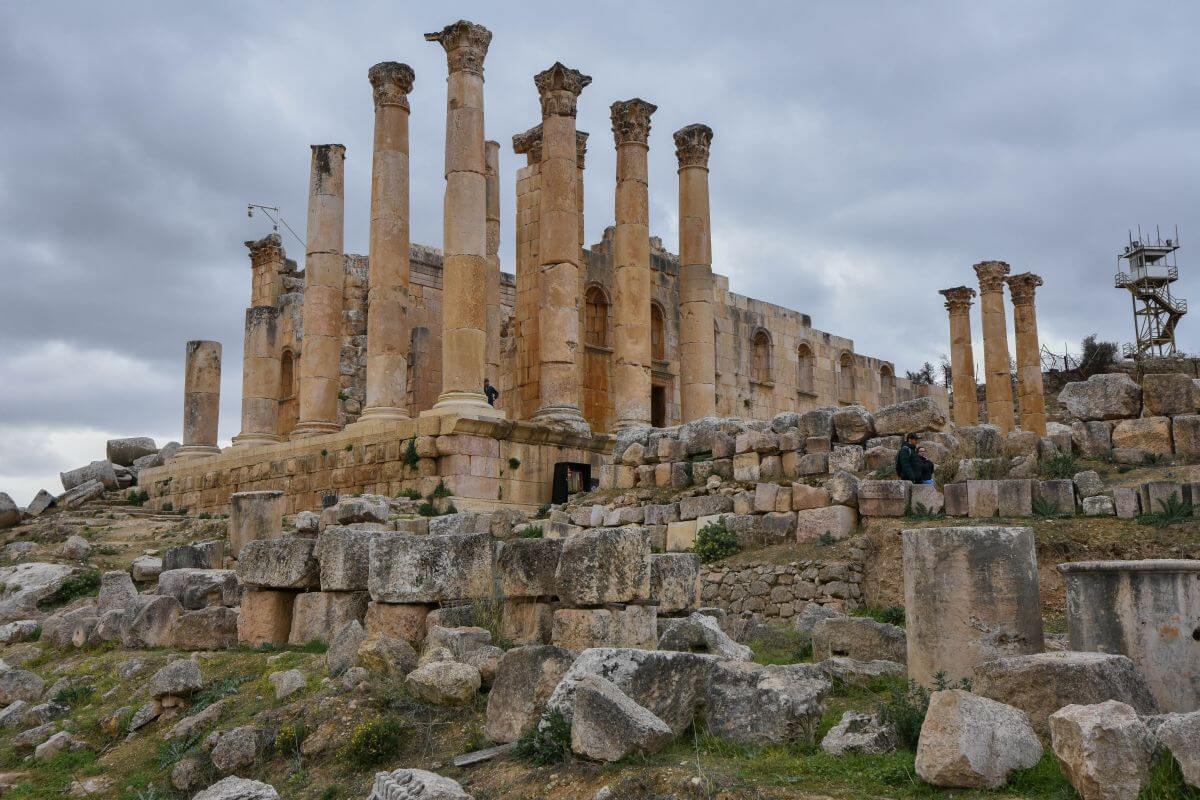
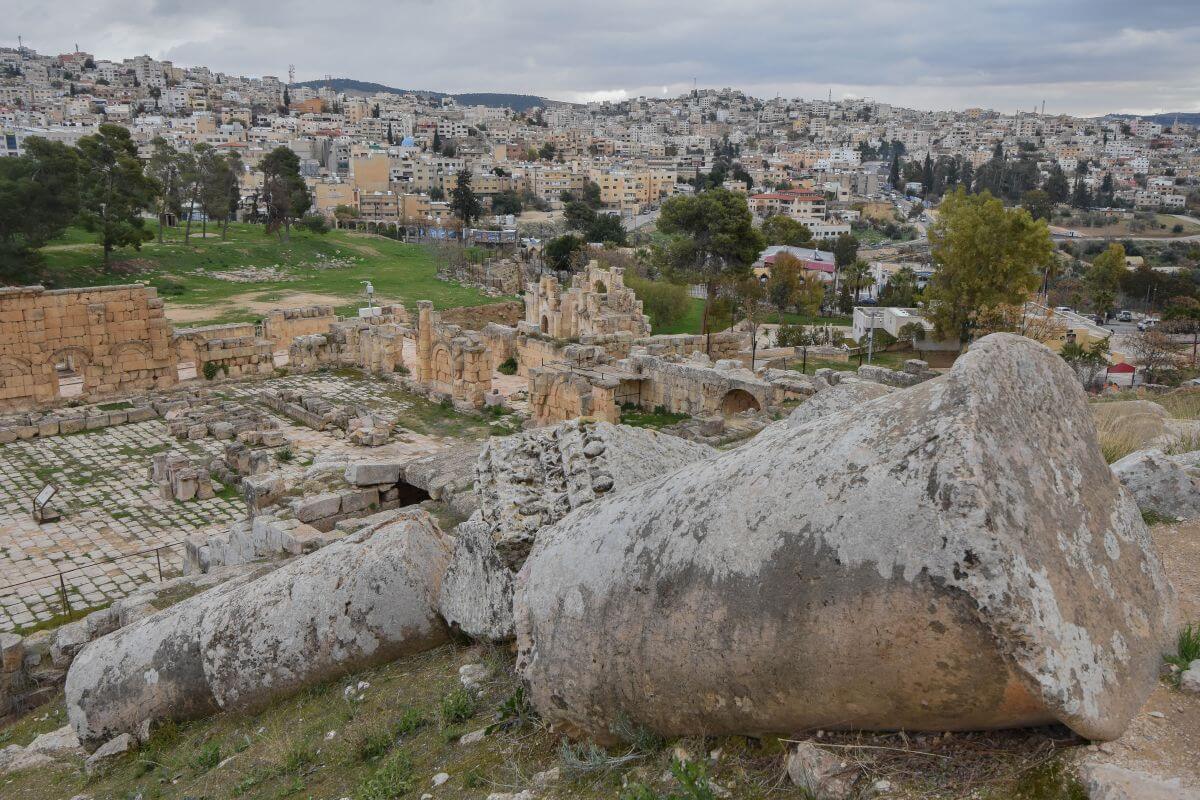
Next to the South Theatre and above the Oval Plaza lies the Great Temple of Zeus. In its glory days, this temple towered over the city, much like its sister, the Temple of Artemis (which we’ll mention later). According to an information panel on the site, the Great Temple of Zeus dates back to 162-163 AD. It was dedicated to the most powerful Greek god.
DESIGN:

The temple stands on a terrace above the original Sanctuary of Zeus, which once lay below. Later builders raised a vast new platform above it and connected it with a staircase that led worshippers to the upper terrace. According to the Universes Art website, the Great Temple of Zeus stood on a 41 x 28 m (134 x 92 ft) podium, surrounded by columns, and had a classic design of the time.
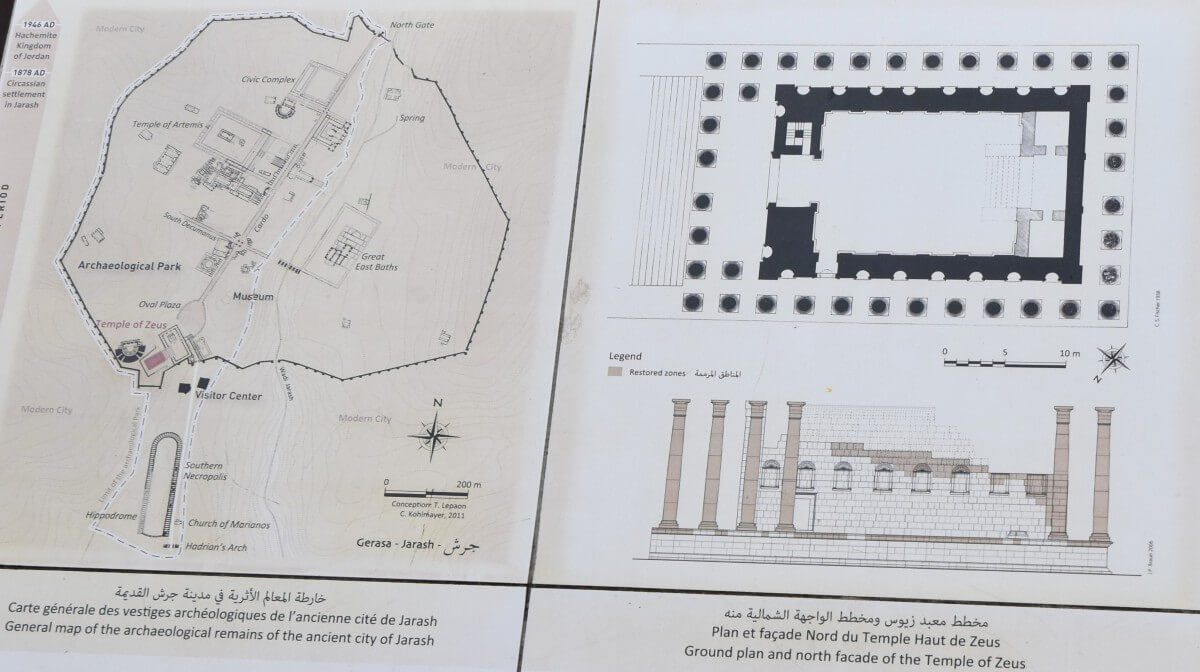
A drawing on an information panel depicts what the temple once looked like. 8 columns with Corinthian capitals lined the façade, and twelve columns decorated each of the two long sides, each almost 15 m (49 ft) high. A flat roof crowned the temple, sheltering its chamber where ceremonies took place.
When Christianity spread across the region in the 5th century AD, the temple’s stones found new life. According to the Universes art website, in Byzantine times, the site’s lower terrace served as a monastery for Christian monks. Bishop Placcus and his builders reused the fine blocks from the great shrine for new churches and the thermal baths. Later, farmers and craftsmen moved until the destructive earthquake in the 8th century destroyed it, and the site was abandoned.
7. Oval Plaza

The Oval Plaza is proof of Roman brilliance in both design and engineering. Built around 130 AD, this vast public space was created to connect the city’s main street (the Cardo) with the Sanctuary of Zeus. Yet, according to Universes Art, constructing it was a real challenge. The builders had to level a deep natural depression in the ground before constructing the plaza.
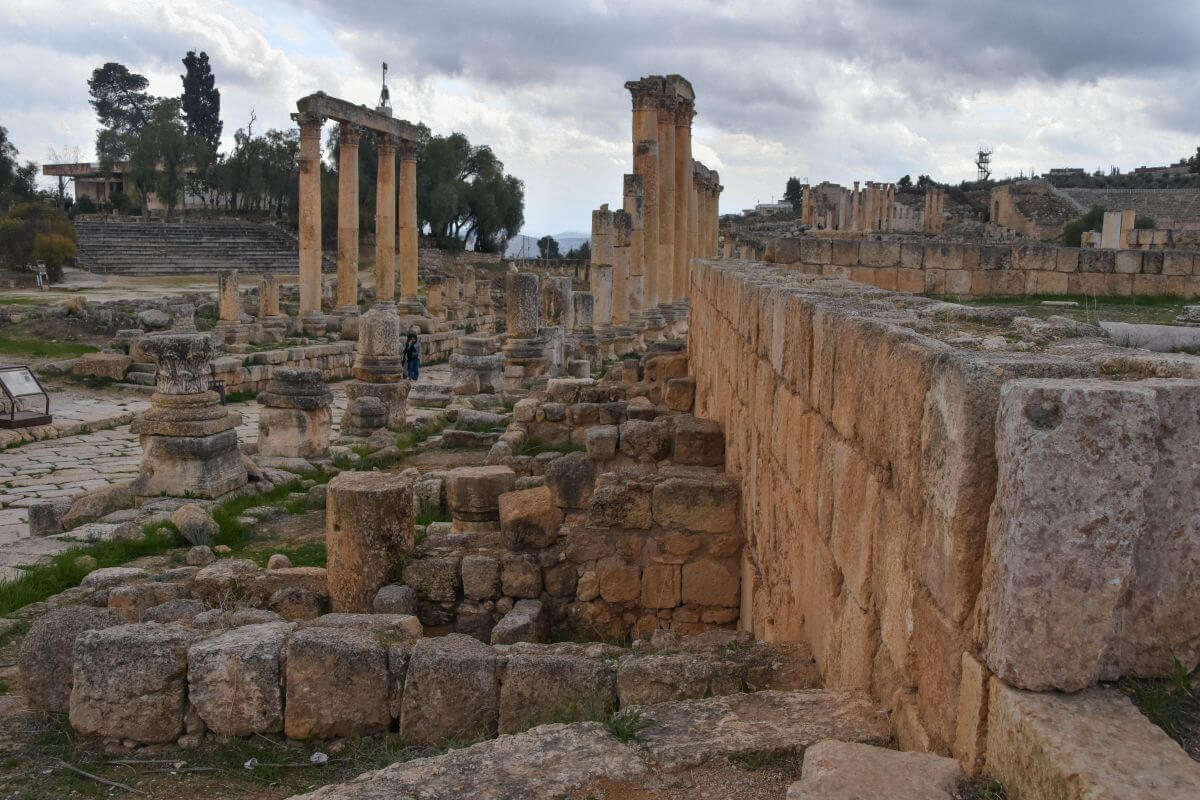
What they created was extraordinary: an elegant, oval-shaped forum about 90 m by 80 m (295 x 262 ft) wide. The colonnades surround the plaza, forming an elegant walkway where citizens once gathered for markets, speeches, and maybe ceremonies. At its centre once stood two small monuments. Today, a single column carries a flame for the opening of the Jerash festival.
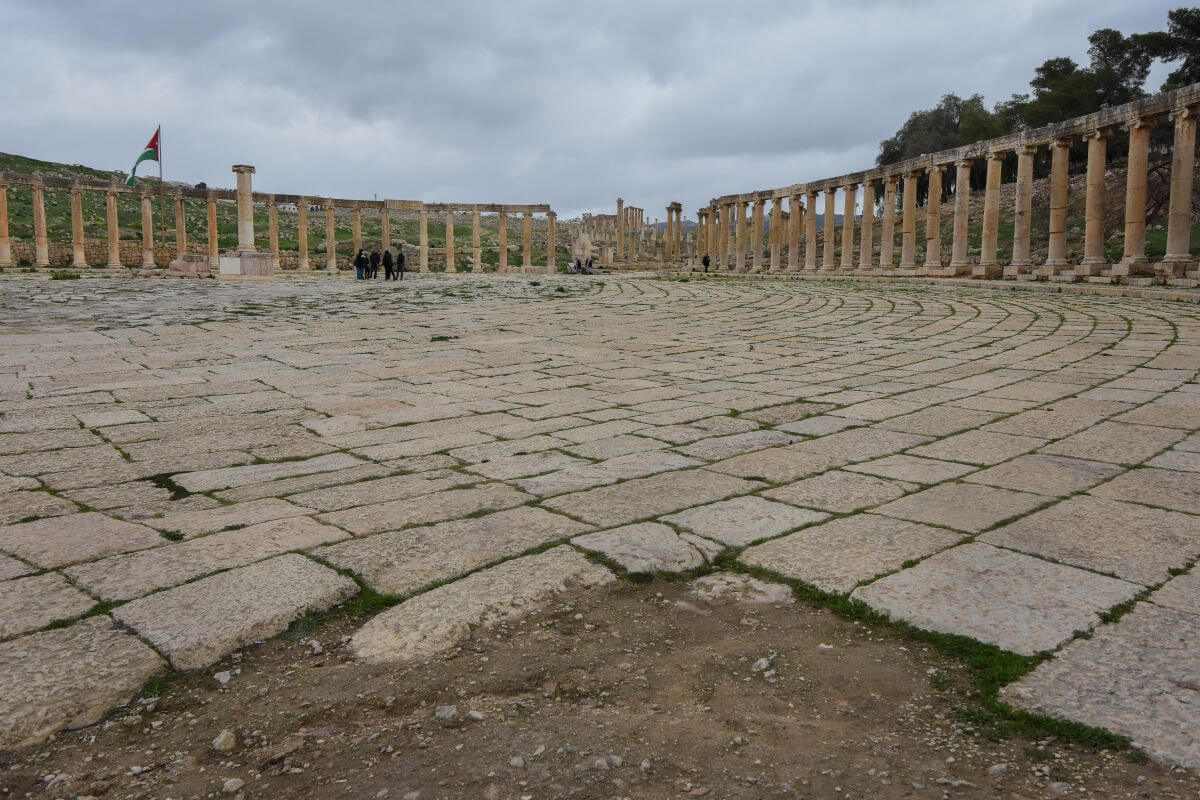
Information panel explains that the plaza and its iconic columns probably date back to the rule of Emperor Trajan (beginning of the 2nd century). However, the paving came much later, not before the 4th century AD. Look closely and you spot how large, carefully cut stones align with the square to fit its flowing curves.
8. Cardo Maximus

The Cardo Maximus was once the main artery of Gerasa, stretching 805 m (0.5 mi) from the Oval Plaza to the city’s northern gate. This grand colonnaded street, which intersected with two other colonnaded streets, served as the main commercial and ceremonial route. It connected everything that mattered in Roman Jerash – temples, shops, and public buildings.
According to the Visit Jordan website, the street was first lined with Ionic columns in the late 1st century. During the city’s expansion in the 2nd century, it was widened and redesigned with grand Corinthian columns. The 500 columns that once lined it were deliberately built in different heights to match the facades of surrounding buildings. Most of these were carefully reassembled in the 1960s to show how spectacular this main street once looked.

Look down as you walk; the paving stones are original. Deep ruts by chariot wheel still mark the path. Beneath the surface, an underground sewage system carried away rainwater through the drains set neatly into the sides of the street.
9. South Tetrapylon

At the meeting point of Roman Gerasa’s two main streets stands the South Tetrapylon. According to the on-site information panel, this circular plaza once transformed a simple intersection into a grand landmark. At its centre stood a monument surrounded by four massive pedestals. Each one was decorated with niches and topped with pink granite columns from Aswan in Egypt.
DID YOU KNOW?
The Romans called this arrangement a tetrakionio, an elegant marker that defined important junctions in great cities. By the end of the 4th century, each pedestal displayed a statue of one of the four emperors (Diocletian, Maximian Hercules, Constantinus Chlorus, and Galerius), the rulers known as the Tetrarchs.

Imagine merchants moving between colonnade shops and travellers pausing beneath the rosy granite pillars. Later, in the 6th century, early Christians reused several of these granite columns to build the nearby Octagonal Martyrion Church. Though this reduced the plaza to its stone bases, its design still reflects the city’s ambition and artistry.
10. Nymphaeum
As Gerasa expanded and grew wealthier, the city needed far more water. Around 125 AD, builders constructed a new water system. By the late 2nd century, they boosted the capacity of the main aqueduct to keep up with demand from the growing baths. According to an inscription noted by the Universes Art website, the city built the grand fountain in 191 AD. The Nymphaeum became the city’s practical water source and work of art.

The monumental fountain, dedicated to the water nymphs (young daughters of Zeus), transformed the Cardo into a living, breathing oasis. Its two-level façade was richly decorated with Corinthian columns, marble panels, and painted stucco. Water poured endlessly from lion heads into a massive basin that stretched across its width. The sound of the splashing water must have echoed down the Cardo, a cooling contrast to the desert heat. Overflow drained neatly into the underground sewage system and kept streets dry.
11. Cathedral Complex

According to the on-site information panel, the Cathedral is the oldest Byzantine church in Jerash, built around 450-455 AD, when Bishop Placcus governed Gerasa. Long before it became a Christian landmark, this sacred hill hosted ancient temples. Wikipedia notes that a Roman temple dedicated to Dionysos (god of wine) once stood here. Before that, the spot hosted an even older Nabataean shrine to Dushara.
As Christianity spread across Gerasa, Bishop Placcus reshaped the city’s skyline. He dismantled parts of the Temple of Zeus and reused its massive stones to build both this church and his famous bath nearby. The reuse of earlier columns and decorations from Zeus’s temple symbolizes Gerasa’s shift from paganism to the new Christian faith.

The Cathedral Complex is stunning even in ruins. According to the Universes Art website, the complex stretches over 163 m across multiple hillside terraces. The church itself followed a three-nave basilica plan, divided by rows of columns. It had eight entrances, including three grand doors from the western Fountain Courtyard, where believers once gathered before services.
12. North Theatre

As you wander through the northern end of the Jerash Ruins, you’ll come across the restored North Theatre. Archaeologists conclude it dates to the first half of the 2nd century AD during a period of great urban reconstruction. The North Theatre served as the council’s meeting place before transforming into a performance space in the 3rd century.

While only the stone skeleton remains, the theatre had a richly decorated stage building with Corinthian columns and three doors. According to Universes Art, the theatre could hold around 1,600 people after the last stage of expansion. While it was much smaller and more intimate, it was no less impressive than the South Theatre.
HIGHLIGHTS:
Don’t miss the stone reliefs showing women and boys dancing and playing different musical instruments at the end of the semicircular orchestra wall.

The original structure offered 14 rows of seating for the council before later expansion. Inscriptions carved nearly 2,000 years ago into the limestone seats still show where members of the city’s elite once sat.
After centuries of use, its formal life ended, and potters used the abandoned north theatre in the Umayyad period. Similar to the other building, the theatre suffered damage from a major earthquake in 749 AD. The recent restoration has preserved much of its charm and symmetry.
13. Temple of Artemis

Dedicated to Artemis, the goddess who guarded this ancient city, this impressive sanctuary once crowned the western hill of Gerasa. Builders began work in the 2nd century AD, determined to honour their goddess with towering columns. According to the site’s information panel, the temple has never reached completion. Only 12 of the planned 32 Corinthian columns rose.

The temple rests on an intricate system of barrel-vaulted terraces that levelled the hillside. The back of the temple hides the sacred inner room, which only the Roman priest could enter.
When pagan worship faded, Christians reused its stones to build nearby churches. Umayyad potters later filled the area with workshops and kilns, turning sacred ground into a centre of craft, according to Universes Art. Even a mosaic floor survives, proof that the space stayed alive long after rituals ended.
Opening times and entry fees of the Jerash Ruins
According to the official Visit Jordan website, the opening hours change with the seasons. As of November 2025, the Jerash ruins open from 8 AM to 4 PM in winter (November through April). It extends to 5.30 PM in April and May and stretches to 6.30 PM between June and October. During the Holy Month of Ramadan, morning starts a bit later at 9 AM and closes at 5 PM.
ENTRY FEES:
As of November 2025, entry costs 10 JOD for foreigners and just 0.5 JOD for Jordanians. The Jordan Pass is the best deal for tourists. It covers over forty other sites across the country, including Petra, Wadi Rum, and this site. Buying it online before your trip will save you both money and queuing time.
For something unforgettable, don’t miss the Roman Army and Chariot Experience (RACE) Show at the Hippodrome. This thrilling live show brings Roman power back to life, with two daily performances. Shows run from Saturday to Thursday at 11 AM and 2 PM, and Fridays at 10 AM only. As of November 2025, tickets for the RACE show cost 12 JOD (foreigners), 5 JOD (locals), and 2 JOD (children).
Tips for visiting the Jerash Ruins
To make the most of your time exploring this Jordan site, here’s a complete guide with practical, experience-based tips. Here’s everything you need to know before you go.
TIMING YOUR VISIT:
If possible, avoid visiting on the official weekend. The weekend in Jordan is Friday and Saturday. These days tend to be busy with local families and groups, so it’s better to plan for another weekday if possible. Crowds grow quickly, and parking disappears by late morning. By starting early, you’ll have time to wander freely before the tours arrive.
ENTRANCE AND MARKET AREA:
After the ticket office, you’ll walk through a small covered market. It’s packed with colourful stalls selling everything from scarves to Roman-themed souvenirs. Some vendors will call out to grab your attention, but we found them friendly and not too pushy. If you’re not planning to buy anything, say polite ‘no, thank you’ and continue walking. While you’ll find toilets here, you may prefer to use the main toilets at the Visitor Centre before entering the main archaeological site.
PARKING:
Parking is free and located close to the entrance. It feels secure, though it fills up quickly later in the day and on weekends, especially during the warmer months.
WHAT TO WEAR AND ESSENTIALS:
Jordan is a conservative country, and even though the Jerash ruins aren’t a religious site, modest clothing is respectful. Cover your shoulders and knees, and wear comfortable shoes as the ancient paving stones are uneven. In summer, you’ll need sunscreen, a hat, and at least one bottle of water. In winter, it gets chilly; bring a warm jacket, gloves, maybe even an umbrella.
DON’T MISS THE MUSEUM:
Hidden among the trees near the Oval Plaza, this small museum displays discoveries from the Jerash region. Its collection spans from the Neolithic up to the Mamluk period, according to the site’s official website. Unfortunately, we missed it during our visit as it’s not well-marked if not following the main path. Keep an eye out for a brown sign so you don’t make the same mistake.
HOW LONG YOU NEED:
To see the main highlights comfortably, plan at least three to four hours. That gives you time to walk through the Hippodrome, Oval Plaza, Cardo Maximus, a few temples, and the two theatres without rushing. We spent approximately four and a half hours exploring the site and missed the museum; allow yourself even more time, if possible. With these tips in mind, your visit will be smooth, respectful, and unforgettable.
Now you know everything you need to know about the Jerash Ruins in Jordan.
Thank you for staying with us until the end! If you’ve enjoyed this article, please consider sharing this post to extend its reach.
Don’t forget to bookmark this post about the Jerash Ruins so you can quickly find it when planning your trip to Jordan.
YOU MAY ALSO ENJOY:


